Home › FAQ Hub › How does a “Digital-Native MGA” model differ from traditional insurance incumbents?
AI, Data & AnalyticsHow does a “Digital-Native MGA” model differ from traditional insurance incumbents?
A digital-native MGA differs from traditional insurance incumbents mainly in architectural agility and data ownership. Traditional insurers often work with monolithic legacy systems and carry heavy balance sheets; a digital-native MGA operates as a lean technology platform with delegated underwriting authority, while an insurer or reinsurer provides the capacity and carries the risk.
Managing general agents have existed for a long time: specialist firms that underwrite on behalf of insurers. A new generation adds something different: they are built as technology companies from the first day, with data and pricing at their core.
A digital-native MGA differs from traditional insurance incumbents mainly in architectural agility and data ownership. Traditional insurers often work with monolithic legacy systems and carry heavy balance sheets; a digital-native MGA operates as a lean technology platform with delegated underwriting authority, while an insurer or reinsurer provides the capacity and carries the risk.
This allows a digital-native MGA to change product features or pricing in days rather than quarters, to integrate external data quickly, and to distribute through digital and embedded channels. The trade-off is dependence on capacity providers, who expect strong governance, data quality and underwriting discipline in return for their support.
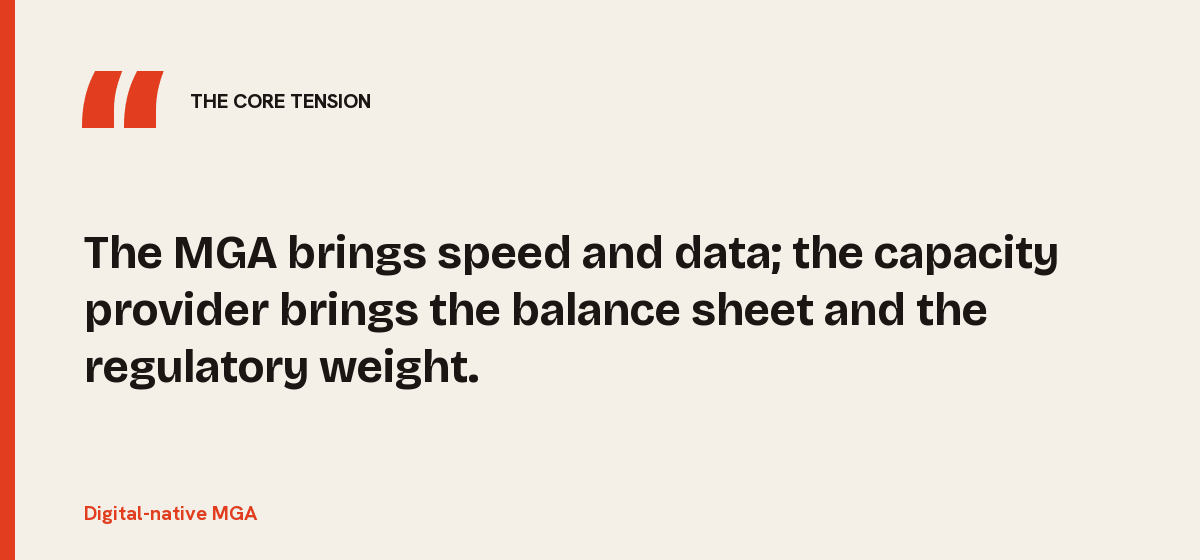
The core tension, in one line:
The MGA brings speed and data; the capacity provider brings the balance sheet and the regulatory weight.
a digital-native MGA specialising in small business cover connects to accounting software, prices risks using business data and binds policies in minutes. Its capacity provider receives daily data on exposures and claims, which gives it confidence to expand the MGA’s authority over time.
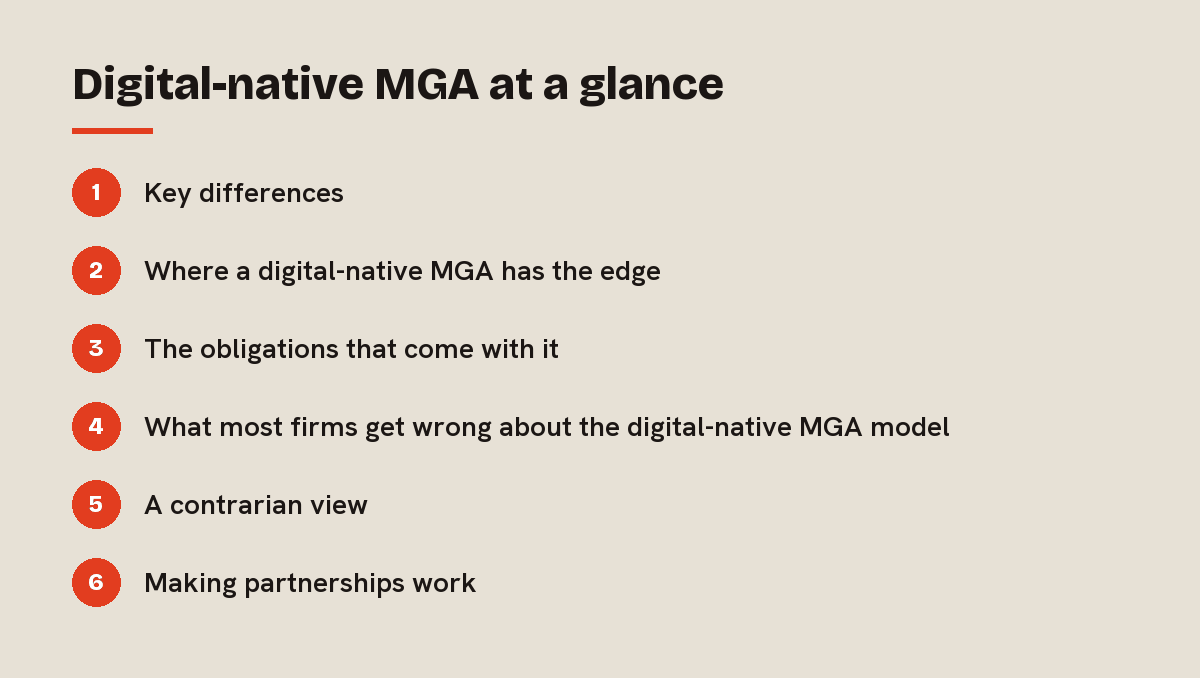
1. Key differences
| Dimension | Digital-native MGA | Traditional insurer |
|---|---|---|
| Technology | Modern, modular platform | Legacy policy and claims systems |
| Product change | Days or weeks | Months or quarters |
| Balance sheet | Uses partner capacity | Carries risk and capital |
| Data | External and real-time sources | Mostly internal, historical |
| Distribution | Digital, embedded, partners | Brokers, agents, direct |
2. Where a digital-native MGA has the edge
- Niche segments: specialist risks that larger insurers find too small or complex.
- Embedded distribution: cover offered inside partner platforms via APIs.
- Data-driven pricing: rapid use of new data sources and models.
- Speed: quick launches and adjustments as the market changes.
AI adoption is part of the story. EIOPA found that AI is used by 50 per cent of insurers in non-life and 24 per cent in life, and the level of digitalisation among European insurers is in most cases still at an early stage. That leaves room for MGAs built around data and automation.
3. The obligations that come with it
| Area | What capacity providers and supervisors expect |
|---|---|
| Underwriting discipline | Clear authority limits, referral rules, audit trails |
| Data quality | Accurate, timely exposure and claims data |
| Resilience | Robust technology and third-party management |
| Conduct | Fair products, clear disclosure, good claims handling |
Operational resilience matters on both sides. Insurers relying on an MGA’s technology need to manage that dependency, and the Digital Operational Resilience Act, applicable since 17 January 2025, sets ICT risk and third-party requirements for EU financial entities.
4. What most firms get wrong about the digital-native MGA model
- Growth over underwriting: rapid premium growth without discipline erodes capacity providers’ trust.
- Thin data sharing: capacity providers need detailed, timely data to support the partnership.
- Weak claims capability: fast sales mean little if claims are slow or poorly handled.
- Over-reliance on one capacity provider: concentration creates fragility.
Example: an insurer partnered with a digital-native MGA to enter embedded travel insurance. Daily data feeds and shared dashboards let the insurer monitor loss ratios closely. When one partner channel showed rising claims, the MGA adjusted pricing within days, something the insurer’s own systems could not have done.
5. A contrarian view
Digital MGAs are often presented as disruptors of incumbents. Many of the most successful ones are partners instead: they give incumbents access to new segments and channels, while incumbents provide capacity, brand strength and claims expertise. The relationship works best when both sides see it that way.
6. Making partnerships work
- Agree clear authority and referral rules.
- Share data daily, with common definitions.
- Plan claims handling as carefully as distribution.
- Review performance jointly, including conduct outcomes.
Key takeaways on digital-native MGA
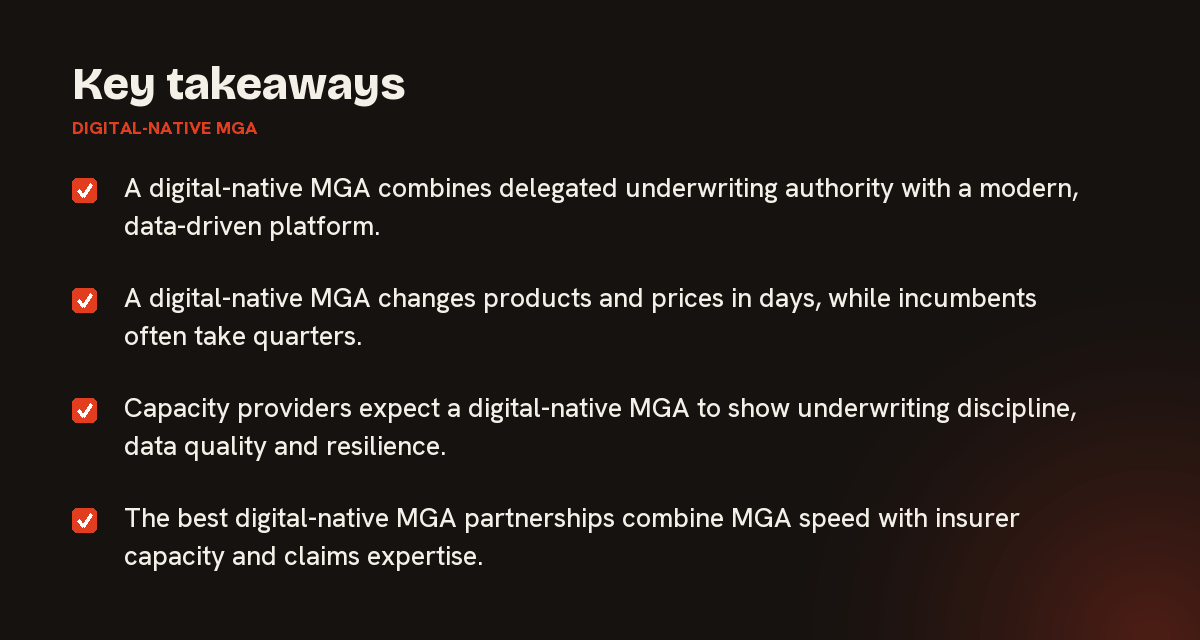
- A digital-native MGA combines delegated underwriting authority with a modern, data-driven platform.
- A digital-native MGA changes products and prices in days, while incumbents often take quarters.
- Capacity providers expect a digital-native MGA to show underwriting discipline, data quality and resilience.
- The best digital-native MGA partnerships combine MGA speed with insurer capacity and claims expertise.
For insurance leaders, the digital-native MGA model offers a way to reach new segments and channels quickly. The key is to structure partnerships with clear governance, shared data and strong claims, so speed does not come at the cost of control.
Optimizium helps insurers, MGAs and capacity providers design and govern these partnerships. We respect the underwriting and actuarial expertise incumbents bring, because it keeps growth sound. And we bring risk, compliance and claims teams into the design as co-authors, so partnerships scale with confidence.
Explore how we approach this across Insurance, Beyond Banking and Banking, browse the FAQ Hub, or read the related question: What limits AI in claims, underwriting, and advisory?
Related questions
Partner with the experts.
Let's discuss how Optimizium can accelerate your roadmap and navigate complex digital transformation.
Schedule a consultation →