Home › FAQ Hub › How do fintechs measure digital performance differently?
Tech & Core ModernisationHow do fintechs measure digital performance differently?
Fintechs measure digital performance with indicators tied directly to growth and the economics of each customer: growth velocity, funnel conversion, the ratio of customer acquisition cost to lifetime value, payback periods, activation and referral rates, and the results of continuous experiments. Their metrics often mirror platform and subscription economics, such as take rate, churn and average revenue per user.
Ask a fintech team how yesterday’s sign-up journey performed and you will get numbers by step, by channel and by cohort. Ask the same question in many incumbents and the answer arrives weeks later, and only for part of the journey.
Fintechs measure digital performance with indicators tied directly to growth and the economics of each customer: growth velocity, funnel conversion, the ratio of customer acquisition cost to lifetime value, payback periods, activation and referral rates, and the results of continuous experiments. Their metrics often mirror platform and subscription economics, such as take rate, churn and average revenue per user.
Incumbents, by contrast, often measure channel activity, such as registrations, downloads or logins, separately from business outcomes. The difference is not in the sophistication of tools but in what is measured, how often, and who is responsible for improving it.
The core tension, in one line:
Incumbents have more customers and more data, but less ability to learn quickly from either.
a fintech notices applicants on older phones dropping out at the document photo step. Within a week it tests an alternative, measures the effect by cohort and rolls it out. A bank with the same issue finds out through complaints a quarter later.
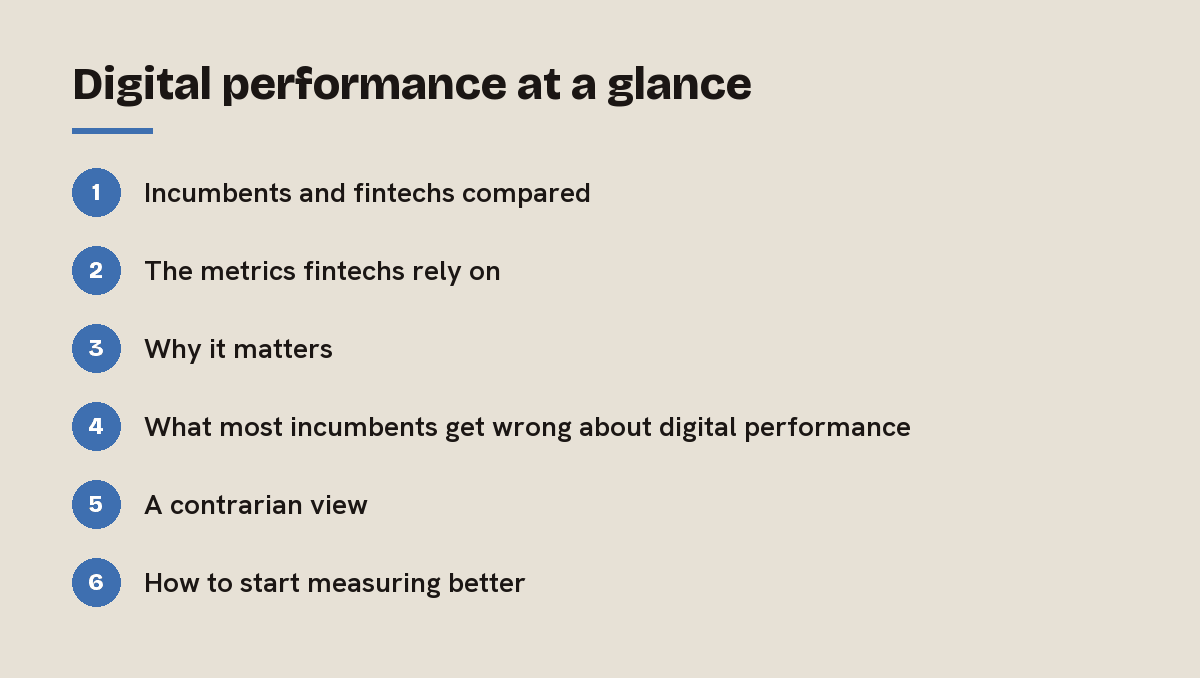
1. Incumbents and fintechs compared
| Aspect | Many incumbents | Many fintechs |
|---|---|---|
| Focus | Profit pools and product sales | Growth velocity and unit economics |
| Headline metric | Registered users, downloads | Active customers and value per cohort |
| Frequency | Monthly or quarterly | Daily |
| Granularity | Aggregated by channel | By journey step and cohort |
| Ownership | Spread across functions | One team owns the outcome |
2. The metrics fintechs rely on
- Funnel conversion: the share of customers moving through each step, from first click to first transaction.
- Acquisition cost and lifetime value: what it costs to win a customer and what they contribute over time.
- Payback period: how many months before a customer repays their acquisition cost.
- Activation: the share completing a first meaningful action within days.
- Cohort curves: how customers acquired in each month or channel behave over time.
3. Why it matters
Abandonment is high across Europe. Signicat’s survey of 7,600 consumers found that 68 per cent had abandoned a financial services application in the previous year. Without granular measurement of digital performance, those losses stay invisible.
Supervisors have noticed the measurement gap too. When the ECB surveyed 105 large banks, it found that almost all had a digital strategy, yet many lacked adequate indicators to steer it. Its 2024 review of digitalisation practices highlights real-time KPI dashboards among sound practices.
| Maturity level | What is measured | What it enables |
|---|---|---|
| Basic | Downloads, registrations, visits | Activity tracking |
| Intermediate | Step conversion, active use | Finding friction |
| Advanced | Cohort value, payback | Investment and priority decisions |
4. What most incumbents get wrong about digital performance
- Measuring activity, not value: many downloads do not mean profitable customers.
- Excluding assisted steps: branch and broker steps belong in the same funnel.
- Slow data: monthly figures arrive too late to fix a problem.
- No single owner: marketing measures traffic, IT measures uptime and nobody measures completion.
Example: a bank formed one team responsible for current account opening, with product, design, analytics, engineering and a compliance partner. It began measuring digital performance step by step and by channel, ran small tests over six months and lifted completion substantially. It then applied the same model to savings and loans.
5. A contrarian view
Fintechs sometimes optimise for sign-ups that never become active or profitable customers. Incumbents can adopt the discipline without the mistake: the best measures of digital performance track active, well-served and profitable customers, including suitability and affordability, not registrations alone.
6. How to start measuring better
- Instrument the full journey, including assisted steps.
- Choose one headline metric tied to value, not activity.
- Measure by cohort through to activation and early value.
- Give one team ownership of each journey’s results.
Key takeaways on digital performance
- Fintechs measure digital performance with growth, conversion, acquisition cost, payback and cohort metrics.
- Many incumbents measure digital performance by channel activity rather than business outcomes.
- Measuring digital performance step by step reveals where customers and money are lost.
- The best digital performance metrics track active, well-served customers, not sign-ups alone.
For leadership teams, changing how digital performance is measured is one of the cheapest and fastest levers in transformation. It shows where customers and money are lost and gives teams a shared goal.
Optimizium helps banks, insurers and wealth managers define the metrics, teams and data to measure what matters. We respect the control and reporting frameworks institutions already have, because they bring rigour. And we bring finance, risk and compliance into the design as co-authors, so new indicators are trusted and useful for decisions.
Explore how we approach this across Banking, Insurance, Wealth Management and Beyond Banking, browse the FAQ Hub, or read the related question: Why are data platforms foundational?
Related questions
Partner with the experts.
Let's discuss how Optimizium can accelerate your roadmap and navigate complex digital transformation.
Schedule a consultation →