Home › FAQ Hub › How do regulatory regimes influence distribution models?
Leadership, Change & Operating ModelsHow do regulatory regimes influence distribution models?
Regulatory regimes influence distribution models because they determine which products can be sold to whom, through which channels, with what advice, disclosures and checks. Rules on product eligibility, suitability, disclosure and fiduciary responsibility shape whether a product can be bought online, needs an adviser or must go through a licensed intermediary.
In most industries, a company decides how to sell and then checks the rules. In financial services, the rules often decide how a product can be sold before anyone draws a customer journey.
Regulatory regimes influence distribution models because they determine which products can be sold to whom, through which channels, with what advice, disclosures and checks. Rules on product eligibility, suitability, disclosure and fiduciary responsibility shape whether a product can be bought online, needs an adviser or must go through a licensed intermediary. Wealth channels are heavily constrained by suitability standards; insurance by underwriting, distribution and solvency rules; banking by credit, know-your-customer and anti-money-laundering requirements.
Regulation also shapes what digital platforms must capture, how data is collected and how channel incentives work. Institutions that integrate compliance into journey orchestration avoid the friction and conduct risk that appear when rules are bolted onto channels after they are built.
The core tension, in one line:
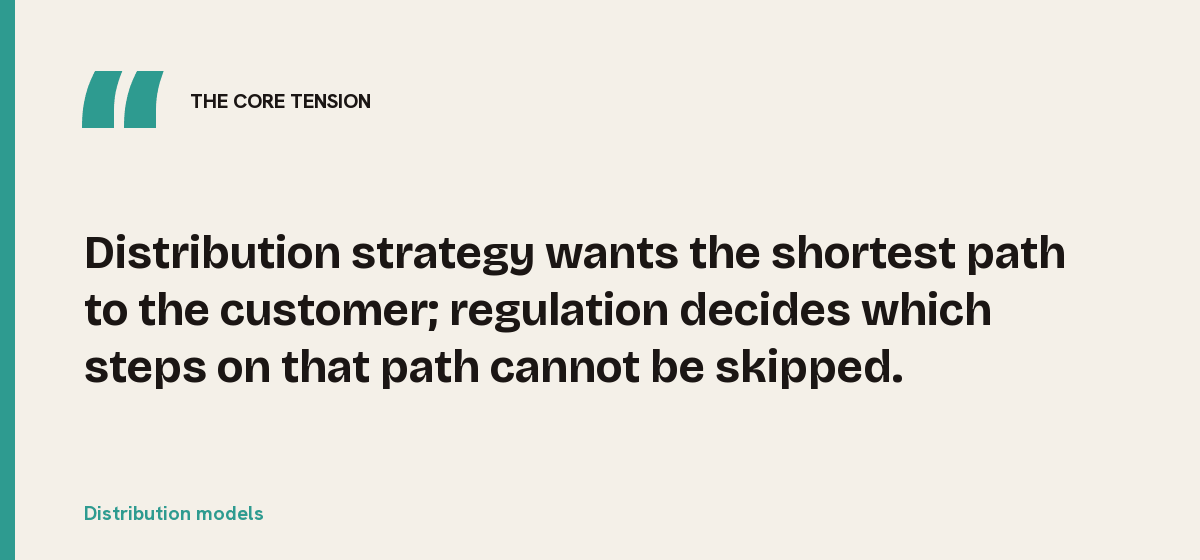
Distribution strategy wants the shortest path to the customer; regulation decides which steps on that path cannot be skipped.
a wealth manager wants to sell model portfolios fully online. Suitability rules require it to gather and assess each client’s knowledge, experience, financial situation and objectives. Instead of dropping the idea, it designs a short digital suitability journey with clear questions, routes complex cases to advisers, and records every assessment automatically.
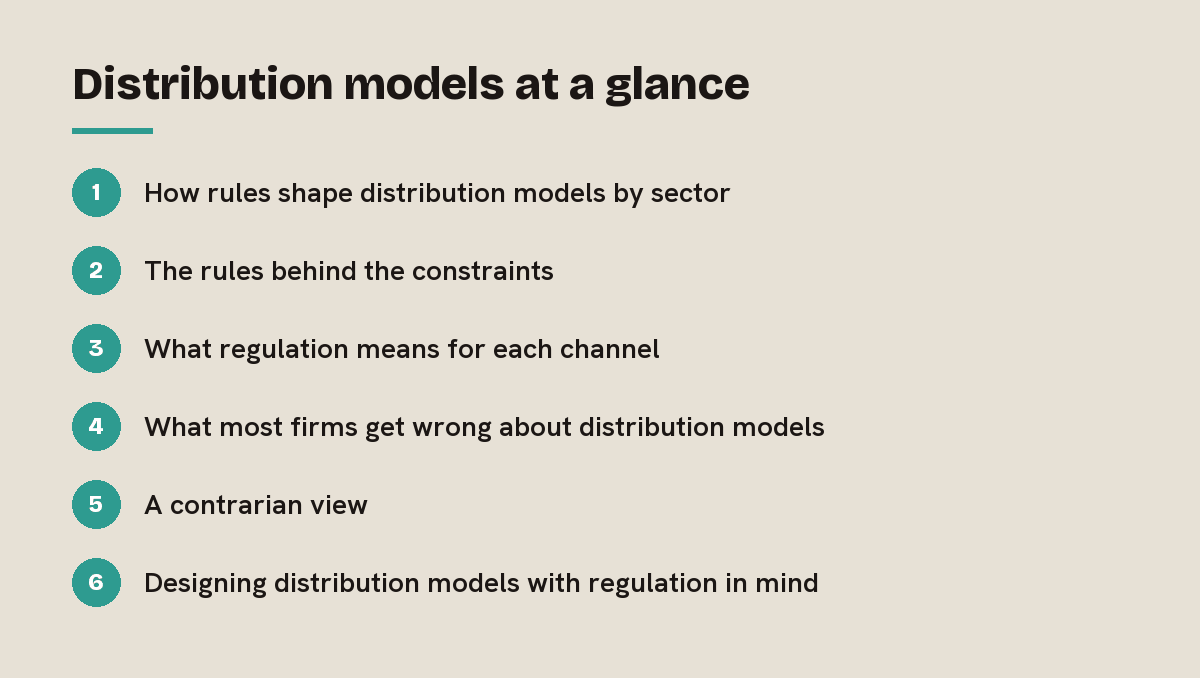
1. How rules shape distribution models by sector
| Sector | Main regulatory constraints | Effect on distribution models |
|---|---|---|
| Wealth | Suitability, appropriateness, costs disclosure | Advice-led or hybrid models dominate for complex needs |
| Insurance | Demands and needs, product oversight, solvency | Brokers and agents remain central; simple cover goes online |
| Banking | Credit assessment, KYC, AML | Digital lending grows, with automated but evidenced checks |
| Fintech | Licences, partner arrangements | Often distribute through partners’ licences and controls |
2. The rules behind the constraints
- Investment suitability: ESMA’s guidelines on the MiFID II suitability requirements set out what firms must gather and assess before recommending investments, including sustainability preferences since 2022.
- Insurance distribution: the Insurance Distribution Directive requires distributors to specify customers’ demands and needs and to explain bundled products and their costs.
- Consumer credit: the revised Consumer Credit Directive, which Member States must apply from 20 November 2026, requires a thorough creditworthiness assessment and brings buy now pay later schemes into scope.
- Consumer outcomes: in the UK, the FCA’s Consumer Duty asks firms to consider how customers behave at every stage of the journey, whichever channel they use.
3. What regulation means for each channel
| Channel | What must be built in |
|---|---|
| Direct digital | Eligibility checks, clear disclosure, evidence of what customers saw |
| Adviser and broker | Suitability or demands-and-needs records, oversight of intermediaries |
| Embedded and partner | Contracts, monitoring and conduct controls across firms |
| Branch and contact centre | Consistent scripts, records and complaint handling |
4. What most firms get wrong about distribution models
- Designing first, checking later: journeys built before compliance input often need expensive redesign.
- Over-interpreting rules: asking for more than required adds friction without adding protection.
- Treating channels separately: the same customer may move between channels, so the regulatory record should follow them.
- Forgetting partners: when products are sold through others, accountability for outcomes usually stays with the regulated firm.
Example: an insurer wanted to sell income protection through a payroll platform. A review showed that the product’s underwriting and demands-and-needs requirements did not fit a two-click journey. The insurer launched a simplified, guaranteed-acceptance version for the platform and kept the full product with advisers, opening a new channel without compromising conduct.
5. A contrarian view
Regulation is often blamed for slow distribution. In practice, many rules ask for what good distribution needs anyway: understanding customer needs, explaining products clearly and keeping evidence. Firms that design distribution models around those requirements from the start often move faster than those that treat compliance as a final gate.
6. Designing distribution models with regulation in mind
- Classify products by advice need, underwriting intensity and disclosure burden.
- Match each product to channels where its obligations can be met well.
- Build compliance into journey orchestration, with records captured automatically.
- Include risk and compliance teams from the first design session.
- Monitor outcomes by channel, not just sales.
Key takeaways on distribution models
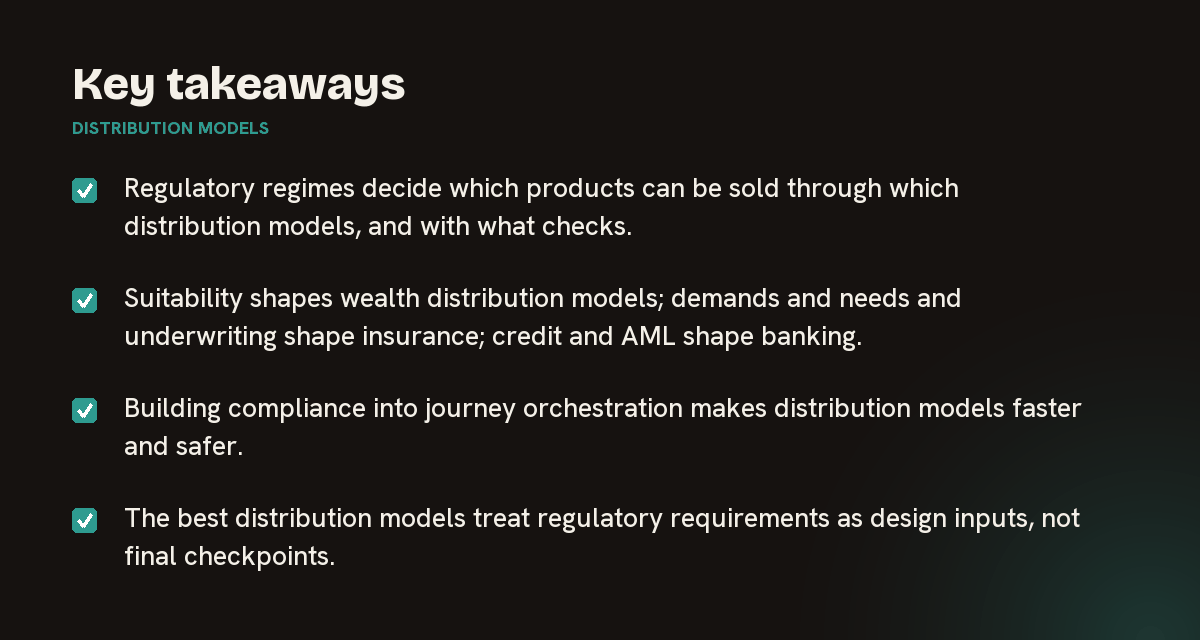
- Regulatory regimes decide which products can be sold through which distribution models, and with what checks.
- Suitability shapes wealth distribution models; demands and needs and underwriting shape insurance; credit and AML shape banking.
- Building compliance into journey orchestration makes distribution models faster and safer.
- The best distribution models treat regulatory requirements as design inputs, not final checkpoints.
For leadership teams, aligning distribution models with regulatory regimes is a strategic choice, not a compliance afterthought. It decides which channels can scale, which products need people, and how quickly new partnerships can launch.
Optimizium helps banks, insurers and wealth managers design distribution models that fit their regulatory obligations and commercial goals. We respect the expertise of compliance and legal teams, because they know what each rule is meant to protect. And we bring them into distribution design as co-authors, so new channels are compliant from day one.
Explore how we approach this across Banking, Insurance, Wealth Management and Beyond Banking, browse the FAQ Hub, or read the related question: How does distribution strategy influence operating models in financial services?
On this page
Partner with the experts.
Let's discuss how Optimizium can accelerate your roadmap and navigate complex digital transformation.
Schedule a consultation →