Home › FAQ Hub › How does “composability” change distribution strategy?
Tech & IntegrationHow does “composability” change distribution strategy?
Composability is the ability to break a financial value chain into small, independent capabilities, such as identify, quote, bind, underwrite, settle and report, each exposed as a reusable service that can be combined in different ways for different channels and partners.
For most of their history, financial institutions sold whole products through channels they owned. A modular world changes both halves of that sentence.
Composability is the ability to break a financial value chain into small, independent capabilities, such as identify, quote, bind, underwrite, settle and report, each exposed as a reusable service that can be combined in different ways for different channels and partners. It changes distribution strategy because an institution no longer has to sell a complete product through its own channel. It can offer a single capability, such as instant credit decisioning or embedded insurance cover, inside a partner’s journey, or assemble its own products from internal and external components. Composability turns distribution from a question of “which channels do we own?” into “which capabilities do we want to offer, to whom, and where?”
The core tension, in one line:
Composability lets you appear everywhere; it also makes it easier for others to appear in your place.

an insurer exposes its quote, bind and claims notification capabilities as separate services. A car marketplace uses quote and bind at checkout, a fleet manager integrates claims notification into its own app, and the insurer’s direct channel uses all three. Same underwriting, three distribution routes, no separate products.
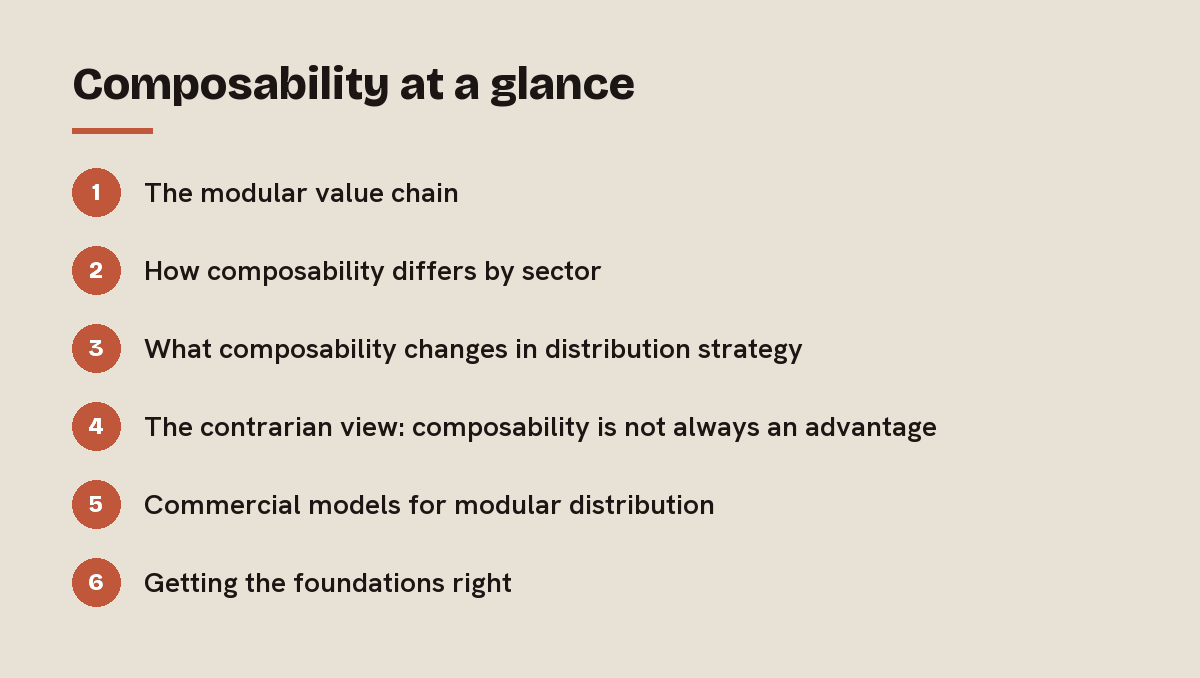
1. The modular value chain
| Capability | What it looks like as a service | Distribution opportunity |
|---|---|---|
| Identify | Identity and KYC checks via API | Reused across products and partners |
| Quote | Instant price based on submitted data | Embedded in comparison and partner journeys |
| Bind | Policy or contract issued programmatically | Purchase completed inside a partner’s checkout |
| Underwrite | Risk or credit decision as a service | Offered to partners who lack a licence or model |
| Settle | Payment, payout or disbursement | Faster, cheaper fulfilment in any channel |
| Report | Statements, tax and regulatory data | Feeds partner platforms and aggregators |
2. How composability differs by sector
- Insurance: underwriting and claims become modular. Insurers can offer cover at the point of need, inside travel, mobility or property journeys, while keeping underwriting and claims in-house.
- Banking: credit decisioning becomes modular. Lending decisions, payments and accounts are exposed to merchants, software platforms and marketplaces.
- Wealth: portfolio construction becomes modular. Model portfolios and rebalancing engines can power partner apps, employer platforms and advisers.
- Fintech: modularity is used to scale partners. Many fintechs build on others’ licences and capabilities, and offer their own components back to the market.
3. What composability changes in distribution strategy
| Strategic question | Before | With composability |
|---|---|---|
| Where do we sell? | Our branches, brokers and apps | Wherever our capabilities add value, including partners |
| What do we sell? | Whole products | Whole products and individual capabilities |
| Who owns the customer? | Us, usually | Sometimes us, sometimes a partner |
| How do we compete? | Brand and reach | Quality, speed and price of each capability |
| How fast can we launch? | Months per product | Weeks, by recombining existing services |
The infrastructure is increasingly in place. The ECB notes that roughly two-thirds of euro area banks have cooperation agreements with external cloud providers, and the European Commission’s Financial Data Access proposal would extend data sharing well beyond payments, to investments, pensions and insurance. Both make modular distribution easier to build and to regulate.
4. The contrarian view: composability is not always an advantage
Composability is often presented as a pure win. It is not.
- Commoditisation risk: a capability that can be plugged in anywhere can also be swapped out. If your quote service is only cheaper, a partner will replace it with a cheaper one.
- Loss of the relationship: offering capabilities inside other firms’ journeys can mean the customer never knows your name.
- Accountability does not move: the regulated firm remains responsible for conduct, suitability and resilience, even when the journey belongs to someone else.
- Complexity shifts: many small services need strong governance, monitoring and versioning, or the architecture becomes a new kind of legacy.
The strategic answer is to be deliberate: decide which capabilities are differentiating and worth offering widely, which should stay inside the institution’s own propositions, and which are better sourced from others.
Example: a mid-sized bank built a modular lending decision service for its own app. It then offered the same service to two software platforms used by small businesses, with its brand visible in the journey. Lending volumes from partners overtook the bank’s direct channel within two years, while risk, pricing and conduct oversight stayed in one place.
5. Commercial models for modular distribution
Offering capabilities to partners raises commercial questions that product-based distribution never had to answer. Pricing can be per call, per contract written, a share of revenue, or a fixed platform fee, and each model sends a different signal about the relationship. Service levels matter just as much: a partner embedding your credit decision in its checkout will expect availability and response times measured in fractions of a second. Contracts must allocate responsibility for customer communication, complaints and data protection clearly, because the regulator will still look to the licensed institution. Firms that settle these questions early move faster when the first serious partner arrives.
6. Getting the foundations right
- Map capabilities, not systems, and decide which are core, shared or sourced.
- Design APIs as products, with owners, service levels and pricing.
- Build control in, so conduct and resilience obligations travel with each capability.
- Measure capability economics, not only product profitability.
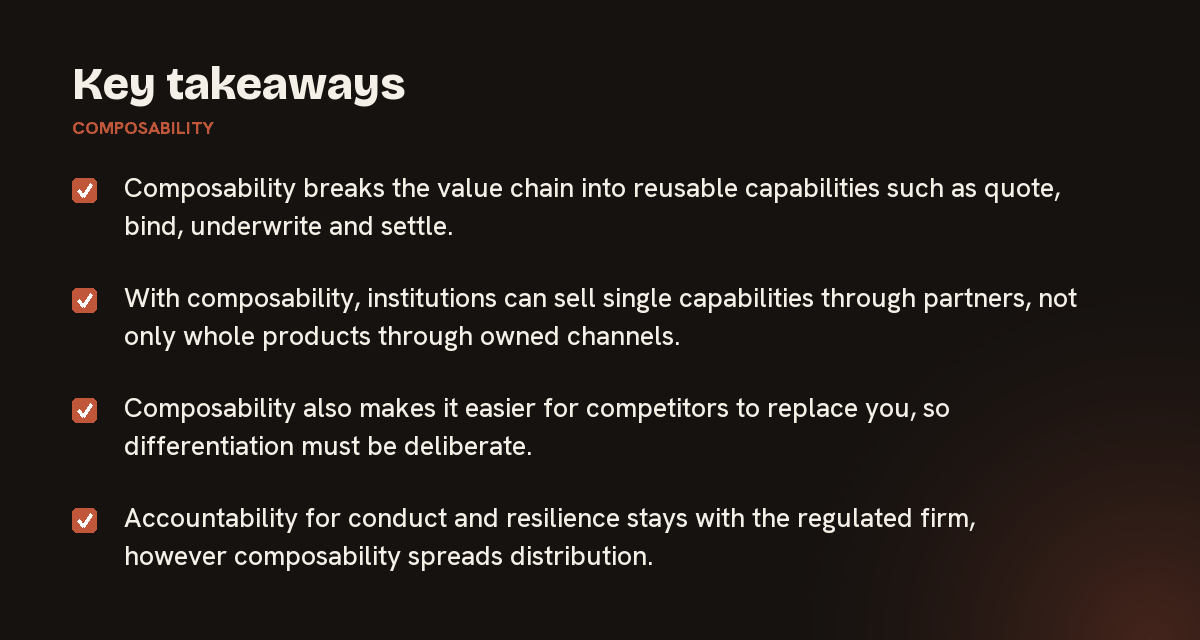
Key takeaways on composability
- Composability breaks the value chain into reusable capabilities such as quote, bind, underwrite and settle.
- With composability, institutions can sell single capabilities through partners, not only whole products through owned channels.
- Composability also makes it easier for competitors to replace you, so differentiation must be deliberate.
- Accountability for conduct and resilience stays with the regulated firm, however composability spreads distribution.
For leadership teams, the move to composability is a chance to rethink where value is created and captured. Institutions that treat it as an architecture project alone will build flexible systems with no clear commercial purpose; those that treat it as a distribution strategy will know which capabilities to sharpen and where to place them.
Optimizium helps banks, insurers and wealth managers make that shift. We respect the product, risk and pricing expertise that makes an institution’s capabilities worth offering in the first place. And we bring risk, compliance and partnership teams into the design as co-authors, so modular distribution grows without losing control of conduct or resilience.
Explore how we approach this across Beyond Banking, Banking, Insurance and Wealth Management, browse the FAQ Hub, or read the related question: How do omnichannel platforms support hybrid distribution?
Related questions
On this page
Partner with the experts.
Let's discuss how Optimizium can accelerate your roadmap and navigate complex digital transformation.
Schedule a consultation →