Home › FAQ Hub › How does customer lifetime value vary across industries?
Strategy & PositioningHow does customer lifetime value vary across industries?
Customer lifetime value (CLV) is the total value a customer is expected to bring to an institution over the whole relationship, net of the cost of acquiring and serving them, and it varies widely across financial services because each sector earns money in different ways and over different time horizons.
Two customers can bring the same revenue this year and very different value over the next twenty. Understanding that difference is at the heart of good strategy in financial services, from pricing and acquisition spend to service design.
Customer lifetime value (CLV) is the total value a customer is expected to bring to an institution over the whole relationship, net of the cost of acquiring and serving them, and it varies widely across financial services because each sector earns money in different ways and over different time horizons. CLV correlates with cross-sell depth, retention, advice intensity, premiums and fees.
Wealth and insurance tend to have higher customer lifetime value because holdings and policies last many years; banking value is often driven by lending and the breadth of the relationship; fintech value depends heavily on its business model and unit economics. Knowing what drives CLV in each sector helps institutions decide where to invest in acquisition, service and digital experience.
The core tension, in one line:
The customers who look most profitable today are not always the ones who will be most valuable over time.
a bank finds that customers who open a current account and set up their salary payment in the first month are far more likely to take a mortgage within five years. It shifts acquisition incentives towards salary switching rather than account openings alone, and the expected customer lifetime value of new customers rises.
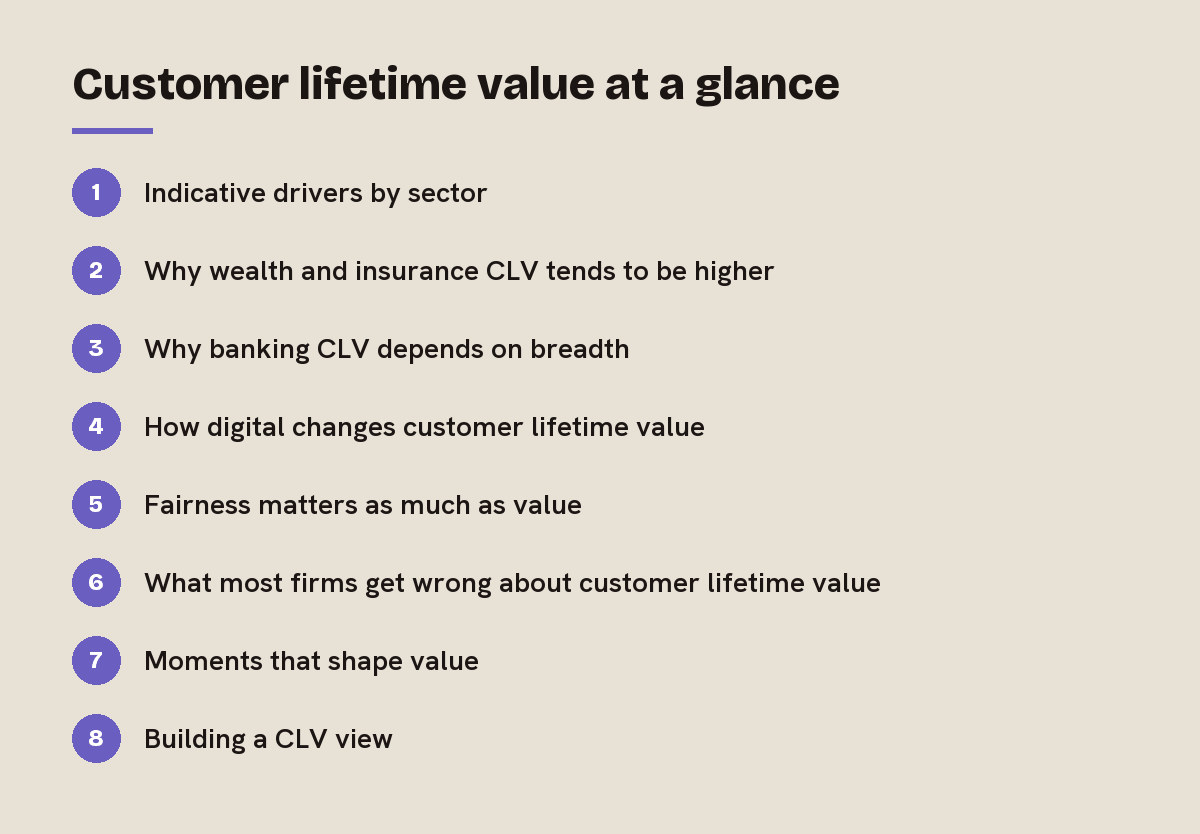
1. Indicative drivers by sector
| Sector | Main CLV drivers | What erodes value |
|---|---|---|
| Wealth | Advice, retention of assets, referrals | Poor performance communication, adviser departures |
| Insurance | Premium persistency, claims outcomes, multi-policy holding | Bad claims experiences, price-driven switching |
| Banking | Lending portfolio, cross-sell, primary relationship | Becoming a secondary account, low engagement |
| Fintech | Unit economics, scale, activation and retention | High acquisition cost, low activation, churn |
2. Why wealth and insurance CLV tends to be higher
- Long holding periods: pensions, investments and life policies can last decades.
- Recurring revenue: fees on assets and regular premiums accumulate over time.
- Referrals: satisfied wealth clients often introduce family members and friends.
- Switching friction: moving investments or policies takes effort, so loyal customers tend to stay.
3. Why banking CLV depends on breadth
Everyday banking generates modest revenue per customer, especially as payment fees fall. Value comes from lending and from being the primary relationship, where salary arrives and most transactions happen. Digital adoption makes the primary relationship easier to win and lose: Eurostat reports that 67 per cent of people aged 16 to 74 in the EU used internet banking in 2024, and switching between apps is far easier than switching between branches.
4. How digital changes customer lifetime value
| Effect | How it raises CLV | How it can lower CLV |
|---|---|---|
| Lower cost-to-serve | More margin from each customer | Lower prices if savings are competed away |
| Better data | More relevant offers and timing | Over-selling that erodes trust |
| Easier switching | Loyal, engaged customers stay | Disengaged customers leave more easily |
| New channels | Access to new segments | Lower-value customers if acquisition is poorly targeted |
5. Fairness matters as much as value
Maximising lifetime value must not mean penalising loyalty. The FCA’s Consumer Duty requires products to provide fair value, which applies over the whole relationship, not only at acquisition. Practices that charge long-standing customers more than new ones, or rely on inertia, create regulatory and reputational risk. Sustainable customer lifetime value comes from customers who stay because they are well served.
6. What most firms get wrong about customer lifetime value
- Optimising acquisition cost only: cheap customers who leave quickly are expensive.
- Ignoring the cost to serve: high-revenue customers who consume a lot of service may be less valuable than they appear.
- Using CLV only in marketing: it should inform product, service and pricing decisions too.
- Treating CLV as fixed: good experiences at key moments, such as a claim or a market fall, raise future value.
Example: an insurer analysed customer lifetime value by acquisition channel and found that customers acquired through price comparison sites had much lower persistency than those acquired through partners or referrals. It rebalanced its marketing spend and improved its first-claim experience, and average lifetime value per new customer rose over the following two years.
7. Moments that shape value
A small number of moments have an outsized effect on future value. In insurance, the first claim often decides whether a customer renews for years or leaves at the next opportunity. In wealth, the conversation after a market fall shapes trust for a decade. In banking, the handling of a fraud case or a mortgage application can turn a secondary account into a primary relationship. Investing in these moments usually raises value more than broad campaigns.
8. Building a CLV view
- Combine data on revenue, cost to serve, retention and cross-sell for each customer.
- Segment by acquisition channel and behaviour, not just demographics.
- Identify early signals of high future value, such as salary switching or multi-product holding.
- Use CLV in decisions on acquisition spend, service levels and product design.
- Check fairness, so value is not built at the expense of loyal customers.
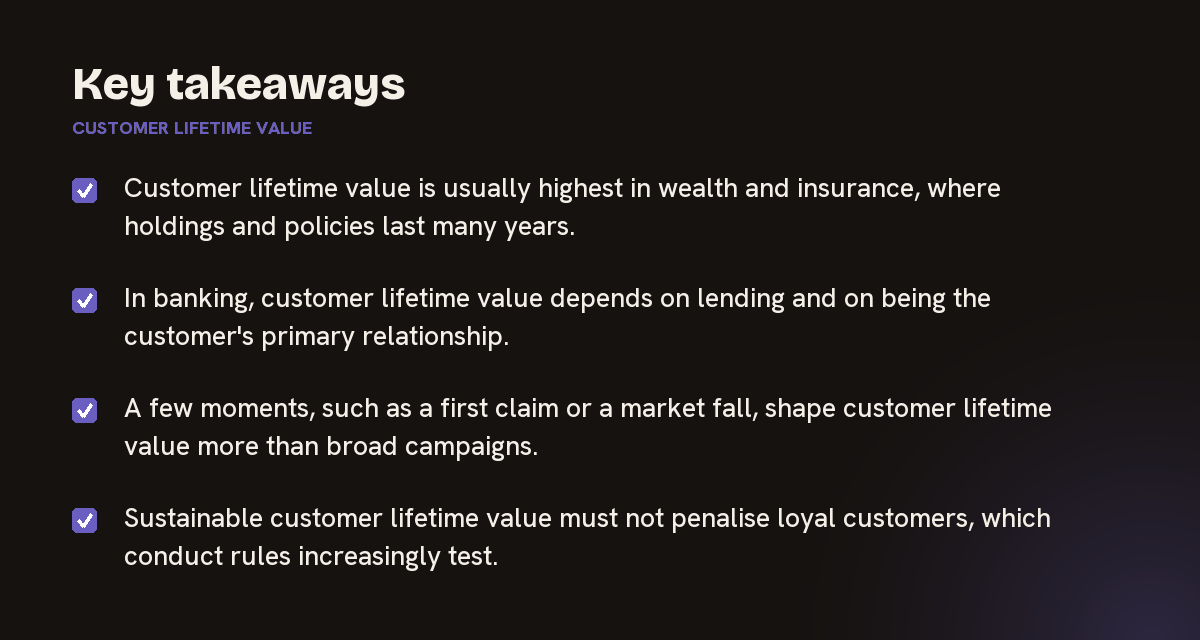
Key takeaways on customer lifetime value
- Customer lifetime value is usually highest in wealth and insurance, where holdings and policies last many years.
- In banking, customer lifetime value depends on lending and on being the customer’s primary relationship.
- A few moments, such as a first claim or a market fall, shape customer lifetime value more than broad campaigns.
- Sustainable customer lifetime value must not penalise loyal customers, which conduct rules increasingly test.
For leadership teams, customer lifetime value is one of the best ways to connect customer experience with financial performance. It shows where investment in service, digital journeys and advice will pay back, and where acquisition spend is being wasted.
Optimizium helps banks, insurers and wealth managers build and use customer lifetime value models in strategy and operations. We respect the customer and actuarial knowledge institutions already hold, because it gives these models their foundation. And we bring finance, risk and compliance colleagues into the design as co-authors, so value is pursued in ways that are fair and sustainable.
Explore how we approach this across Banking, Insurance, Wealth Management and Beyond Banking, browse the FAQ Hub, or read the related question: Why does customer-centricity matter in financial services?
Related questions
On this page
Partner with the experts.
Let's discuss how Optimizium can accelerate your roadmap and navigate complex digital transformation.
Schedule a consultation →