Home › FAQ Hub › How does digital change customer research and insights?
Tech & Core ModernisationHow does digital change customer research and insights?
Digital changes customer research by turning it from an occasional project into a continuous loop. Digital channels generate behavioural, transactional and cohort data at high frequency, showing what customers do, where they hesitate and what they value.
Financial institutions used to learn about their customers in occasional bursts: an annual satisfaction survey, a set of focus groups before a product launch, a complaint analysis once a quarter. Digital channels make it possible to learn every day.
Digital changes customer research by turning it from an occasional project into a continuous loop. Digital channels generate behavioural, transactional and cohort data at high frequency, showing what customers do, where they hesitate and what they value. Product managers combine that data with user experience research, analytics and experimentation to test ideas quickly and learn from real behaviour, not only from what customers say. Each sector draws on different signals: insurers use claims behaviour, banks spending patterns, wealth managers investment behaviour and fintechs growth funnels. The best customer research now blends quantitative data with qualitative interviews, so institutions understand both what customers do and why they do it.
The core tension, in one line:
Data shows what customers do; only conversations reveal why.
a bank’s analytics show that many customers start setting up a savings goal in the app but never finish. Five short interviews reveal that customers are unsure whether money in the goal can be withdrawn at any time. A single line of explanation, tested with an A/B experiment, lifts completion noticeably.
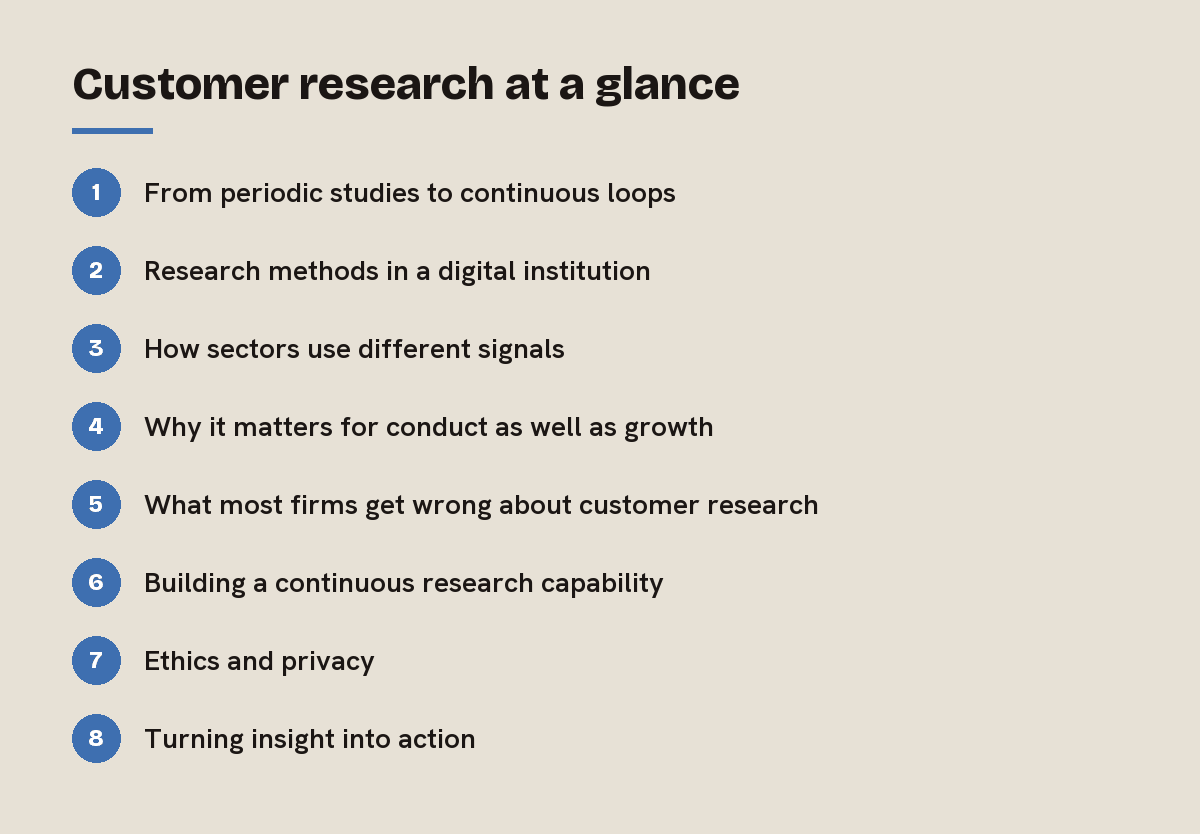
1. From periodic studies to continuous loops
| Aspect | Traditional research | Digital customer research |
|---|---|---|
| Frequency | Annual or per project | Continuous |
| Main sources | Surveys, focus groups | Behavioural data, experiments, interviews |
| Speed of learning | Months | Days or weeks |
| Who uses it | Marketing and research teams | Product teams, design, analytics, leadership |
| Link to action | Recommendations in reports | Changes tested and shipped directly |
2. Research methods in a digital institution
- A/B testing: comparing two versions of a screen, message or journey with real customers to see which performs better.
- Journey analytics: tracking where customers start, pause, return and drop off across steps and channels.
- Behavioural analytics: understanding patterns of use, such as which features are used together and by whom.
- Cohort analysis: comparing groups of customers who joined at different times or through different channels.
- Qualitative interviews: short, regular conversations with customers to understand motivations, worries and language.
3. How sectors use different signals
| Sector | Richest digital signal | What it reveals |
|---|---|---|
| Insurance | Claims behaviour | Where customers struggle, what drives satisfaction and trust |
| Banking | Spending and payment patterns | Life events, financial pressure, product needs |
| Wealth | Investment behaviour | Risk tolerance in practice, reactions to markets, engagement |
| Fintech | Growth funnels | Conversion, activation and retention drivers |
The scale of digital interaction makes this possible. Eurostat reports that 67 per cent of people aged 16 to 74 in the EU used internet banking in 2024, which means that for most customers, digital behaviour is now the main evidence of how they experience their bank.
4. Why it matters for conduct as well as growth
Customer research is no longer only a commercial tool. The FCA’s Consumer Duty requires firms to understand how customers behave at each stage of a journey and to ensure they receive information they can understand. Testing comprehension, monitoring outcomes and acting on evidence are now part of demonstrating good conduct, and continuous customer research is the most practical way to do it.
Supervisors also look for evidence-based steering. The ECB’s 2024 review of digitalisation practices highlights the analysis of clients’ behaviours and expectations, and real-time KPI dashboards, among sound practices.
5. What most firms get wrong about customer research
- Drowning in data, starving for insight: dashboards full of metrics do not explain behaviour without qualitative research.
- Research separated from decisions: findings that sit in reports rather than with product teams rarely change anything.
- Testing only small things: button colours are easy to test; the bigger value lies in testing propositions, pricing presentation and journey structure.
- Forgetting vulnerable customers: averages hide the experiences of those who struggle most.
- Ignoring privacy: behavioural data must be used within clear legal and ethical limits.
Example: an insurer noticed that customers who checked their claim status online several times in the first week were far more likely to complain later. Interviews showed they were anxious about whether their claim had been accepted. The insurer added a clear acceptance message and an expected timeline, and complaints from that group fell substantially.
6. Building a continuous research capability
- Embed researchers and analysts in product teams.
- Instrument key journeys so behaviour can be measured step by step.
- Run regular, lightweight interviews, for example a handful each fortnight.
- Agree an experimentation policy with risk and compliance.
- Share insights widely, so learning reaches every team.
7. Ethics and privacy
Behavioural data is powerful and personal. Clear rules on what is collected, how it is used and how long it is kept protect customers and the institution. Research involving vulnerable customers needs particular care, from consent to how findings are reported. Building these rules with data protection colleagues at the start avoids difficult conversations later.
8. Turning insight into action
The value of research comes from the decisions it changes. Teams that review findings weekly, decide what to test next and measure the result build a habit of learning. Over time, this habit becomes a competitive advantage that is hard to copy, because it lives in how the organisation works rather than in any single tool.
Key takeaways on customer research
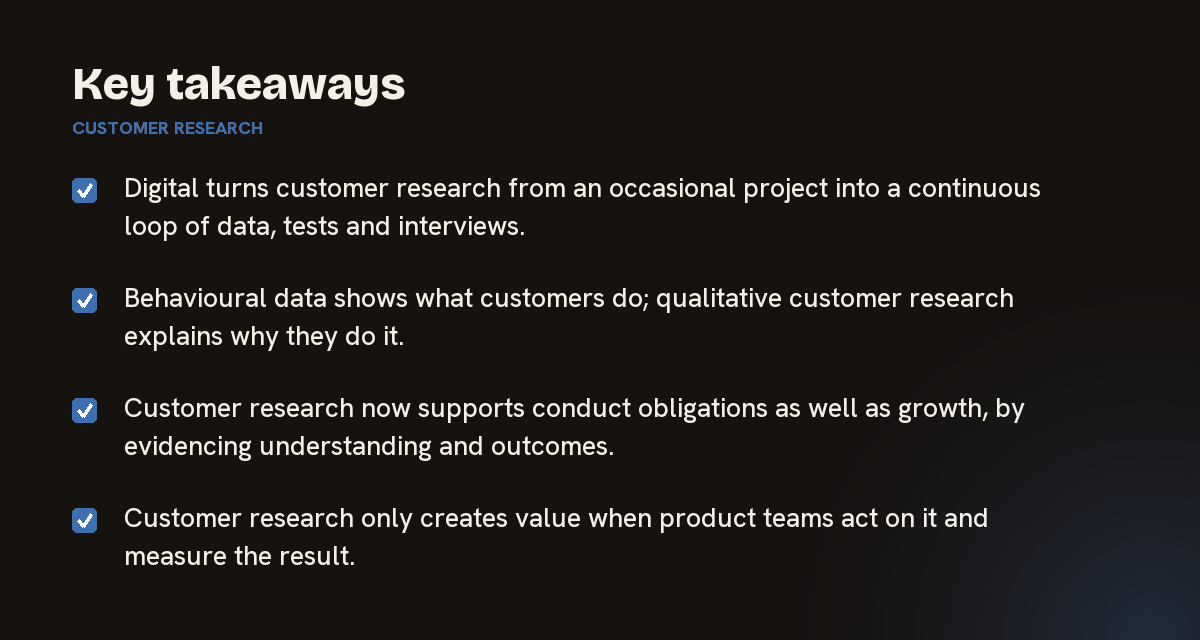
- Digital turns customer research from an occasional project into a continuous loop of data, tests and interviews.
- Behavioural data shows what customers do; qualitative customer research explains why they do it.
- Customer research now supports conduct obligations as well as growth, by evidencing understanding and outcomes.
- Customer research only creates value when product teams act on it and measure the result.
For leadership teams, digital customer research is one of the most powerful levers for better products, lower costs and stronger conduct outcomes. It requires modest investment compared with large technology programmes, and it improves the return on all of them.
Optimizium helps banks, insurers and wealth managers build continuous customer research into their operating model. We respect the customer knowledge held by frontline teams and existing research functions, because it is the starting point for every good question. And we bring data protection, risk and compliance colleagues into the design as co-authors, so insights are gathered and used responsibly.
Explore how we approach this across Banking, Insurance, Wealth Management and Beyond Banking, browse the FAQ Hub, or read the related question: Which digital KPIs matter most for wealth managers?
On this page
Partner with the experts.
Let's discuss how Optimizium can accelerate your roadmap and navigate complex digital transformation.
Schedule a consultation →