Home › FAQ Hub › How does digital enable new credit models?
Tech & Core ModernisationHow does digital enable new credit models?
Digital enables new credit models by combining digital onboarding, real-time data and alternative data scoring to make lending faster, more contextual and more flexible.
Lending used to follow a familiar pattern: apply, provide documents, wait for a decision, sign, receive funds. Digital technology has compressed that sequence into seconds for many products and moved the moment of borrowing into the places where customers spend.
Digital enables new credit models by combining digital onboarding, real-time data and alternative data scoring to make lending faster, more contextual and more flexible. The results include instant lending, buy now pay later at the point of sale, revolving credit managed entirely in an app, and credit limits that adjust dynamically to a customer’s circumstances. Embedded lending extends distribution into merchant checkouts and business software, where credit is offered at the moment of need. Regulation moderates the pace: consumer credit rules, anti-money-laundering requirements and capital rules apply to incumbents and fintechs alike, and new EU rules are bringing many buy now pay later products firmly into scope.
The core tension, in one line:
Digital makes credit easy to offer at any moment; responsible lending asks whether it should be offered at that moment.
a small business uses accounting software that connects to its bank account. When the software detects a gap between invoices due and bills to pay, it offers a short-term working capital loan from a partner bank, priced using the business’s real cash-flow data. The owner accepts in a few clicks, and the bank’s risk is assessed on far richer information than a traditional application would provide.
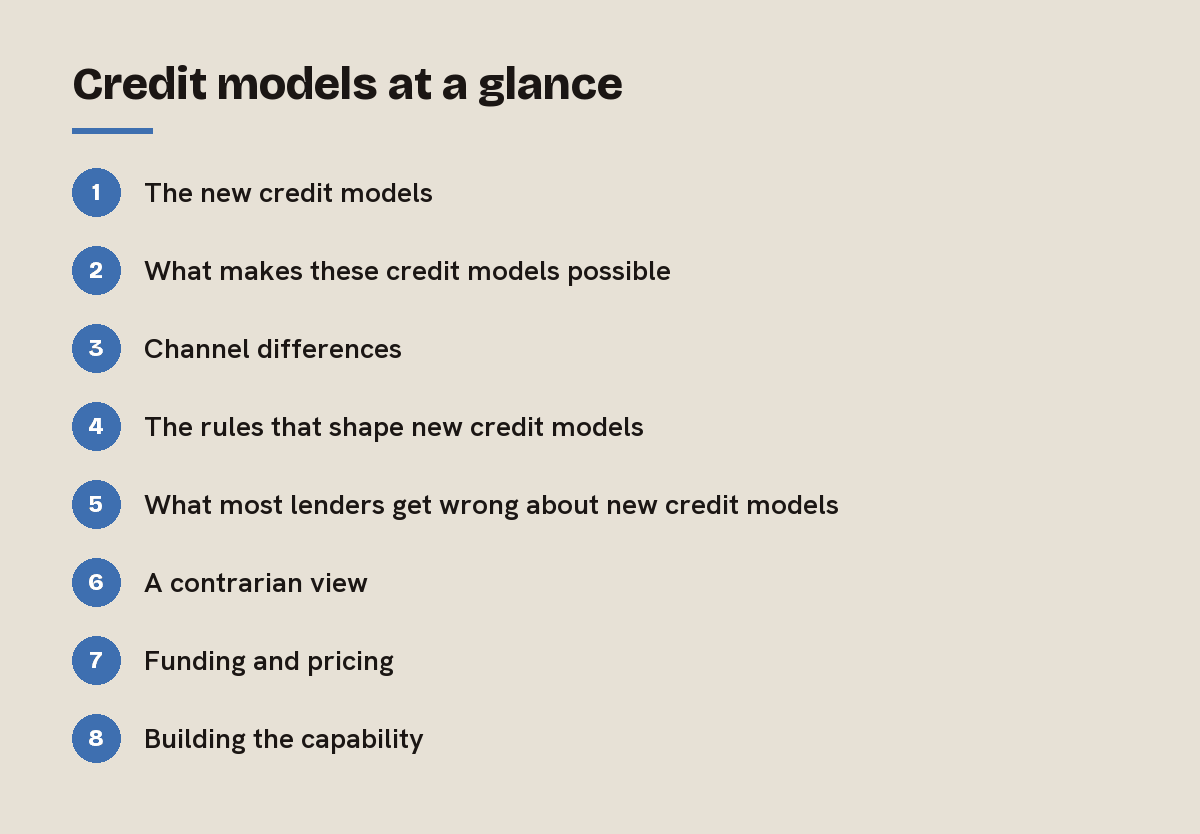
1. The new credit models
| Model | How it works | Where it fits best |
|---|---|---|
| Instant lending | Automated decision and funding in minutes | Personal loans, small business loans |
| Buy now pay later | Purchase split into instalments at checkout | Retail and e-commerce |
| Revolving credit in-app | Flexible credit lines managed digitally | Everyday spending, cash flow |
| Dynamic credit limits | Limits adjust based on real-time data | Cards, business credit lines |
| Embedded lending | Credit offered inside partner platforms | Merchant checkouts, business software, marketplaces |
2. What makes these credit models possible
- Digital onboarding: identity and checks completed in minutes.
- Real-time data: transaction, account and cash-flow data, often accessed with customer permission through open banking.
- Alternative data scoring: information beyond traditional credit files, such as income patterns or business accounting data.
- Automated decisioning: rules and models that decide instantly and consistently.
- APIs: credit offered through partners’ platforms as easily as through the lender’s own app.
3. Channel differences
| Channel | Strength | Typical use |
|---|---|---|
| Direct digital | Fastest decisioning | Personal loans, credit cards, overdrafts |
| Embedded | Contextual, high conversion | Point-of-sale finance, business working capital |
| Branch and adviser | Complex cases and risk-adjusted pricing | Mortgages, larger business lending |
4. The rules that shape new credit models
- Consumer credit: the revised EU Consumer Credit Directive explicitly brings buy now pay later schemes into scope and requires a thorough creditworthiness assessment in the consumer’s interest. Member States must apply the new rules from 20 November 2026.
- AI in lending: the EU AI Act classifies AI systems used to evaluate creditworthiness as high-risk, with requirements on data, documentation and human oversight.
- Automated decisions: in its SCHUFA judgment, the Court of Justice held that a credit score can be an automated decision under the GDPR when it plays a decisive role in the lender’s decision.
- Financial crime and capital: anti-money-laundering and prudential rules apply regardless of how credit is distributed.
5. What most lenders get wrong about new credit models
- Speed without affordability: instant decisions that skip meaningful affordability checks create arrears and regulatory risk.
- Data without consent clarity: alternative data must be used with clear customer permission and purpose.
- Partners without oversight: embedded lending through partners still leaves the lender responsible for conduct.
- Models without monitoring: credit models trained in benign conditions may behave badly when conditions change.
Example: a bank launched instant personal loans in its app using a new scoring model. Approval rates rose, but early arrears among one segment were higher than expected. Monitoring caught the pattern within weeks; the bank adjusted its affordability rules for that segment and added income verification through open banking, bringing performance back in line.
6. A contrarian view
New credit models are often presented as a fintech advantage. In practice, incumbents hold many of the ingredients that matter most: deposit funding, customer data, risk expertise and regulatory experience. What they often lack is the ability to decide instantly and to distribute through partners. Incumbents that build those capabilities can compete strongly, especially as tighter rules raise the bar for lenders without deep risk management.
7. Funding and pricing
Faster origination changes the economics of lending. Instant and embedded products often carry smaller balances and shorter terms, so pricing must cover acquisition, servicing and expected losses on each loan rather than across a long relationship. Partner fees and revenue shares add another layer. Lenders that model these economics carefully, product by product and channel by channel, avoid growing volumes that look attractive but do not pay back.
8. Building the capability
- Modernise decisioning with real-time data and explainable models.
- Use open banking data with clear consent to improve affordability checks.
- Design embedded propositions with partners, including conduct controls.
- Monitor credit models continuously, by segment and channel.
- Prepare for regulatory change, including the revised consumer credit rules.
Key takeaways on credit models
- New credit models combine digital onboarding, real-time data and automated decisions to lend in minutes.
- Embedded lending places credit models inside merchant checkouts and business software at the moment of need.
- From November 2026, EU consumer credit rules bring buy now pay later and similar credit models firmly into scope.
- The best credit models pair speed with affordability checks and continuous monitoring by segment.
For leadership teams, new credit models offer growth and better customer experience, but only with strong foundations in data, decisioning and conduct. The lenders that win will be those that combine speed with responsible lending, not those that simply decide fastest.
Optimizium helps banks and lenders design and launch new credit models across direct and embedded channels. We respect the credit risk expertise that institutions have built over decades, because it is what makes fast decisions sound. And we bring risk, compliance and data protection teams into the design as co-authors, so innovation in lending is responsible from the start.
Explore how we approach this across Banking, Beyond Banking, Insurance and Wealth Management, browse the FAQ Hub, or read the related question: Why are data platforms foundational?
Related questions
On this page
Partner with the experts.
Let's discuss how Optimizium can accelerate your roadmap and navigate complex digital transformation.
Schedule a consultation →