Home › FAQ Hub › How does digital improve operational excellence?
Tech & Core ModernisationHow does digital improve operational excellence?
Digital technology helps institutions improve operational excellence by increasing throughput, reducing manual processing and improving accuracy through rules-based and AI-driven decisions. It cuts rework, lowers error rates and increases capacity without a proportional rise in headcount.
For years, growing a financial institution meant hiring more people to process more transactions. Digital technology has broken that link, provided it is applied to how work is done and not only to the screens customers see.
Digital technology helps institutions improve operational excellence by increasing throughput, reducing manual processing and improving accuracy through rules-based and AI-driven decisions. It cuts rework, lowers error rates and increases capacity without a proportional rise in headcount. Straight-through processing and automated exception management have a direct effect on returns in banks and insurers, because they reduce the cost of each transaction and free people for work that needs judgement.
The areas where institutions most often improve operational excellence are onboarding and know-your-customer checks, claims and underwriting, payments, and reporting. The common thread is redesigning processes before automating them, and measuring results continuously.
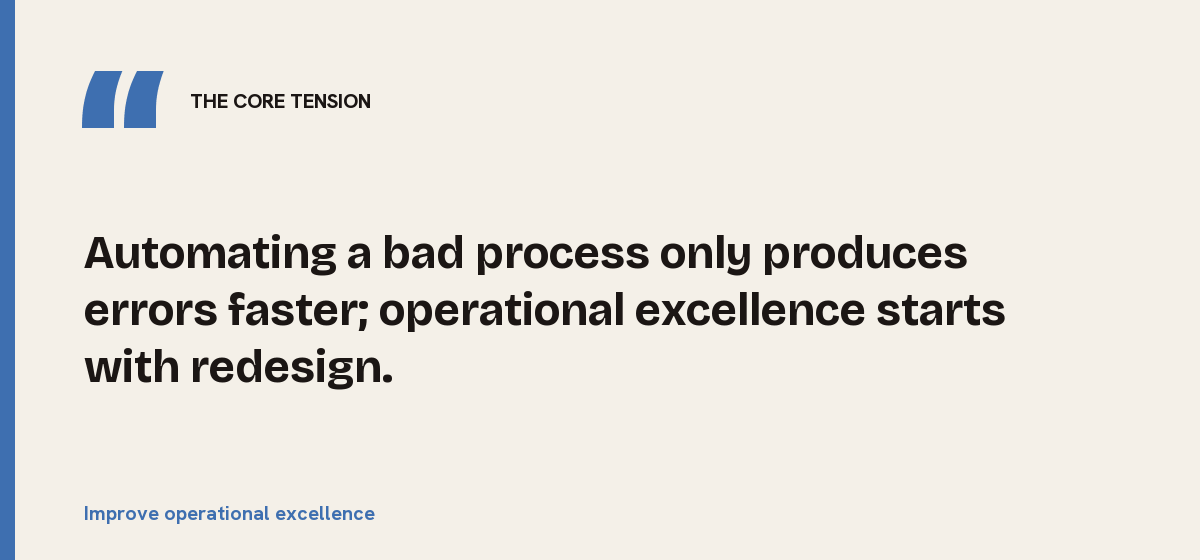
The core tension, in one line:
Automating a bad process only produces errors faster; operational excellence starts with redesign.
a bank’s operations team took days to resolve payment exceptions, reviewing each one by hand. After classifying exceptions automatically, resolving simple ones with rules and routing complex ones to specialists with full context, resolution time fell to hours and error rates dropped.
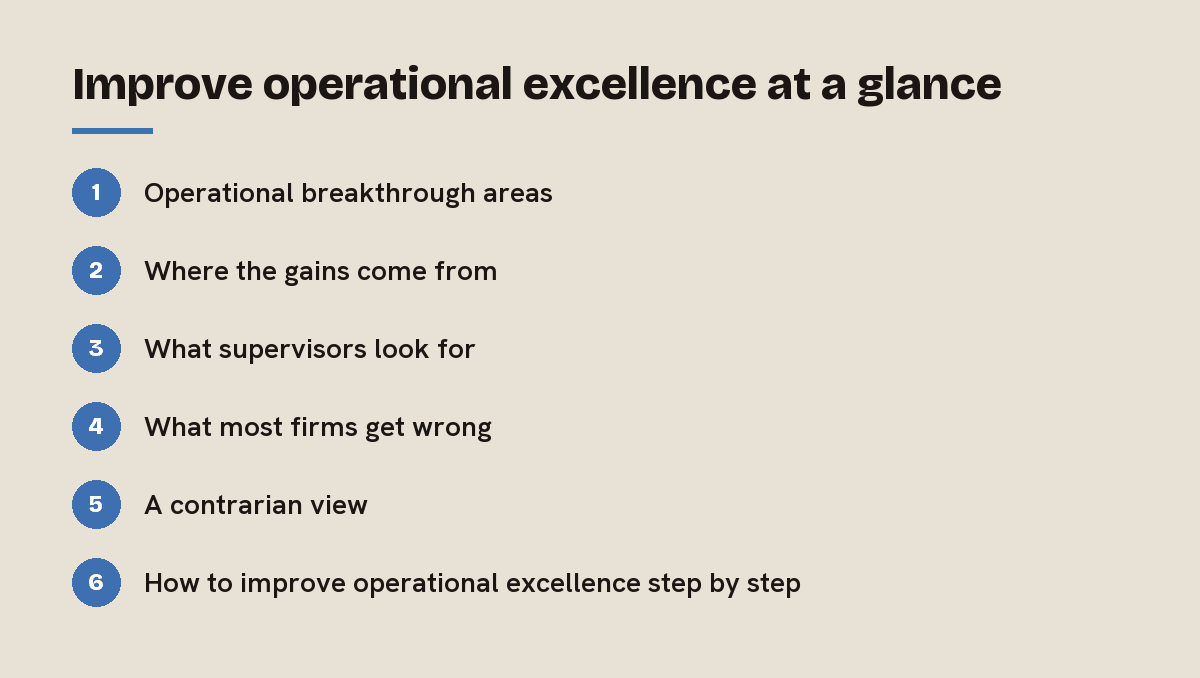
1. Operational breakthrough areas
| Area | What digital changes | How it helps improve operational excellence |
|---|---|---|
| Onboarding, KYC and AML | Digital identity, automated screening | Faster openings, fewer manual reviews |
| Claims and underwriting | Triage, document reading, rules | Shorter cycle times, consistent decisions |
| Payments | Straight-through processing, exception rules | Fewer breaks and investigations |
| Reporting | Single data source, automated reports | Less reconciliation |
| Servicing | Self-service and workflow automation | Lower cost per request |
2. Where the gains come from
- Straight-through processing: transactions complete without manual steps.
- Exception management: automated classification and routing of the cases that do need people.
- Decision automation: rules and models applied consistently in credit, fraud and claims.
- Single sources of data: fewer reconciliations between systems.
- Continuous measurement: real-time operational indicators to find and fix bottlenecks.
AI is now part of this toolkit. According to ECB Supervisory Board Chair Claudia Buch, more than 90 per cent of banks directly supervised by the ECB integrate AI into their operations, while only around 5 per cent of staff work on digital transformation initiatives. Using automation to release capacity is one of the few ways to keep transformation moving with limited people.
3. What supervisors look for
The ECB’s 2024 review of digitalisation practices highlights automated data quality checks and real-time KPI dashboards among sound practices. Efforts to improve operational excellence that also strengthen data and control evidence therefore serve both cost and supervisory goals.
| Measure | Before | After digital improvements |
|---|---|---|
| Cycle time | Days | Hours or minutes |
| Error rate | Frequent rework | Fewer corrections |
| Cost per case | High, labour-driven | Lower, automation-driven |
| Capacity | Tied to headcount | Scales with volume |
4. What most firms get wrong
- Automating without redesigning: steps that should not exist are simply made faster.
- Ignoring exceptions: if special cases stay manual, savings stay small.
- Measuring cost only: quality, cycle time and customer experience matter too.
- Leaving operations teams out: the people doing the work know where the real bottlenecks are.
Example: a wealth manager spent several days each quarter producing client reports, reconciling data from several systems by hand. After consolidating portfolio data and automating report generation, the process took hours, and advisers stopped checking numbers and started explaining them.
5. A contrarian view
Efforts to improve operational excellence are often presented as headcount reduction. The institutions that do it best redeploy people to judgement-based work, complex cases and process improvement. Savings still arrive, but without losing the knowledge that keeps operations running.
6. How to improve operational excellence step by step
- Measure current processes: cycle time, errors, rework, cost per case.
- Redesign before automating.
- Automate frequent exceptions as well as simple cases.
- Train teams for new supervision and improvement roles.
Key takeaways on improve operational excellence
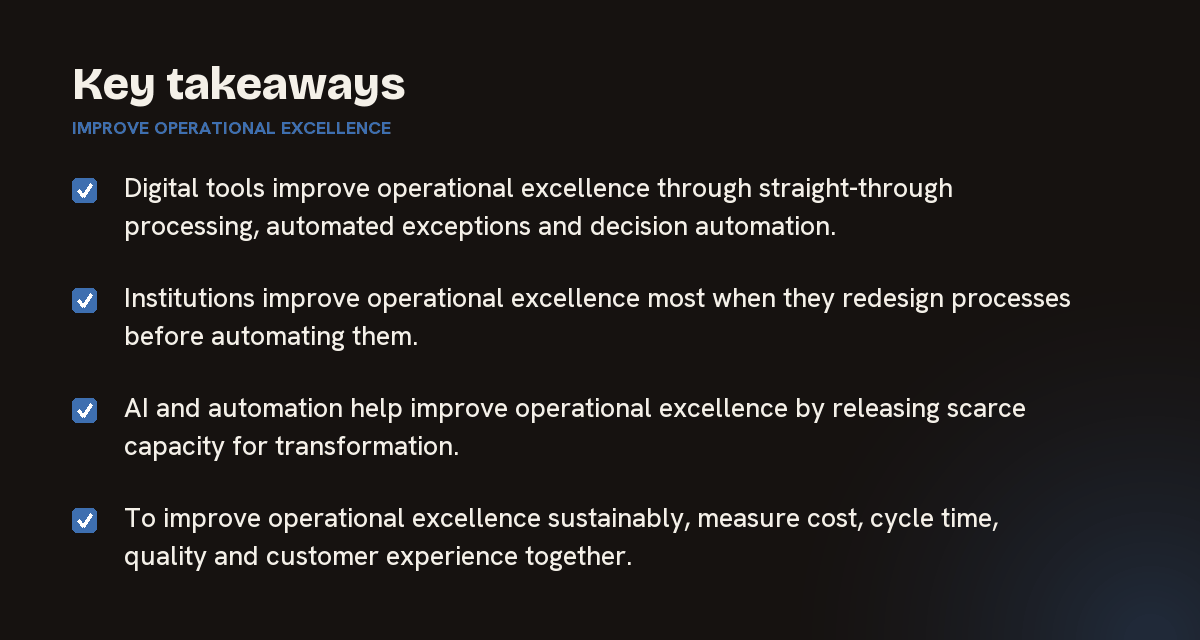
- Digital tools improve operational excellence through straight-through processing, automated exceptions and decision automation.
- Institutions improve operational excellence most when they redesign processes before automating them.
- AI and automation help improve operational excellence by releasing scarce capacity for transformation.
- To improve operational excellence sustainably, measure cost, cycle time, quality and customer experience together.
For leadership teams, efforts to improve operational excellence are among the most measurable results of digital transformation. Gains appear within months, affect profitability directly and free capacity for growth.
Optimizium helps banks, insurers and wealth managers redesign and automate their operations. We respect the knowledge of operations teams, because they know where time is really lost. And we bring risk and compliance into the design as co-authors, so processes become faster and better controlled.
Explore how we approach this across Banking, Insurance and Wealth Management, browse the FAQ Hub, or read the related question: Which digital KPIs matter most for banks?
Related questions
Partner with the experts.
Let's discuss how Optimizium can accelerate your roadmap and navigate complex digital transformation.
Schedule a consultation →