Home › FAQ Hub › How does digital maturity differ across the sectors?
Strategy & PositioningHow does digital maturity differ across the sectors?
Digital maturity differs across the sectors because each faces different products, channels and regulatory demands. Banks often lead in channel digitisation and payments; insurers tend to lag in claims automation; wealth managers often lag in digital onboarding and suitability workflows.
Ask executives in banking, insurance and wealth how digital their organisation is, and most will say “further along than a few years ago, but not where we need to be”. The interesting part is where each sector is ahead and where it lags, because the gaps are not the same.
Digital maturity differs across the sectors because each faces different products, channels and regulatory demands. Banks often lead in channel digitisation and payments; insurers tend to lag in claims automation; wealth managers often lag in digital onboarding and suitability workflows. Fintechs lead in product agility but frequently lack enterprise-scale risk controls.
Channels show the same pattern. Direct digital channels have matured fastest in banking and fintech. Adviser and broker channels mature more slowly because of compliance and complexity, especially in insurance and wealth. Branches and contact centres have become a transitional hybrid in banking and are marginal for fintechs. Understanding these differences helps each sector set realistic priorities instead of copying another’s roadmap.
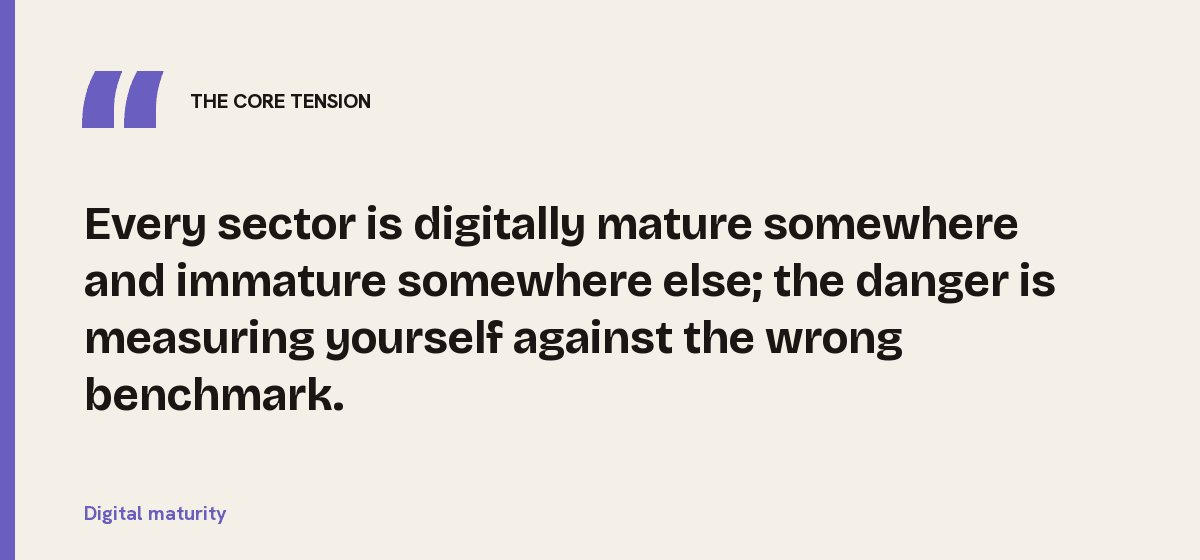
The core tension, in one line:
Every sector is digitally mature somewhere and immature somewhere else; the danger is measuring yourself against the wrong benchmark.
an insurer benchmarked its app against leading banks and invested in daily-engagement features. Customers barely used them. A second review compared it with the best insurers on claims and found the real gap: most claims still required phone calls and paper. Redirecting investment to claims raised satisfaction far more.
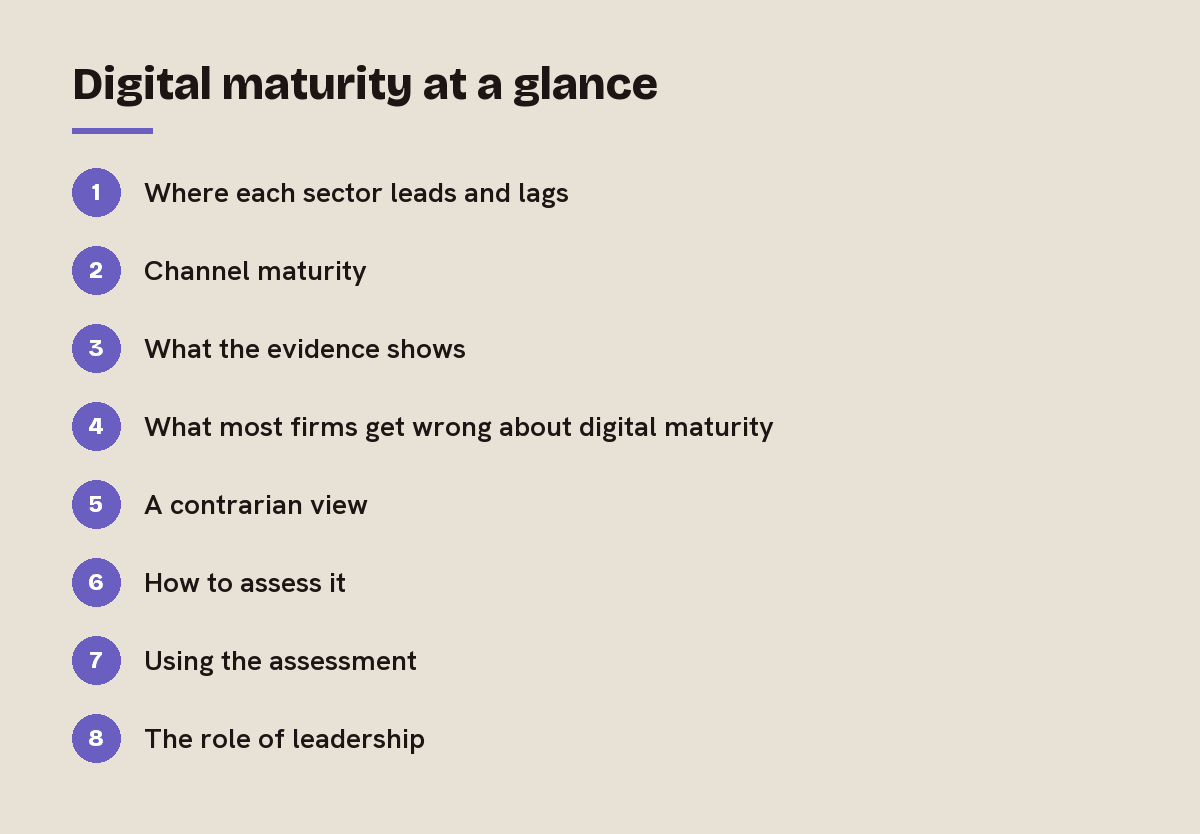
1. Where each sector leads and lags
| Sector | Where digital maturity is highest | Where it lags |
|---|---|---|
| Banking | Channels, payments, everyday servicing | Complex lending, legacy cores |
| Insurance | Simple quote and buy for personal lines | Claims automation, broker integration |
| Wealth | Reporting and client portals | Digital onboarding, suitability workflows |
| Fintech | Product agility, onboarding | Enterprise risk controls and resilience |
2. Channel maturity
| Channel | Most mature in | Why others lag |
|---|---|---|
| Direct digital | Banking, fintech | Product complexity in insurance and wealth |
| Adviser and broker | Varies | Compliance, intermediary systems |
| Branch and contact centre | Banking as a hybrid | Marginal for fintechs |
3. What the evidence shows
Supervisors see progress and gaps. When the ECB surveyed 105 large banks, it found that almost all had a digital strategy, yet many lacked adequate indicators to steer it. In insurance, EIOPA concluded that the level of digitalisation is varied and in most cases still at an early stage. Customer behaviour has moved faster in banking: Eurostat reports that 67 per cent of people aged 16 to 74 in the EU used internet banking in 2024.
4. What most firms get wrong about digital maturity
- Benchmarking against the wrong sector: an insurer copying a bank’s priorities may neglect claims, where its reputation is made.
- Measuring features, not outcomes: the number of digital features says little about completion, cost or satisfaction.
- Averaging across the business: one mature line can hide others that lag badly.
- Ignoring controls: fintechs that measure digital maturity only by product speed may underinvest in resilience.
Example: a wealth manager rated itself highly because its client portal was modern. A journey review showed that new clients still completed paper suitability forms and waited weeks to invest. Digitising onboarding and suitability became the priority, and time to first investment fell from weeks to days.
5. A contrarian view
Maturity models often rank firms on a single scale. A more useful approach maps maturity by journey and capability: an institution may be advanced in payments and basic in claims, or strong in reporting and weak in onboarding. Investment should follow the gaps that matter most to customers and economics, not a generic score.
6. How to assess it
- Assess by journey: onboarding, servicing, claims, lending, advice.
- Measure outcomes: digital completion, cycle time, cost per case, satisfaction.
- Compare with the right peers for each journey.
- Include controls and resilience alongside customer features.
7. Using the assessment
An assessment is only useful if it changes priorities. The best ones end with a short list of journeys to fix, owners for each and measures that will show progress within a year. Repeating the assessment annually turns digital maturity from a one-off report into a management discipline.
8. The role of leadership
Raising digital maturity is a leadership task as much as a technical one. Executive teams that review journey outcomes alongside financial results, assign clear owners to lagging journeys and fund improvements continuously see steadier progress than those that launch periodic programmes. Visible sponsorship also signals to frontline teams that digital change is part of the core business, not a side project.
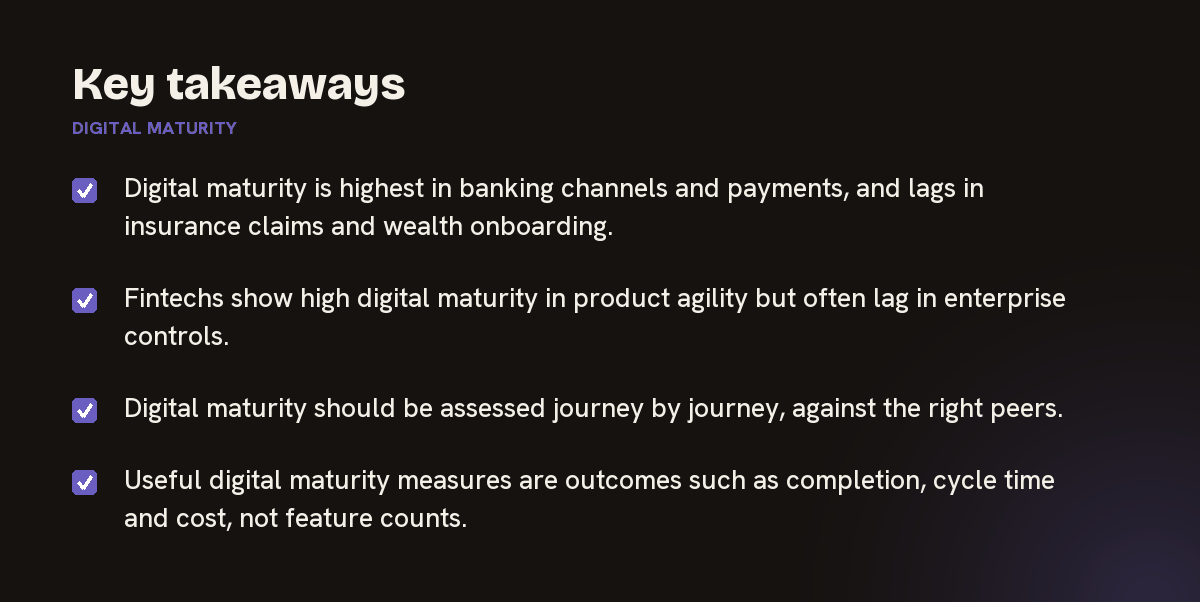
Key takeaways on digital maturity
- Digital maturity is highest in banking channels and payments, and lags in insurance claims and wealth onboarding.
- Fintechs show high digital maturity in product agility but often lag in enterprise controls.
- Digital maturity should be assessed journey by journey, against the right peers.
- Useful digital maturity measures are outcomes such as completion, cycle time and cost, not feature counts.
For leadership teams, understanding how digital maturity differs by sector and by journey is the starting point for sensible investment. It prevents copying the wrong roadmap and focuses effort where customers and economics benefit most.
Optimizium helps banks, insurers and wealth managers assess digital maturity and turn the results into priorities. We respect the operational knowledge that explains why some journeys lag, because it points to practical fixes. And we bring risk and compliance colleagues into the assessment as co-authors, so maturity includes control as well as customer features.
Explore how we approach this across Banking, Insurance, Wealth Management and Beyond Banking, browse the FAQ Hub, or read the related question: Why do digital adoption patterns differ between industries?
Related questions
Partner with the experts.
Let's discuss how Optimizium can accelerate your roadmap and navigate complex digital transformation.
Schedule a consultation →