Home › FAQ Hub › How does digital reduce cost-to-serve?
Tech & Core ModernisationHow does digital reduce cost-to-serve?
Digital reduces cost-to-serve by replacing branch, adviser, broker and call-centre interactions with self-service workflows, and by automating the processing behind them.
Every interaction a financial institution has with a customer carries a cost, and those costs add up: a branch visit, a call, a letter, a manual check in the back office. Over millions of customers and many years, those costs shape the economics of the whole business.
Digital reduces cost-to-serve by replacing branch, adviser, broker and call-centre interactions with self-service workflows, and by automating the processing behind them. Straight-through processing, digital signatures and electronic identity checks shorten everyday tasks across the customer life cycle, from onboarding to changes and renewals, while automation reduces manual exception handling and rework. The size of the benefit varies materially by sector, because some rely more heavily on human intermediaries than others: banking typically gains most, insurance a medium amount, and wealth a mixed picture, because advice remains personal even when administration is automated. Reducing cost-to-serve works best when it improves the customer’s experience at the same time.
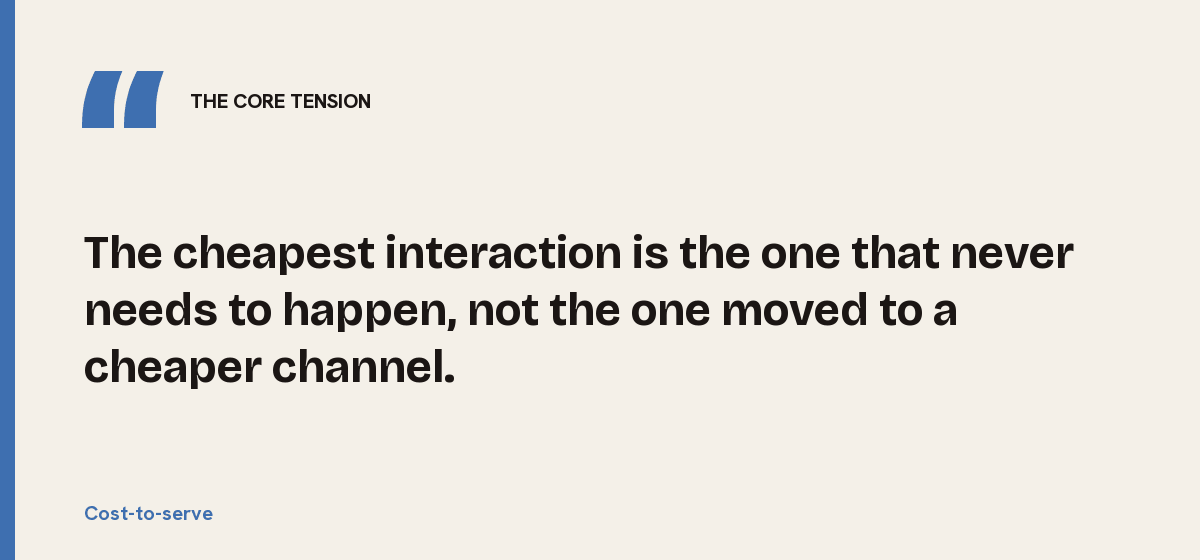
The core tension, in one line:
The cheapest interaction is the one that never needs to happen, not the one moved to a cheaper channel.
an insurer analyses why customers call its contact centre and finds that many calls are about policy documents and payment dates. It adds clear self-service access to documents and payment schedules in its app, with proactive reminders. Call volumes for those topics fall sharply, and customers get answers faster.
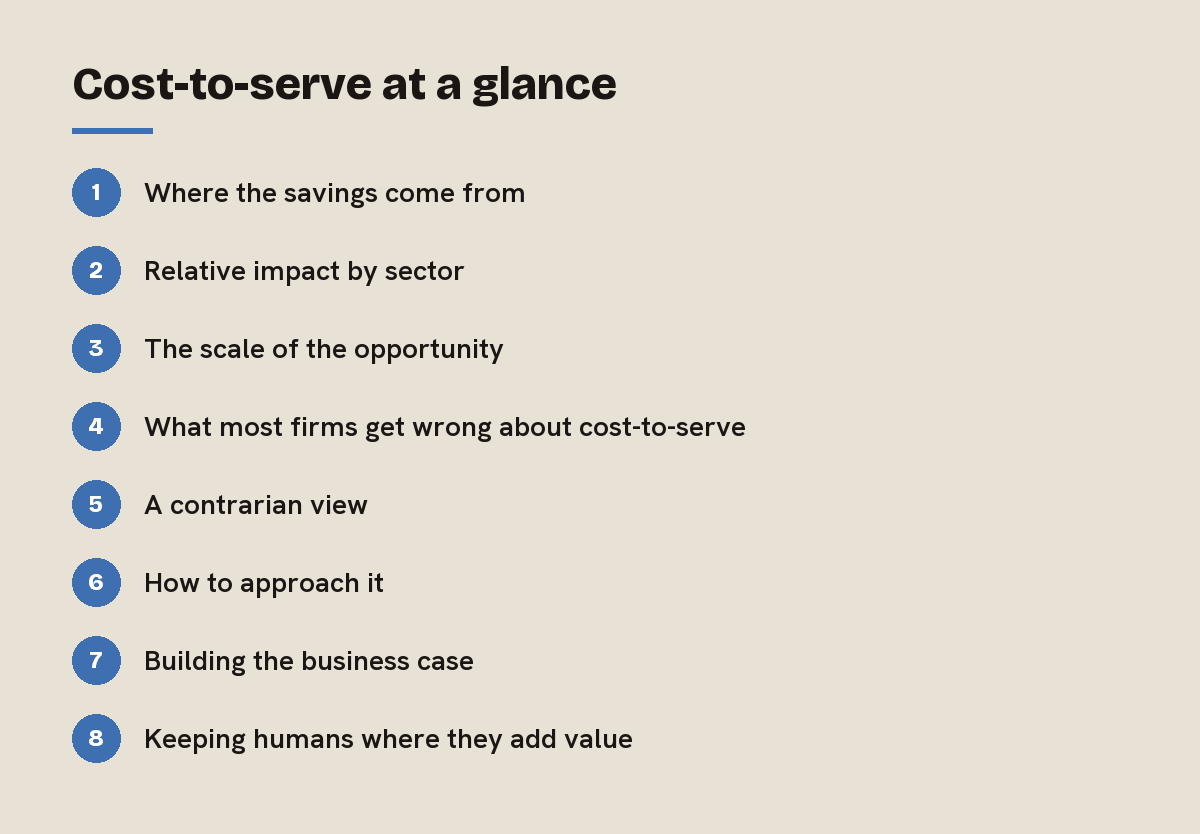
1. Where the savings come from
| Lever | What it looks like on the ground | Effect on cost-to-serve |
|---|---|---|
| Self-service | Customers make changes, download documents and track status themselves | Fewer calls and branch visits |
| Straight-through processing | Applications and changes processed without manual steps | Lower handling cost and faster outcomes |
| Digital signatures | Contracts signed electronically | No paper, post or rework |
| Electronic identity checks | KYC completed digitally | Faster onboarding, fewer manual reviews |
| Automation of exceptions | Rules and models handle common edge cases | Less rework and investigation |
| Avoiding failure demand | Clear communication prevents unnecessary contact | Fewer interactions overall |
2. Relative impact by sector
| Sector | Digital leverage on cost | Why |
|---|---|---|
| Banking | High | High volumes of standardised transactions and servicing |
| Insurance | Medium | Claims and underwriting still need expertise; intermediaries remain important |
| Wealth | Mixed | Administration automates well; advice remains personal and valued |
| Fintech | High from the start | Built digital, with low physical costs |
3. The scale of the opportunity
Customers have already moved much of their activity online. Eurostat reports that 67 per cent of people aged 16 to 74 in the EU used internet banking in 2024. Yet investment in change remains modest relative to the size of institutions: according to ECB Supervisory Board Chair Claudia Buch, banks under ECB supervision invest on average 2.8 per cent of their operating income in digital transformation projects. Institutions that target that investment at the biggest drivers of cost-to-serve see faster returns.
4. What most firms get wrong about cost-to-serve
- Moving work, not removing it: shifting a confusing process from a branch to an app moves the cost to the customer and often back to the call centre.
- Ignoring failure demand: many contacts happen because something went wrong or was unclear; fixing the cause is cheaper than handling the contact.
- Automating the happy path only: if exceptions still go to manual teams, much of the cost remains.
- Forgetting the customer: savings that damage the experience tend to return as complaints and attrition.
Example: a bank set a target to reduce contact-centre volumes and initially focused on encouraging customers to use the app. Volumes barely changed. A closer look showed that most calls were caused by unclear letters and failed payments. Rewriting letters and fixing the payment process removed a large share of calls entirely, delivering a bigger reduction in cost-to-serve than the channel shift campaign.
5. A contrarian view
Reducing cost-to-serve is often pursued by pushing customers towards digital channels. The more powerful approach is to remove the need for contact altogether by making products simpler, communication clearer and processes more reliable. Channel shift then follows naturally, because the digital journey works.
6. How to approach it
- Measure costs by journey and contact reason, not only by channel.
- Identify failure demand and fix its causes.
- Automate end to end, including common exceptions.
- Design self-service with customers, so it is used.
- Track outcomes: cost per customer, contacts per customer, satisfaction and complaints.
7. Building the business case
Savings from digital servicing are often overstated because they assume every digital interaction replaces a costly one. A more reliable case counts only contacts that disappear or move from expensive to cheaper handling, adds savings from fewer errors and faster processing, and subtracts the running cost of new platforms. Presented journey by journey, this kind of case is easier to track after launch and more credible with finance teams.
8. Keeping humans where they add value
Lower cost-to-serve does not mean removing people from every interaction. In complex claims, advice, financial difficulty and complaints, human contact often prevents larger costs later and builds loyalty. The best programmes free experienced staff from routine work so they can spend more time on these moments.
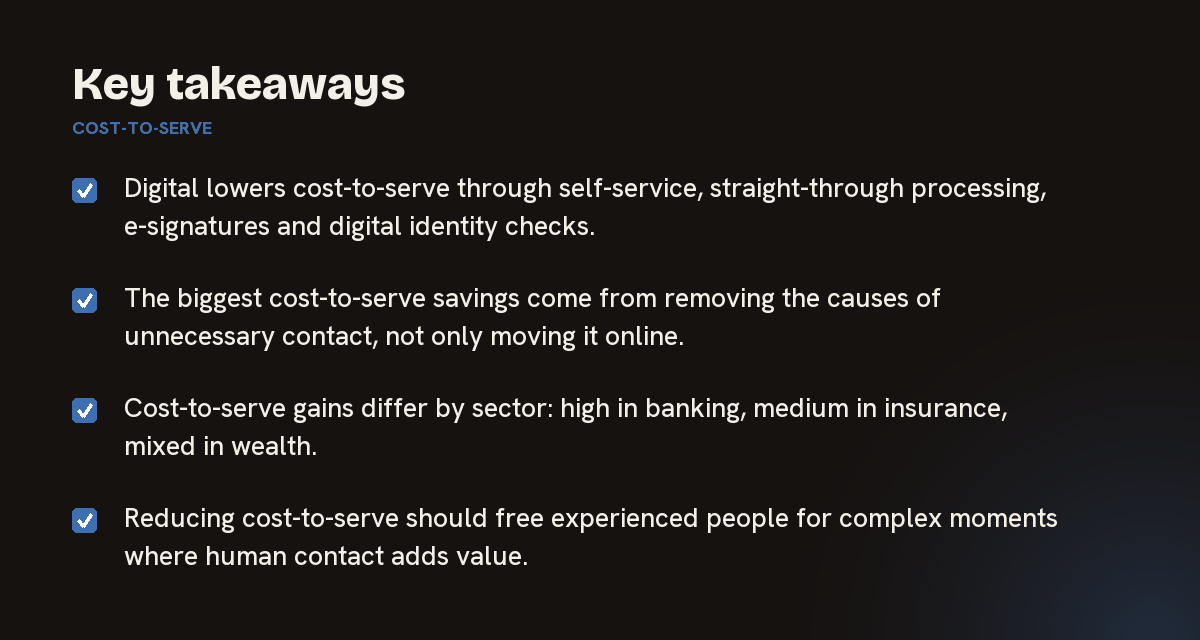
Key takeaways on cost-to-serve
- Digital lowers cost-to-serve through self-service, straight-through processing, e-signatures and digital identity checks.
- The biggest cost-to-serve savings come from removing the causes of unnecessary contact, not only moving it online.
- Cost-to-serve gains differ by sector: high in banking, medium in insurance, mixed in wealth.
- Reducing cost-to-serve should free experienced people for complex moments where human contact adds value.
For leadership teams, servicing cost is one of the clearest measures of whether digital investment is paying off. Reducing it sustainably requires redesigning products, processes and communication, not just moving interactions online.
Optimizium helps banks, insurers and wealth managers reduce cost-to-serve while improving the customer experience. We respect the operational knowledge of service teams, because they know why customers really get in touch. And we bring operations, risk and compliance colleagues into the design as co-authors, so efficiency gains are safe and lasting.
Explore how we approach this across Banking, Insurance, Wealth Management and Beyond Banking, browse the FAQ Hub, or read the related question: How are data-sharing regulations reshaping competition?
Related questions
On this page
Partner with the experts.
Let's discuss how Optimizium can accelerate your roadmap and navigate complex digital transformation.
Schedule a consultation →