Home › FAQ Hub › How does digital transformation change talent requirements?
Tech & Core ModernisationHow does digital transformation change talent requirements?
Digital transformation changes talent requirements by adding roles that financial institutions historically employed in small numbers, such as product managers, software engineers, designers, data scientists and transformation leaders, while changing what is expected of existing roles.
Financial institutions have always been talent businesses: actuaries, credit analysts, underwriters, portfolio managers. Digital transformation does not replace that expertise, but it adds a new layer of roles that most institutions were never built to attract or develop.
Digital transformation changes talent requirements by adding roles that financial institutions historically employed in small numbers, such as product managers, software engineers, designers, data scientists and transformation leaders, while changing what is expected of existing roles. Institutions built around actuarial, credit, risk and portfolio expertise must now combine that knowledge with digital delivery skills, which requires upskilling and role transitions as well as hiring. Wealth firms in particular need people who blend domain knowledge, advisory skills and digital fluency. The gaps most commonly observed are in product ownership, platform architecture, customer research, growth and analytics, and agile delivery. Meeting these talent requirements is one of the biggest determinants of whether a transformation succeeds.
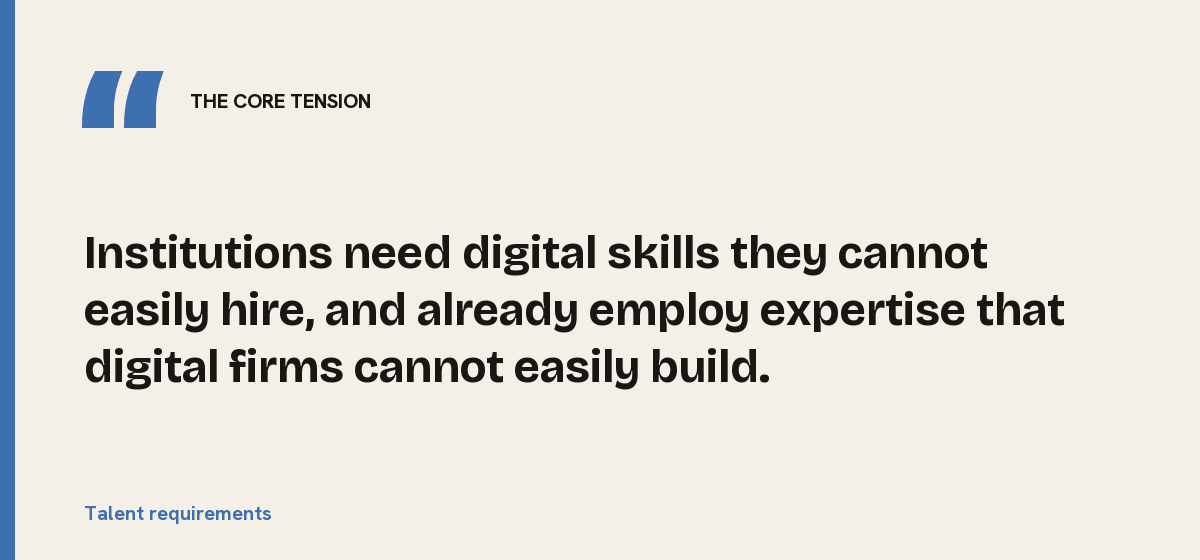
The core tension, in one line:
Institutions need digital skills they cannot easily hire, and already employ expertise that digital firms cannot easily build.
an insurer launching digital products finds that its biggest bottleneck is not technology but product ownership. It has excellent underwriters and engineers, but few people who can own a product end to end. It creates a product management track, recruits a small number of experienced product leaders and trains underwriters and operations specialists to join them.
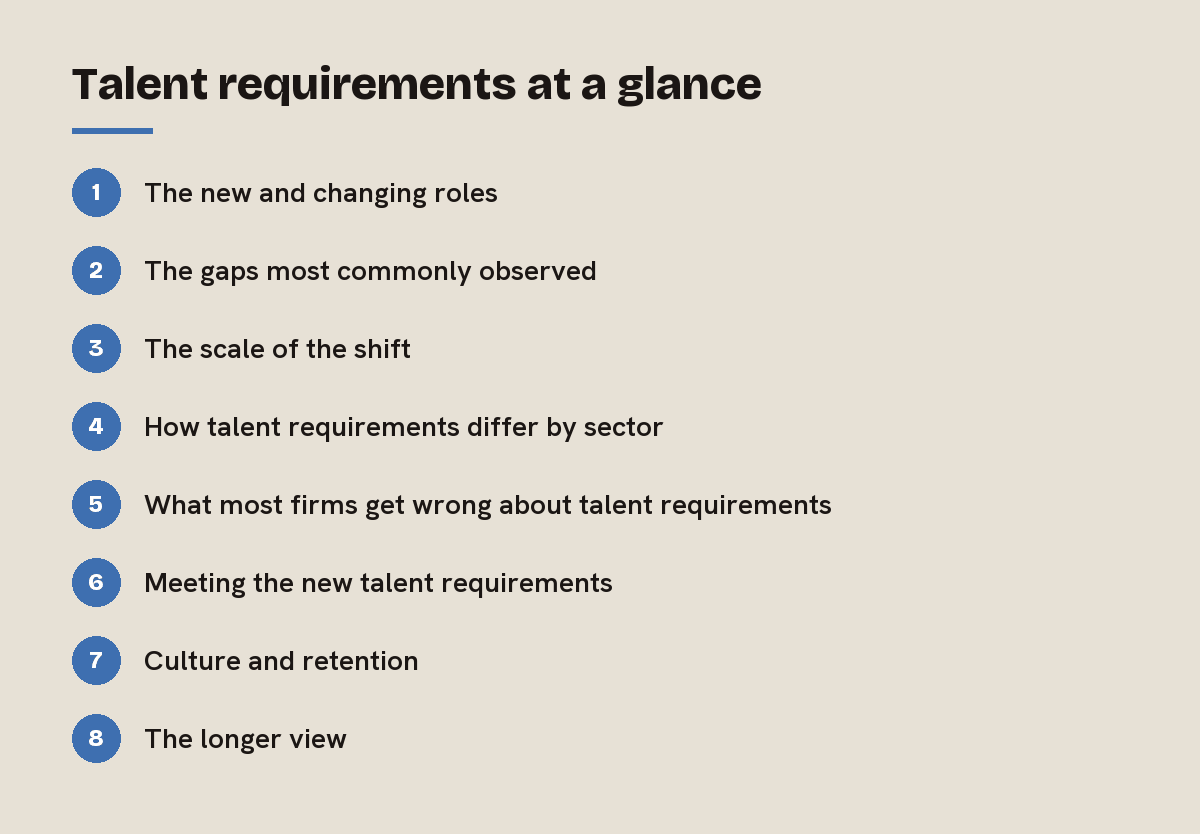
1. The new and changing roles
| Role | What it does | Traditional equivalent |
|---|---|---|
| Product manager | Owns a product or journey end to end, from need to results | Product or project manager with narrower scope |
| Software and platform engineer | Builds and runs digital services and platforms | IT developer working on vendor systems |
| Designer and researcher | Shapes experiences based on customer evidence | Often missing or outsourced |
| Data scientist and analyst | Builds models and insights from data | Actuaries, quantitative analysts, MI teams |
| Transformation leader | Leads change across functions | Programme director |
2. The gaps most commonly observed
- Product ownership: few people combine business accountability with digital delivery experience.
- Platform architecture: designing modular, cloud-based architectures alongside legacy systems.
- Customer research: turning customer evidence into product decisions.
- Growth and analytics: measuring and improving funnels, engagement and retention.
- Agile delivery: working in iterative, cross-functional teams.
3. The scale of the shift
Skills are changing quickly across the economy. The World Economic Forum’s Future of Jobs Report 2025 found that employers expect 39 per cent of workers’ core skills to change by 2030. In banking, ECB Supervisory Board Chair Claudia Buch noted that around 5 per cent of bank staff are allocated to digital transformation, and institutions report difficulty recruiting technology talent. The supply of digital talent is not keeping pace with demand.
4. How talent requirements differ by sector
| Sector | Distinctive talent need |
|---|---|
| Banking | Product managers and engineers for high-volume digital journeys; data science for credit and fraud |
| Insurance | Digital underwriting and claims expertise; data skills combined with actuarial knowledge |
| Wealth | Hybrid profiles combining advisory skills, investment knowledge and digital fluency |
| Fintech | Senior risk, compliance and regulatory expertise as they scale |
Interestingly, fintechs face the mirror image of incumbents’ challenge: they have digital skills in abundance but often need the risk, compliance and domain expertise that established institutions have.
5. What most firms get wrong about talent requirements
- Hiring only externally: expensive, slow and often culturally difficult; external hires lack institutional knowledge.
- Training without new roles: people who complete digital training but return to unchanged jobs soon lose the skills.
- Ignoring leadership capability: leaders who have never worked in digital teams struggle to manage them.
- Treating talent as an HR workstream: talent requirements should be planned alongside the target operating model and delivery roadmap.
Example: a wealth manager defined its future operating model and counted the roles it would need: product owners, engineers, data analysts and digital advisers. It found it could fill around half of them through internal moves with training, and recruited externally for the rest. Planning talent this way allowed it to start delivery earlier and retain experienced staff who knew the clients.
6. Meeting the new talent requirements
- Plan from the operating model: define the roles and numbers needed, by year.
- Build internal pathways: academies and certifications for product, data and engineering roles.
- Hire selectively: bring in experienced leaders who can develop others.
- Create mixed teams: combine domain experts with digital specialists.
- Develop leaders: help managers lead cross-functional, iterative teams.
- Measure progress: internal fill rates, time to productivity, retention.
7. Culture and retention
Attracting digital talent is only half the challenge; keeping it is the other. Digital specialists value autonomy, modern tools, clear purpose and visible impact. Institutions that give teams ownership of real products, invest in engineering practices and show how their work helps customers retain people far better than those that offer pay alone. Career paths matter too: specialists need routes to seniority that do not require them to become general managers.
8. The longer view
Talent requirements will keep moving as AI and automation change how work is done. Routine processing roles will shrink, while roles that combine judgement, domain knowledge and digital tools will grow. Institutions that build a habit of continuous learning, rather than one-off training programmes, will adapt more easily as the next wave of change arrives.
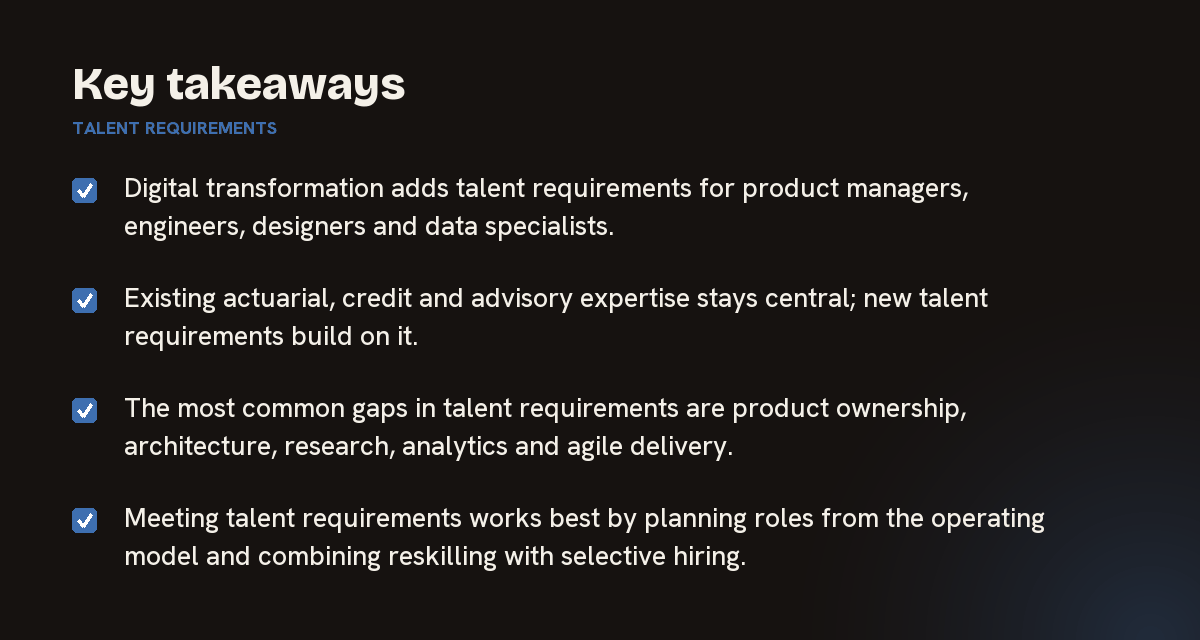
Key takeaways on talent requirements
- Digital transformation adds talent requirements for product managers, engineers, designers and data specialists.
- Existing actuarial, credit and advisory expertise stays central; new talent requirements build on it.
- The most common gaps in talent requirements are product ownership, architecture, research, analytics and agile delivery.
- Meeting talent requirements works best by planning roles from the operating model and combining reskilling with selective hiring.
For leadership teams, talent requirements deserve the same rigour as technology and financial planning. The institutions that transform successfully are those that know which skills they need, where they will come from and how they will be combined with the expertise they already have.
Optimizium helps banks, insurers and wealth managers define and meet the talent requirements of their transformation. We respect the actuarial, credit, risk and advisory expertise institutions have built, because it remains their core strength. And we bring HR, risk and business leaders into the design as co-authors, so new roles fit the organisation and its controls.
Explore how we approach this across Banking, Insurance, Wealth Management and Beyond Banking, browse the FAQ Hub, or read the related question: Which digital KPIs matter most for wealth managers?
On this page
Partner with the experts.
Let's discuss how Optimizium can accelerate your roadmap and navigate complex digital transformation.
Schedule a consultation →