Home › FAQ Hub › How does distribution conflict inhibit digital transformation?
Digital Ops & Customer ExperienceHow does distribution conflict inhibit digital transformation?
Distribution conflict, often called channel conflict, arises when digital self-service channels threaten the revenue or profit pools of the people and partners who distribute an institution's products: brokers, bankers, advisers and agents.
Many digital programmes in financial services stall for reasons that have little to do with technology. The new journey works; customers like it; and yet adoption stays low, because the people who sell the institution’s products have good reasons not to promote it.
Distribution conflict, often called channel conflict, arises when digital self-service channels threaten the revenue or profit pools of the people and partners who distribute an institution’s products: brokers, bankers, advisers and agents. It inhibits digital transformation because those channels often control customer relationships and a large share of sales, and they respond rationally to protect their income. The pattern differs by sector: in wealth, advisers defend fee models against robo-advice and direct brokerage; in insurance, broker commissions slow direct digital adoption; in banking, branch networks resist the migration of credit to digital channels. Mitigations exist, including segmented incentives, tiered compensation and hybrid fulfilment, but they require deliberate design.
The core tension, in one line:
The channels that built the business are often the ones with most to lose from its digital future.
an insurer launches a direct online channel for home insurance at lower prices than through brokers. Brokers, who write most of the insurer’s commercial business, threaten to move that business elsewhere. The insurer redesigns the proposition so brokers can use the same digital journey for their clients and earn a reduced but fair commission, and the conflict eases.
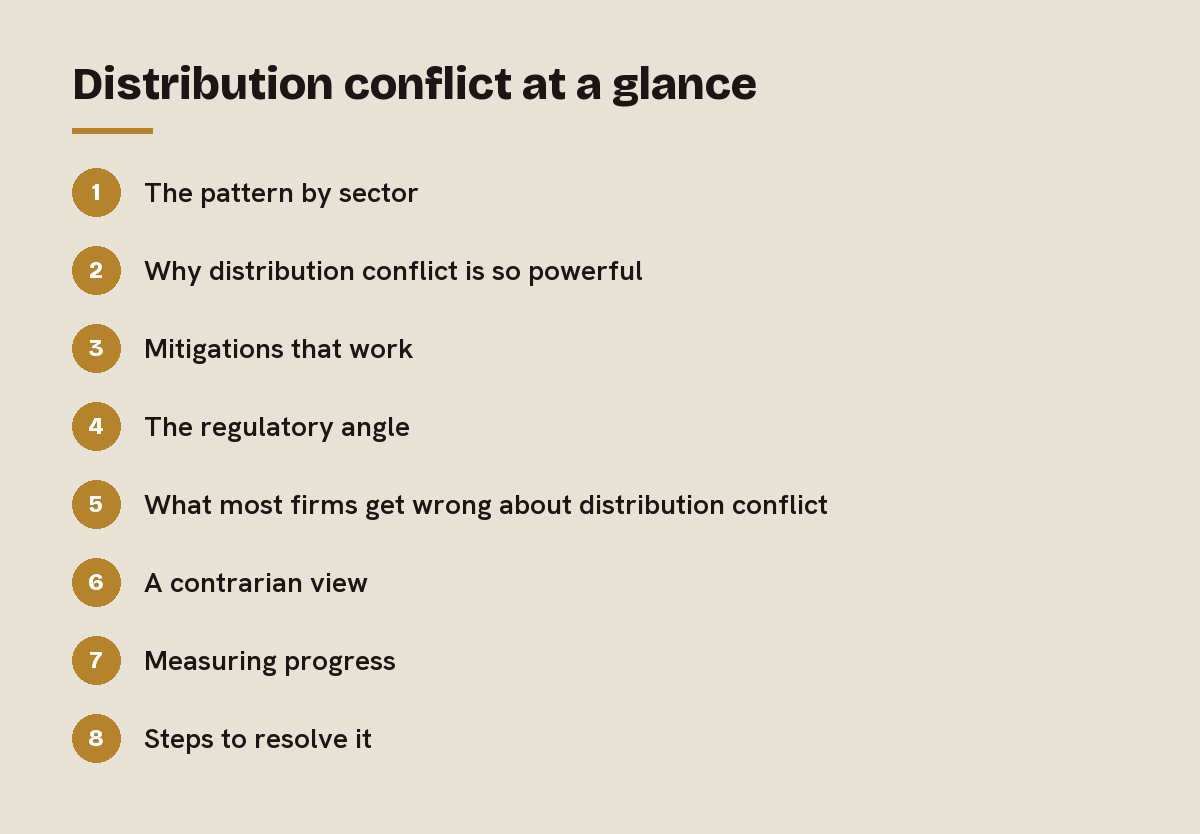
1. The pattern by sector
| Sector | Who feels threatened | What they defend | Typical effect on digital |
|---|---|---|---|
| Wealth | Advisers | Advice fees and client relationships | Slow adoption of robo-advice and direct brokerage |
| Insurance | Brokers and agents | Commissions | Direct digital channels kept small or hidden |
| Banking | Branch networks | Branch targets and roles | Credit applications steered to the branch |
| Fintech partnerships | Existing intermediaries | Customer ownership | Resistance to embedded partners |
2. Why distribution conflict is so powerful
- Channels control relationships: in many lines, brokers and advisers own the customer contact and can move business to competitors.
- Incentives are explicit: commissions, bonuses and targets make the financial impact of digital immediately visible.
- Digital economics differ: lower prices in direct channels can undercut intermediaries selling the same product.
- Status and identity: for many advisers and branch staff, the relationship is part of their professional identity, not just their income.
The market data shows why insurers in particular tread carefully. EIOPA found that digital-only distribution channels still lag well behind physical or hybrid ones, especially for life insurance, where consumers prefer in-person meetings. Intermediaries remain essential, so alienating them is costly.
3. Mitigations that work
| Mitigation | What it looks like on the ground |
|---|---|
| Segmented incentives | Different channels focus on different customers or products, with targets to match |
| Tiered compensation | Intermediaries earn for digital business from their clients, at an appropriate rate |
| Hybrid fulfilment | Customers start digitally and finish with an adviser or broker, or the reverse |
| Shared tools | Intermediaries use the same digital journeys as direct customers |
| Clear channel roles | Simple needs served digitally; complex needs served by people |
4. The regulatory angle
Distribution conflict is not only commercial. Rules on how products are sold apply to every channel. The Insurance Distribution Directive requires distributors to specify customers’ demands and needs and sets conduct standards that apply whether a policy is sold by a broker or online. Designing digital channels that meet these obligations makes it easier to share journeys with intermediaries, because the controls travel with the journey.
5. What most firms get wrong about distribution conflict
- Pretending it does not exist: launching direct channels quietly and hoping intermediaries will not notice rarely works.
- Competing on price alone: undercutting intermediaries with cheaper direct offers invites retaliation.
- Leaving incentives unchanged: asking channels to promote digital while paying them only for non-digital sales guarantees resistance.
- Excluding channels from design: brokers, advisers and branch staff know where digital journeys fail; ignoring them wastes that knowledge.
Example: a wealth manager launched a digital investment service and saw little uptake among existing clients, because advisers feared losing fees. It changed the model so advisers could offer the digital service to smaller clients and family members, credited to their book, while focusing their time on complex planning. Adoption rose and adviser productivity improved.
6. A contrarian view
Distribution conflict is often treated as resistance to be overcome. A more useful view is that it is information: it shows exactly where the institution’s economics and incentives are misaligned with its strategy. Firms that use it to redesign roles and rewards often end up with a stronger distribution model than those that simply push digital harder.
7. Measuring progress
A few indicators show whether distribution conflict is easing: the share of intermediated customers using digital tools, digital business credited to channel teams, broker and adviser satisfaction with the institution’s platforms, and retention of intermediated business. Tracking these alongside direct digital sales prevents leadership from celebrating growth in one channel that is quietly costing more in another.
8. Steps to resolve it
- Map revenue by channel and product, and where digital will change it.
- Decide channel roles explicitly, by customer segment and need.
- Redesign incentives so channels benefit from digital adoption by their customers.
- Offer shared digital tools to intermediaries.
- Communicate early and openly with channels about the plan.
Key takeaways on distribution conflict
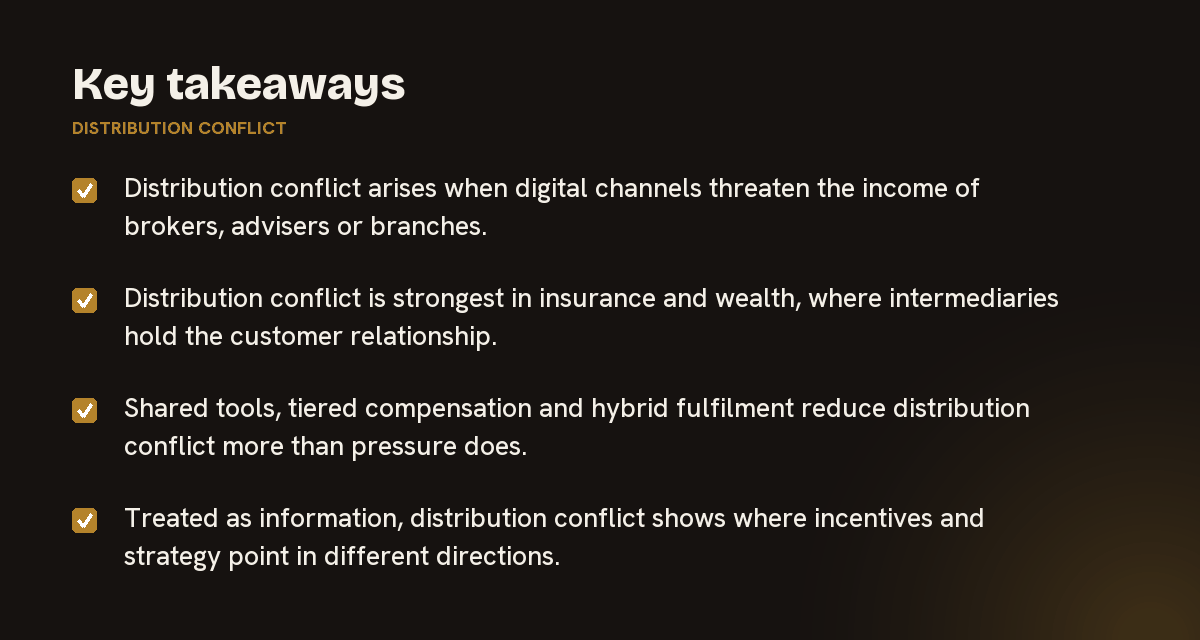
- Distribution conflict arises when digital channels threaten the income of brokers, advisers or branches.
- Distribution conflict is strongest in insurance and wealth, where intermediaries hold the customer relationship.
- Shared tools, tiered compensation and hybrid fulfilment reduce distribution conflict more than pressure does.
- Treated as information, distribution conflict shows where incentives and strategy point in different directions.
For leadership teams, distribution conflict is one of the most important and least discussed constraints on digital transformation. Addressing it openly, with fair incentives and clear channel roles, turns potential opponents into partners who bring their customers with them.
Optimizium helps banks, insurers and wealth managers design channel strategies and incentive models that resolve distribution conflict. We respect the relationships that brokers, advisers and branch teams have built, because they remain among an institution’s most valuable assets. And we bring distribution, HR, risk and compliance into the design as co-authors, so new models are fair, sustainable and well controlled.
Explore how we approach this across Insurance, Wealth Management, Banking and Beyond Banking, browse the FAQ Hub, or read the related question: How are compensation and incentives impacted by digital transformation?
Related questions
On this page
Partner with the experts.
Let's discuss how Optimizium can accelerate your roadmap and navigate complex digital transformation.
Schedule a consultation →