Home › FAQ Hub › How does product complexity impact partnership scope?
Strategy & PositioningHow does product complexity impact partnership scope?
Product complexity determines partnership scope because products that involve advice, underwriting, suitability or actuarial judgement need hybrid models that bring in advisers, brokers or specialists, while simple transactional products can be distributed fully digitally or embedded in a partner's journey.
Partnerships are one of the fastest ways for financial institutions to reach new customers: retailers, platforms, employers and software providers all want to offer financial products inside their own journeys. Not every product can travel that way.
Product complexity determines partnership scope because products that involve advice, underwriting, suitability or actuarial judgement need hybrid models that bring in advisers, brokers or specialists, while simple transactional products can be distributed fully digitally or embedded in a partner’s journey. The more complex the product, the more the regulated institution must control within the partnership, and the narrower the set of partners that can carry it.
Branch, adviser and broker channels remain essential for suitability-driven products; direct digital is efficient for transactional ones; embedded finance works best for modular products triggered by an event, such as a purchase or a trip. Matching product complexity to the right partnership model is one of the most important distribution decisions an institution makes.
The core tension, in one line:
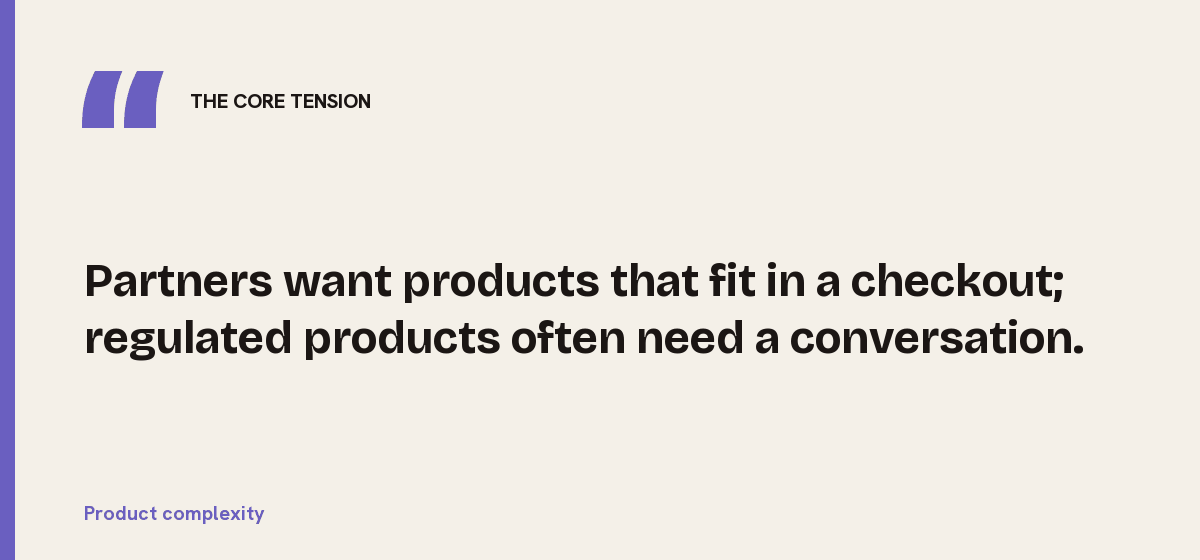
Partners want products that fit in a checkout; regulated products often need a conversation.
an electronics retailer wants to offer both instalment credit and gadget insurance at checkout. The bank and insurer agree quickly on simple, standardised products that can be explained in two screens. When the retailer asks to add income protection, the insurer declines: it needs a demands-and-needs assessment that the checkout cannot support well.
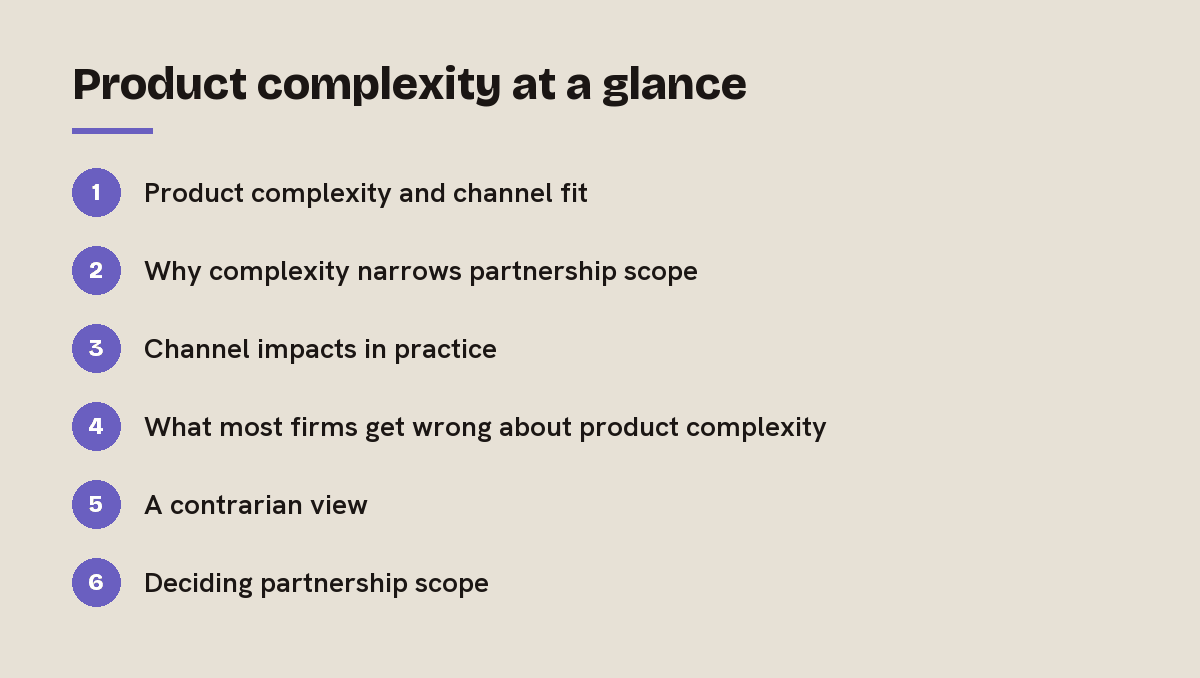
1. Product complexity and channel fit
| Product type | Examples | Best channel fit | Partnership scope |
|---|---|---|---|
| Transactional | Payments, simple savings, instant credit | Direct digital, embedded | Broad: many partners, light integration |
| Modular, event-triggered | Travel cover, gadget insurance, point-of-sale credit | Embedded finance | Broad, with standard products and clear rules |
| Moderately complex | Mortgages, motor and home insurance | Digital with broker or adviser support | Selective: partners with assisted journeys |
| Advice-led | Pensions, investments, protection | Advisers, brokers, hybrid advice | Narrow: regulated advisers and specialist platforms |
2. Why complexity narrows partnership scope
- Suitability and advice: investment and insurance-based investment products are subject to suitability rules. ESMA’s guidelines on the MiFID II suitability requirements set out what must be gathered and assessed, which few non-financial partners can do.
- Demands and needs: under the Insurance Distribution Directive, insurance distributors must specify the customer’s demands and needs, and explain packages clearly when insurance is sold together with other products.
- Underwriting: products that need individual risk assessment depend on data and judgement that partners rarely hold.
- Accountability: the regulated firm remains responsible for conduct outcomes, however the product is distributed.
3. Channel impacts in practice
- Branch, adviser and broker: needed for suitability-driven products, where customers benefit from a conversation and firms need evidenced recommendations.
- Direct digital: efficient for transactional products, where speed and clarity matter most.
- Embedded finance: effective for modular, event-triggered products that can be offered at the moment of need with a simple decision.
| Partnership model | What the institution controls | What the partner controls |
|---|---|---|
| Referral | Whole journey and decision | Introduction only |
| Assisted | Decision, advice, documentation | Customer contact, part of the journey |
| Embedded | Product, decision, compliance logic | Journey, brand, moment of need |
| White label | Product manufacturing and risk | Brand, distribution, customer relationship |
4. What most firms get wrong about product complexity
- Forcing complex products into embedded journeys: squeezing an advice-led product into a checkout creates conduct risk and poor outcomes.
- Underestimating simplification: many products can be redesigned into simpler variants suitable for partners, while the full product stays with advisers.
- Neglecting oversight: partners that perform important functions need proper governance. The EBA’s guidelines on outsourcing arrangements require institutions to identify critical or important functions and manage them accordingly.
- Treating all partners alike: a regulated broker and a retail platform need very different contracts, controls and integrations.
Example: an insurer wanted to grow protection sales through partners. It split the proposition in two: a simple, guaranteed-acceptance product with limited cover for embedded distribution through employers and banks, and the full underwritten product for advisers and brokers. Partnership volumes grew quickly, and advisers welcomed the simple product as a way to start conversations.
5. A contrarian view
It is often said that complex products cannot be sold digitally. The more accurate statement is that complex products cannot be sold well without the right support at the right moment. Hybrid journeys, in which customers start digitally and an adviser or specialist joins where judgement is needed, can make complex products far more accessible. Product complexity limits partnership scope; it does not have to limit digital ambition.
6. Deciding partnership scope
A simple scoring exercise helps. Rate each product on advice need, underwriting intensity, disclosure burden and post-sale servicing, then compare the scores with what each type of partner can support. The result is a clear map of which products can go where, and which need simplifying before they can travel.
- Classify products by complexity, advice need and underwriting intensity.
- Map partner capabilities against those requirements.
- Simplify where possible to create partner-ready variants.
- Design control frameworks for each partnership model.
- Monitor outcomes by partner, not just volume.
Key takeaways on product complexity
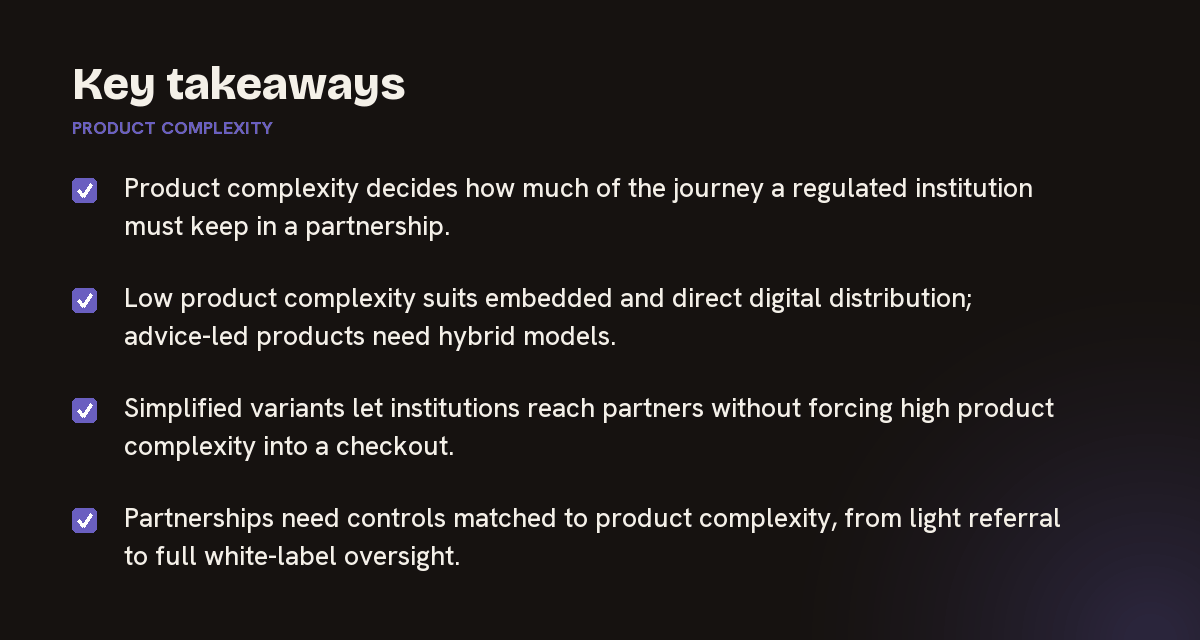
- Product complexity decides how much of the journey a regulated institution must keep in a partnership.
- Low product complexity suits embedded and direct digital distribution; advice-led products need hybrid models.
- Simplified variants let institutions reach partners without forcing high product complexity into a checkout.
- Partnerships need controls matched to product complexity, from light referral to full white-label oversight.
For leadership teams, aligning product complexity with partnership models turns partnerships from scattered deals into a coherent distribution strategy. The right products reach the right partners, conduct risks stay manageable, and the institution keeps control where it matters most.
Optimizium helps banks, insurers and wealth managers design partnership strategies grounded in product complexity. We respect the underwriting and advice expertise that complex products rely on, because it is what makes them valuable. And we bring risk, compliance and legal teams into partnership design as co-authors, so growth through partners is sound from the first contract.
Explore how we approach this across Beyond Banking, Banking, Insurance and Wealth Management, browse the FAQ Hub, or read the related question: How does digital impact actuarial and underwriting functions?
Related questions
Partner with the experts.
Let's discuss how Optimizium can accelerate your roadmap and navigate complex digital transformation.
Schedule a consultation →