Home › FAQ Hub › How does transformation affect labor models and workforce composition?
Leadership, Change & Operating ModelsHow does transformation affect labor models and workforce composition?
Transformation affects labour models and workforce composition in two directions at once. Back-office automation and cloud adoption reduce the amount of manual processing, so roles built around data entry, checking and reconciliation shrink or change.
When financial institutions talk about transformation, the conversation usually turns to technology and customers. Yet the deepest change is often in who works for the institution, what they do all day and how their work is organised.
Transformation affects labour models and workforce composition in two directions at once. Back-office automation and cloud adoption reduce the amount of manual processing, so roles built around data entry, checking and reconciliation shrink or change. At the same time, digital growth increases demand for product managers, designers, engineers and analysts.
In wealth and insurance, new hybrid adviser roles emerge that combine personal guidance with digital tools. The observed shifts are consistent: operations move from processing to automation and exception management, branches move to universal banker models, advisers and brokers move to hybrid digital advice, and IT moves from maintaining systems to building platforms, APIs and cloud services. Managing this shift fairly and deliberately is one of the hardest parts of transformation.
The core tension, in one line:
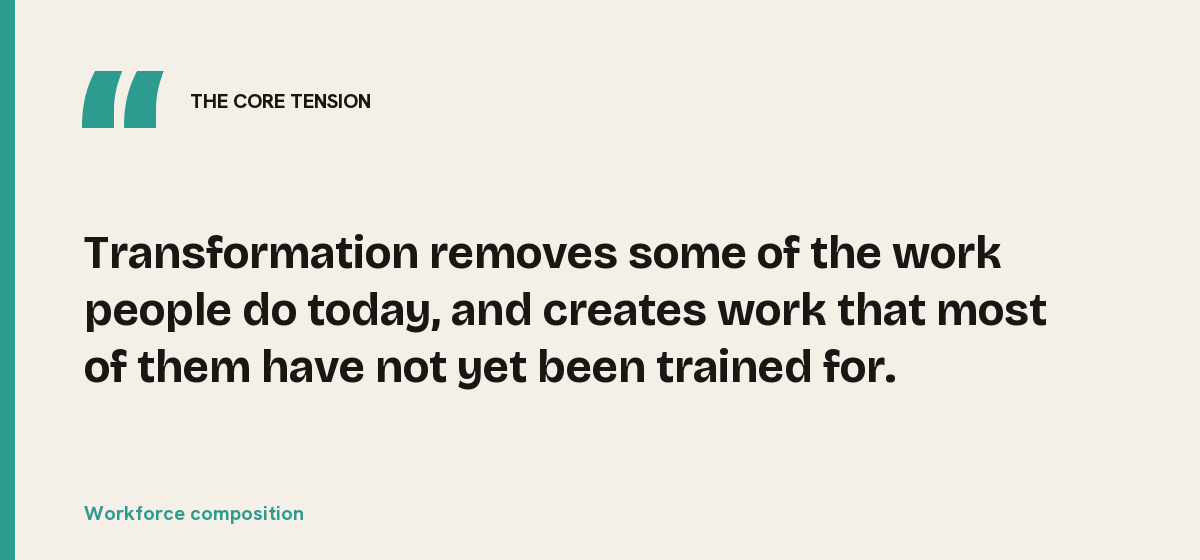
Transformation removes some of the work people do today, and creates work that most of them have not yet been trained for.
a bank automates most routine account maintenance. Rather than simply reducing headcount, it retrains part of its operations team to handle complex exceptions and vulnerable customers, and moves others into data quality and process improvement roles. Service quality improves and much of the institutional knowledge stays in the bank.
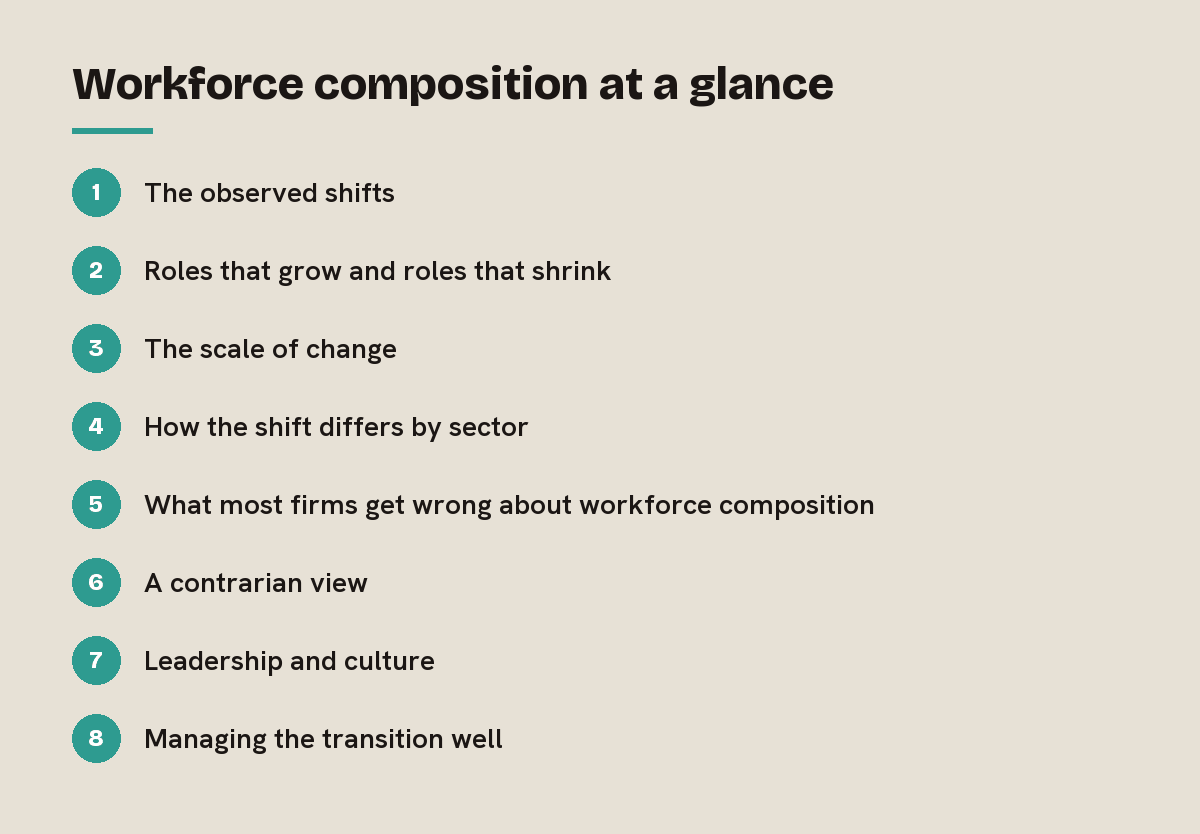
1. The observed shifts
| From | To | What it looks like on the ground |
|---|---|---|
| Operations processing | Automation and exception management | Fewer people keying data, more handling complex cases and improving processes |
| Branch transactions | Universal banker models | Staff who handle advice, problem-solving and sales across products |
| Adviser and broker sales | Hybrid digital advice | Advisers using digital tools to serve more clients and complex needs |
| IT maintenance | Platform, API and cloud skills | Engineers building reusable services rather than maintaining vendor systems |
2. Roles that grow and roles that shrink
| Growing | Changing | Shrinking |
|---|---|---|
| Product managers, designers, engineers | Advisers, underwriters, relationship managers | Manual data entry and checking |
| Data scientists and analysts | Operations specialists | Routine branch transactions |
| Cyber and resilience specialists | Compliance and risk professionals | Paper-based processing |
3. The scale of change
Across the economy, the World Economic Forum’s Future of Jobs Report 2025 found that employers expect 39 per cent of workers’ core skills to change by 2030, and that 50 per cent of the workforce has completed training as part of long-term learning strategies, up from 41 per cent in 2023. In banking, ECB Supervisory Board Chair Claudia Buch noted that around 5 per cent of bank staff are allocated to digital transformation initiatives, and that institutions report difficulty recruiting technology talent. The workforce composition of the future has to be built largely from the workforce of today.
4. How the shift differs by sector
- Banking: branch networks shrink and change role, operations automate, and digital product teams grow.
- Insurance: underwriting and claims become more data-driven, with specialists focusing on complex risks and cases.
- Wealth: advisers adopt hybrid models, serving more clients with digital support and focusing on planning and relationships.
- Fintech: lean, technology-heavy teams add risk, compliance and customer service capacity as they scale.
5. What most firms get wrong about workforce composition
- Treating it as a cost exercise only: cutting roles without building new capabilities leaves the institution unable to deliver its strategy.
- Planning too late: workforce plans written after technology decisions leave little time to retrain people.
- Ignoring knowledge loss: experienced staff hold product, process and customer knowledge that automation cannot replace.
- Underestimating change support: people moving into new roles need training, coaching and time.
Example: an insurer planned to automate a large share of its claims processing. Early in the programme, it mapped every affected role, identified those suitable for retraining as claims specialists, data analysts or customer advocates, and started training before automation went live. When the new system launched, most affected colleagues moved into new roles, and the insurer avoided both a skills gap and the loss of experienced staff.
6. A contrarian view
Automation is often described as replacing people. In financial services, it more often changes the mix: fewer people doing routine work, more people doing work that requires judgement, empathy and expertise. Institutions that plan their workforce composition around that change, rather than around headcount targets, tend to end up with better service and stronger capabilities.
7. Leadership and culture
Managers play a decisive role in shaping future workforce composition. Those who understand where their teams are heading can identify talent for new roles, support people through change and model new ways of working. Investing in managers first, before broader reskilling, tends to make the whole transition smoother and builds trust that the institution intends to develop its people rather than replace them.
8. Managing the transition well
- Plan workforce composition alongside the operating model, year by year.
- Identify roles at risk early and offer clear pathways to new roles.
- Invest in reskilling through academies and on-the-job learning.
- Preserve critical knowledge by involving experienced staff in designing new processes.
- Communicate openly about what will change and why.
- Measure progress: internal moves, skills gained, retention and service quality.
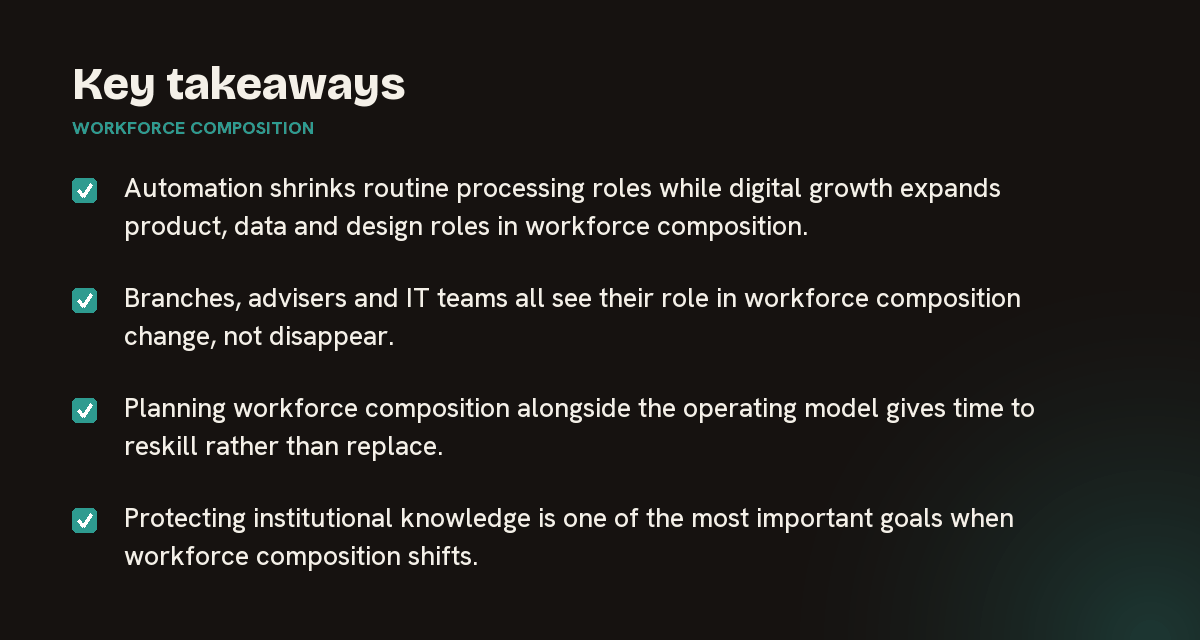
Key takeaways on workforce composition
- Automation shrinks routine processing roles while digital growth expands product, data and design roles in workforce composition.
- Branches, advisers and IT teams all see their role in workforce composition change, not disappear.
- Planning workforce composition alongside the operating model gives time to reskill rather than replace.
- Protecting institutional knowledge is one of the most important goals when workforce composition shifts.
For leadership teams, workforce composition is one of the most visible and sensitive outcomes of transformation. Handling it well protects knowledge, morale and reputation; handling it badly can undermine the whole programme.
Optimizium helps banks, insurers and wealth managers plan the workforce side of transformation alongside technology and operating model change. We respect the experience and knowledge of existing teams, because they are essential to making new ways of working succeed. And we bring HR, risk and business leaders into the design as co-authors, so the shift in workforce composition is fair, deliberate and sustainable.
Explore how we approach this across Banking, Insurance, Wealth Management and Beyond Banking, browse the FAQ Hub, or read the related question: How do platform models reshape distribution economics?
Related questions
On this page
Partner with the experts.
Let's discuss how Optimizium can accelerate your roadmap and navigate complex digital transformation.
Schedule a consultation →