Home › FAQ Hub › What differentiates digital-native from digitally-enabled models?
Strategy & PositioningWhat differentiates digital-native from digitally-enabled models?
Digital-native models are built from inception around cloud infrastructure, APIs and real-time, event-driven data, so products, operations and channels are digital by design.
Financial institutions often describe themselves as “digital” whether they were born in the cloud last year or opened their first branch a century ago. The label hides two very different ways of building and running a business.
Digital-native models are built from inception around cloud infrastructure, APIs and real-time, event-driven data, so products, operations and channels are digital by design. Digitally-enabled models belong to incumbents that retrofit digital capabilities onto legacy cores, established risk frameworks and physical networks of branches, brokers or advisers, scaling change across a large existing business. Native models tend to be modular, real-time and product-led; digitally-enabled models tend to be integrated, risk-mitigated and shaped by long regulatory experience. A third path, the hybrid, combines a platform approach with physical or adviser networks. None is automatically superior: each brings distinct strengths, constraints and economics.
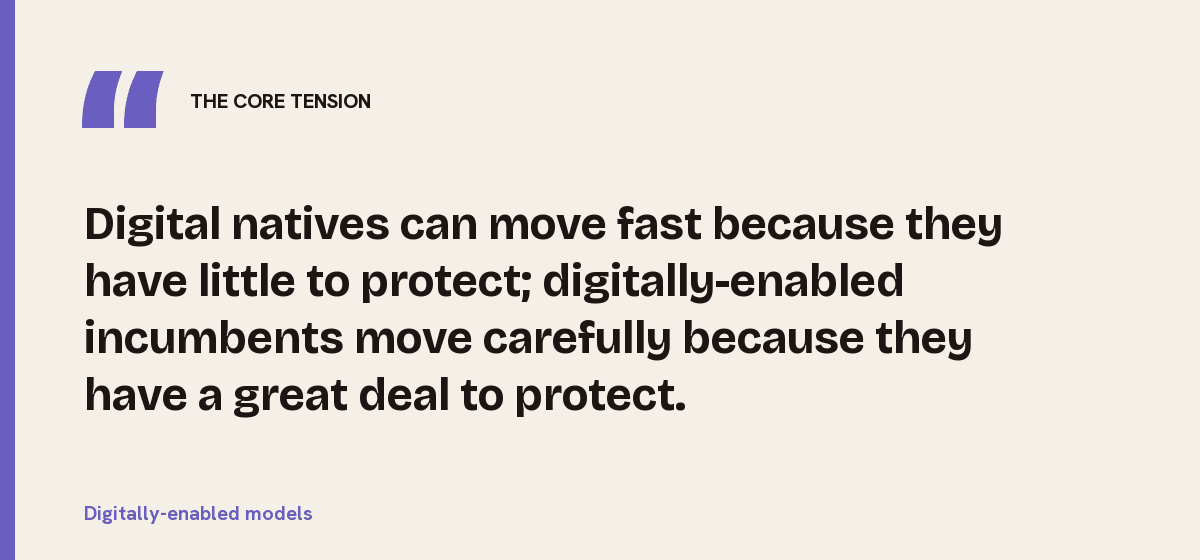
The core tension, in one line:
Digital natives can move fast because they have little to protect; digitally-enabled incumbents move carefully because they have a great deal to protect.
a challenger bank launches a savings feature in weeks, because its core, app and data platform were designed together. A long-established bank launches a similar feature in six months, because it must connect a legacy deposit system, update branch procedures and run full risk reviews across millions of existing customers.
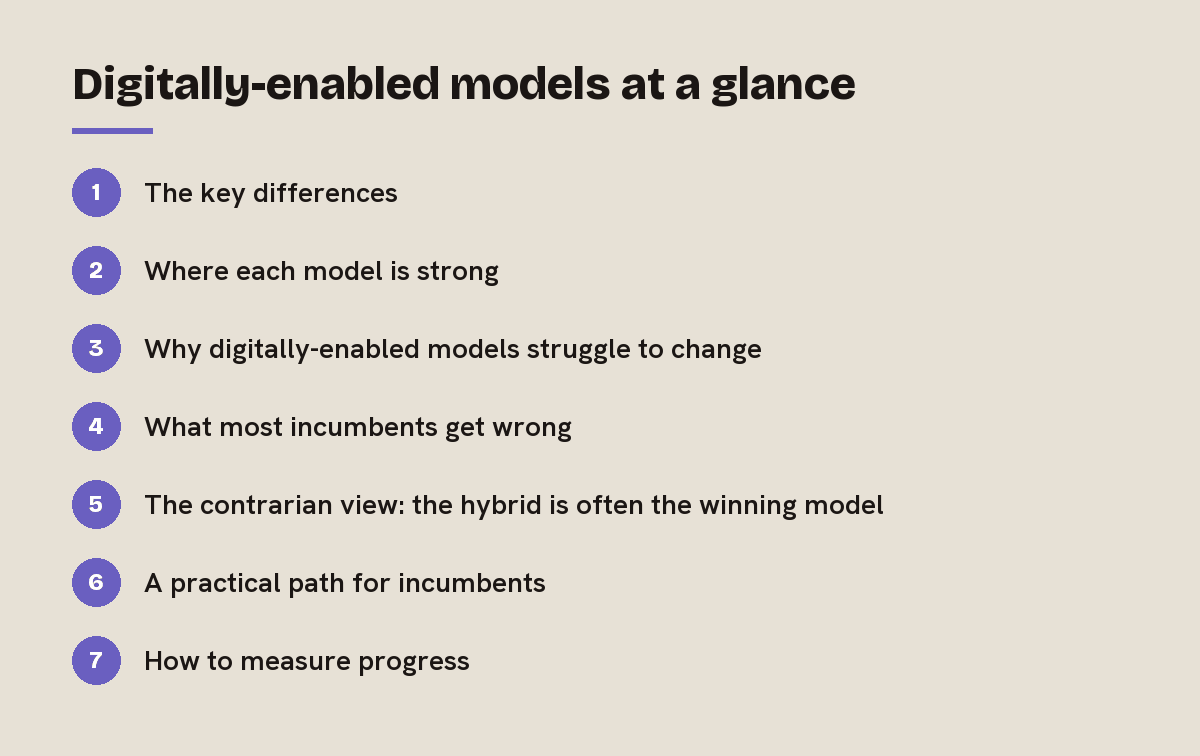
1. The key differences
| Dimension | Digital-native | Digitally-enabled | Hybrid |
|---|---|---|---|
| Architecture | Cloud, APIs, event-driven data from day one | Legacy cores with digital layers added | Modern platform plus legacy where needed |
| Operating style | Modular, real-time, product-led | Integrated, risk-mitigated, process-led | Platform teams alongside relationship channels |
| Channels | Mostly app and partners | Branches, brokers, advisers, plus digital | Digital first, with physical or adviser support |
| Risk and regulation | Building maturity as they scale | Deep experience and established controls | Mix of both |
| Scale | Smaller base, fast growth | Large base, steady change | Varies |
2. Where each model is strong
- Digital-native strengths: speed of change, lower cost-to-serve, data available in real time, and organisations designed around products rather than functions.
- Digitally-enabled strengths: large customer bases, trusted brands, balance sheets, licences, deep risk and regulatory expertise, and physical presence for moments that matter.
- Hybrid strengths: the reach and trust of established channels with the speed of a modern platform, which suits wealth management and complex insurance particularly well.
The market reflects this balance. According to the ECB, purely digital banks held a market share below 4 per cent in the euro area in 2024. Digital natives set the pace of innovation, but digitally-enabled models still serve most customers.
3. Why digitally-enabled models struggle to change
| Constraint | What it looks like on the ground |
|---|---|
| Legacy cores | Batch processing, tightly coupled systems, scarce skills |
| Physical networks | Branch and broker processes must change alongside digital ones |
| Risk frameworks | Controls built for slower, paper-based processes |
| Organisation | Functional silos rather than product teams |
| Funding | Annual project budgets rather than continuous product funding |
The track record of large change programmes is sobering. McKinsey’s research found that only 16 per cent of respondents said their digital transformations had improved performance and been sustained. Digitally-enabled models face those odds with the added weight of their legacy, which is why sequencing matters so much.
4. What most incumbents get wrong
- Trying to become a digital native overnight: copying a challenger’s structure without its architecture, culture or risk appetite rarely works.
- Bolting digital onto the front only: apps on top of unchanged processes create a digital veneer, not a digitally-enabled business.
- Ignoring their own advantages: trust, data, balance sheet and expertise are assets challengers would love to have, and they are what digitally-enabled models should build on.
- Underestimating regulators’ expectations: supervisors expect digital strategies to be executable. The ECB’s 2024 review of digitalisation practices assesses execution capabilities, governance and risk management alongside strategy.
5. The contrarian view: the hybrid is often the winning model
The debate is often framed as natives versus incumbents. In practice, many of the strongest propositions in financial services are hybrid: a modern platform combined with people where people matter, such as advice, complex claims and business banking. Incumbents can build hybrids by placing new platforms alongside legacy systems; natives increasingly add human channels as they move into more complex products. The question is less “native or enabled?” than “which parts of our model should be digital-native, and which should stay human-led?”
Example: a wealth manager created a new digital platform, built cloud-native from scratch, for clients with simpler needs, while its advisers continued to serve complex clients on the existing systems. Clients could move between the two as their needs changed. The firm gained the speed of a native model for one segment without abandoning the strengths of its digitally-enabled core business.
6. A practical path for incumbents
- Choose where to be native: new products and segments are often best built on a modern platform from the start.
- Modernise the core in waves, behind stable APIs, rather than all at once.
- Organise around products and journeys, with clear ownership.
- Fund continuously, so teams can respond to what they learn.
- Keep risk and compliance close, so speed does not outrun control.
7. How to measure progress
Incumbents can track how far they have moved with a few indicators: the share of products running on modern platforms, lead time from idea to customer, the share of journeys completed digitally end to end, and the proportion of change delivered by stable product teams rather than temporary projects. These measures show whether the institution is becoming more native where it matters, not just adding digital features.
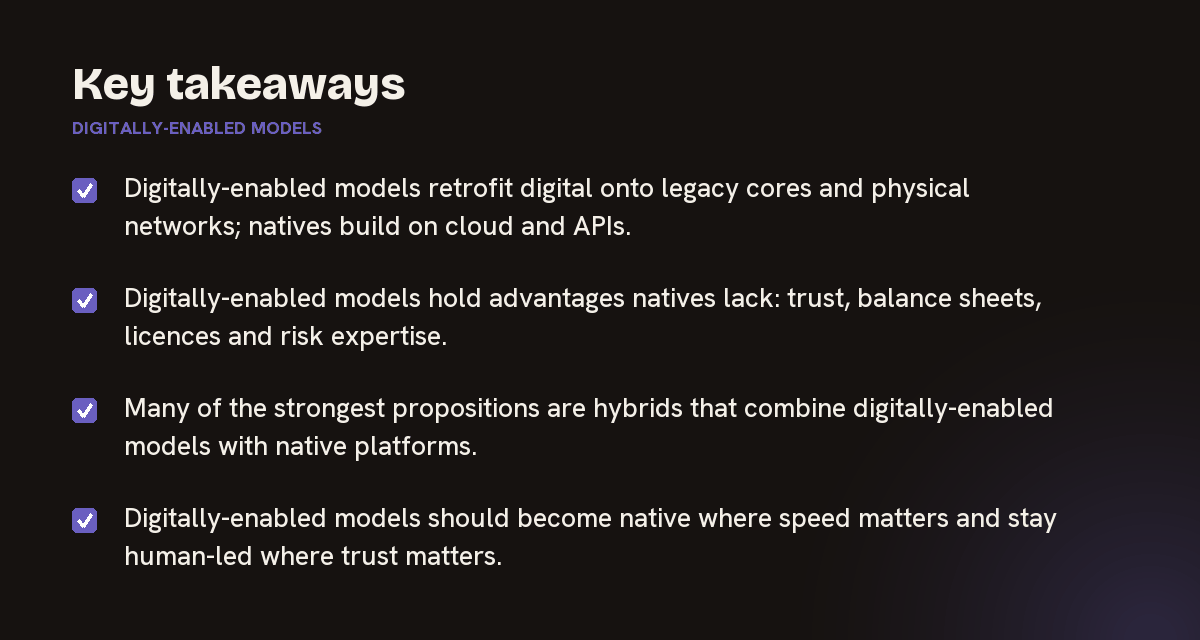
Key takeaways on digitally-enabled models
- Digitally-enabled models retrofit digital onto legacy cores and physical networks; natives build on cloud and APIs.
- Digitally-enabled models hold advantages natives lack: trust, balance sheets, licences and risk expertise.
- Many of the strongest propositions are hybrids that combine digitally-enabled models with native platforms.
- Digitally-enabled models should become native where speed matters and stay human-led where trust matters.
For leaders of established institutions, the most useful question is not how to copy a challenger, but how to combine the strengths of digitally-enabled models with native capabilities in the places where they create the most value.
Optimizium helps banks, insurers and wealth managers design that combination. We respect the knowledge, trust and controls built into digitally-enabled organisations, because they are hard-won advantages. And we bring risk, compliance and architecture into the design as co-authors, so new native capabilities strengthen the institution rather than sit beside it.
Explore how we approach this across Banking, Insurance, Wealth Management and Beyond Banking, browse the FAQ Hub, or read the related question: How do digital operating models differ between incumbents and challengers?
On this page
Partner with the experts.
Let's discuss how Optimizium can accelerate your roadmap and navigate complex digital transformation.
Schedule a consultation →