Home › FAQ Hub › What differentiates SME and corporate distribution from consumer channels?
Leadership, Change & Operating ModelsWhat differentiates SME and corporate distribution from consumer channels?
SME and corporate distribution differs from consumer channels because business clients need customised products, negotiated terms and relationship-driven service, and because onboarding involves underwriting, credit assessment, multiple decision-makers and more complex due diligence.
Many of the digital lessons financial institutions learned in consumer banking and insurance do not transfer neatly to business customers. A small company and a multinational both expect speed and convenience, but they also bring complexity that consumer journeys were never designed to handle.
SME and corporate distribution differs from consumer channels because business clients need customised products, negotiated terms and relationship-driven service, and because onboarding involves underwriting, credit assessment, multiple decision-makers and more complex due diligence. Consumer channels can scale through standardised digital onboarding and product catalogues; SME and corporate distribution must combine digital efficiency with the judgement of relationship managers and specialists. That is why hybrid models dominate, pairing relationship managers with automated workflows. The balance shifts with size: small businesses increasingly expect consumer-like digital journeys, while large corporates need bespoke solutions and dedicated teams.
The core tension, in one line:
Business clients want the speed of consumer apps and the attention of a dedicated banker at the same time.
a bank lets small businesses open accounts and apply for standard credit lines fully online, with automated checks on company registers and beneficial owners. Applications above a threshold or with unusual structures are routed to a relationship manager, who receives the case with all data already collected. Simple cases complete in a day; complex ones get expert attention without starting again.
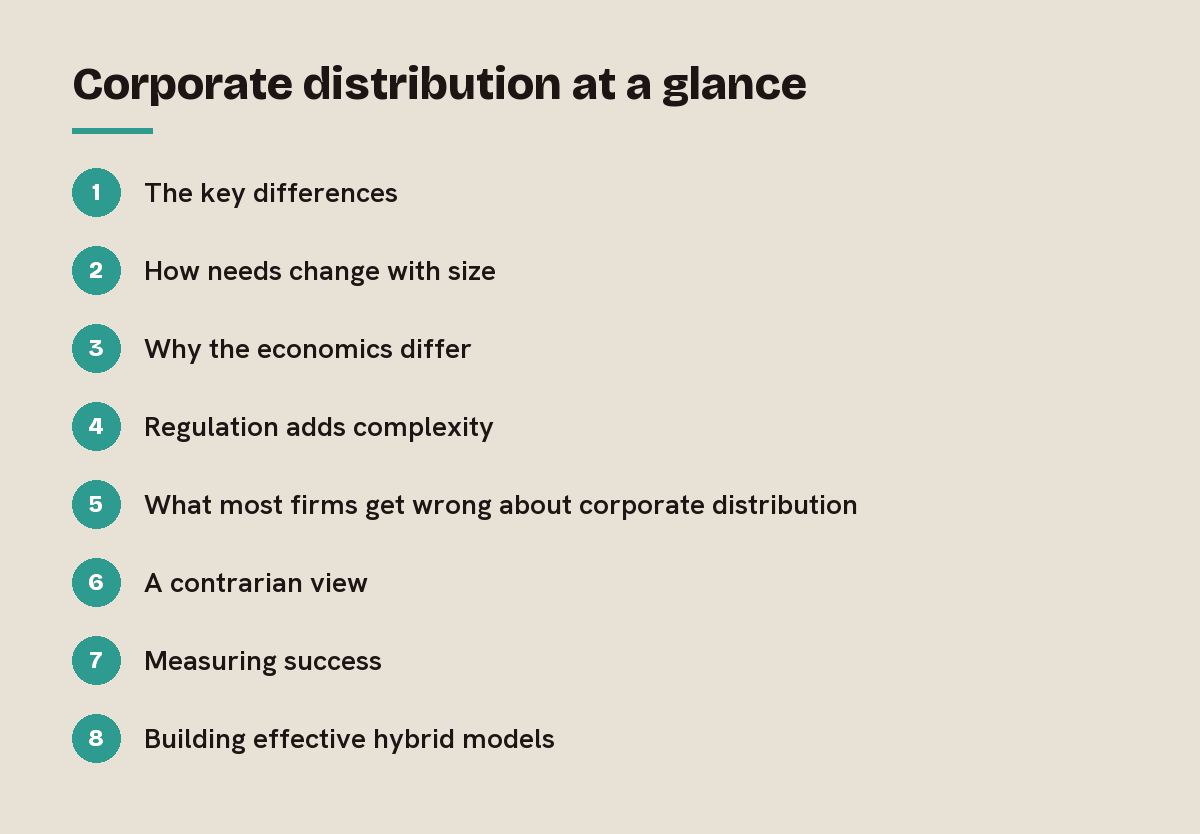
1. The key differences
| Dimension | Consumer channels | SME and corporate distribution |
|---|---|---|
| Products | Standardised | Customised, often bundled |
| Pricing | Published rates | Negotiated terms |
| Onboarding | Individual identity checks | Company, ownership and signatory checks, often several people |
| Credit | Automated scoring | Underwriting, financial analysis, covenants |
| Service | Self-service plus contact centre | Relationship managers and specialists |
| Decision-making | One person | Often several stakeholders |
2. How needs change with size
| Segment | Typical expectation | Best-fit model |
|---|---|---|
| Micro and small businesses | Fast, simple, mostly digital | Digital-first with human support |
| Medium-sized businesses | Digital efficiency plus advice | Hybrid: relationship manager with digital tools |
| Large corporates | Bespoke solutions, global coverage | Dedicated teams, integrated with client systems |
3. Why the economics differ
Financing conditions shape demand. The ECB’s survey of euro area firms for the fourth quarter of 2025 found that a net 12 per cent of firms reported higher interest rates on bank loans, with SMEs and large firms affected similarly, and that a net 28 per cent reported increases in other financing costs such as fees and charges. In that environment, business clients scrutinise terms closely, which reinforces the role of negotiated pricing and expert advice in corporate distribution.
4. Regulation adds complexity
- Due diligence: business onboarding requires checks on beneficial owners, directors and signatories. The EU’s Anti-Money Laundering Regulation, applicable from 10 July 2027, sets common customer due diligence rules across Member States.
- Digital identity: the European Digital Identity Regulation extends wallets to legal persons as well as individuals, which could simplify business onboarding over time.
- Credit and capital: lending to businesses involves prudential requirements that shape pricing and structure.
5. What most firms get wrong about corporate distribution
- Copying consumer journeys: a consumer onboarding flow cannot handle multiple owners, signatories and complex structures.
- Over-relying on relationship managers: asking bankers to handle routine administration wastes their time and slows clients.
- Ignoring small businesses: treating them like large corporates makes them expensive to serve; treating them like consumers misses their needs.
- Fragmented data: information about a business client is often spread across credit, payments and treasury systems.
Example: a bank found that its relationship managers spent much of their time collecting documents and chasing signatures for routine business account openings. It introduced a digital onboarding portal with automated registry checks and e-signatures, and gave managers a single view of each client. Managers gained time for advice and new business, and clients completed onboarding faster.
6. A contrarian view
It is often assumed that digital will gradually replace relationship managers in business banking. The more likely path is that digital replaces their administrative work and makes them more valuable for advice, structuring and problem-solving. In corporate distribution, the best digital tools are often the ones that make the banker better, not the ones that remove the banker.
7. Measuring success
Business distribution needs its own measures. Useful indicators include time from first contact to account opening and to first credit drawdown, the share of standard cases completed digitally, relationship manager time spent with clients rather than on administration, product holding per client and retention of valuable relationships. Tracked by segment, these measures show whether the hybrid model is working for small businesses and large corporates alike.
8. Building effective hybrid models
- Segment business clients by size, complexity and needs.
- Digitise onboarding and servicing for standard cases.
- Equip relationship managers with data, tools and automated workflows.
- Route complex cases to experts with full context.
- Integrate with client systems, such as accounting and treasury platforms, where valuable.
Key takeaways on corporate distribution
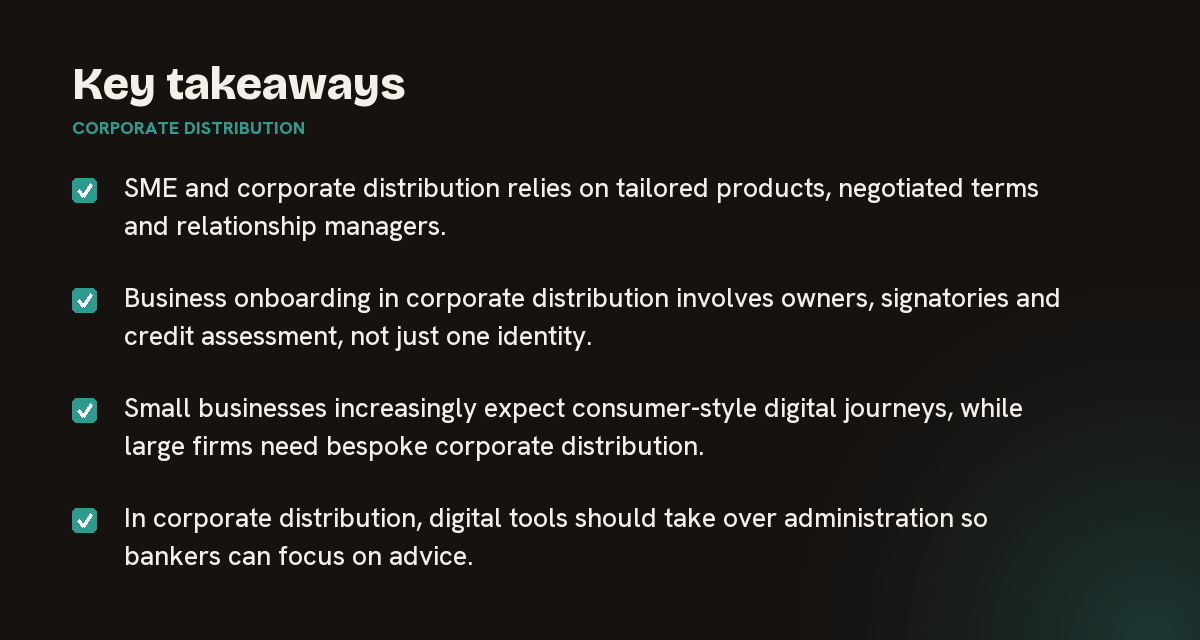
- SME and corporate distribution relies on tailored products, negotiated terms and relationship managers.
- Business onboarding in corporate distribution involves owners, signatories and credit assessment, not just one identity.
- Small businesses increasingly expect consumer-style digital journeys, while large firms need bespoke corporate distribution.
- In corporate distribution, digital tools should take over administration so bankers can focus on advice.
For leadership teams, getting SME and corporate distribution right is a significant opportunity. Business clients are valuable, loyal when well served and increasingly willing to switch when they are not. Hybrid models that combine digital efficiency with expert relationships are the most reliable way to serve them.
Optimizium helps banks and insurers design distribution models for small businesses, mid-sized firms and large corporates. We respect the expertise of relationship managers and credit specialists, because their judgement is central to business banking. And we bring risk, compliance and operations teams into the design as co-authors, so faster journeys remain safe and well controlled.
Explore how we approach this across Banking, Insurance, Beyond Banking and Wealth Management, browse the FAQ Hub, or read the related question: What is the role of cross-sell in digital distribution?
Related questions
On this page
Partner with the experts.
Let's discuss how Optimizium can accelerate your roadmap and navigate complex digital transformation.
Schedule a consultation →