Home › FAQ Hub › What distinguishes “digital trust” from “brand trust” in finance?
Digital Ops & Customer ExperienceWhat distinguishes “digital trust” from “brand trust” in finance?
Digital trust is the confidence a customer has that a digital service will work, protect them and treat them fairly each time they use it; brand trust is the confidence they place in the institution as a whole, built on safety, reputation and history.
A customer can believe their bank will never lose their savings and still refuse to use its app for anything more than checking a balance. That gap is the difference between two kinds of trust.
Digital trust is the confidence a customer has that a digital service will work, protect them and treat them fairly each time they use it; brand trust is the confidence they place in the institution as a whole, built on safety, reputation and history. Brand trust is slow to build and slow to lose. Digital trust is earned or lost every time a customer attempts a task: a payment that confirms clearly, a claim that shows its status, a consent screen that means what it says. Financial institutions often have strong brand trust and weak digital trust, which is why customers keep the account but move the activity elsewhere.
The core tension, in one line:
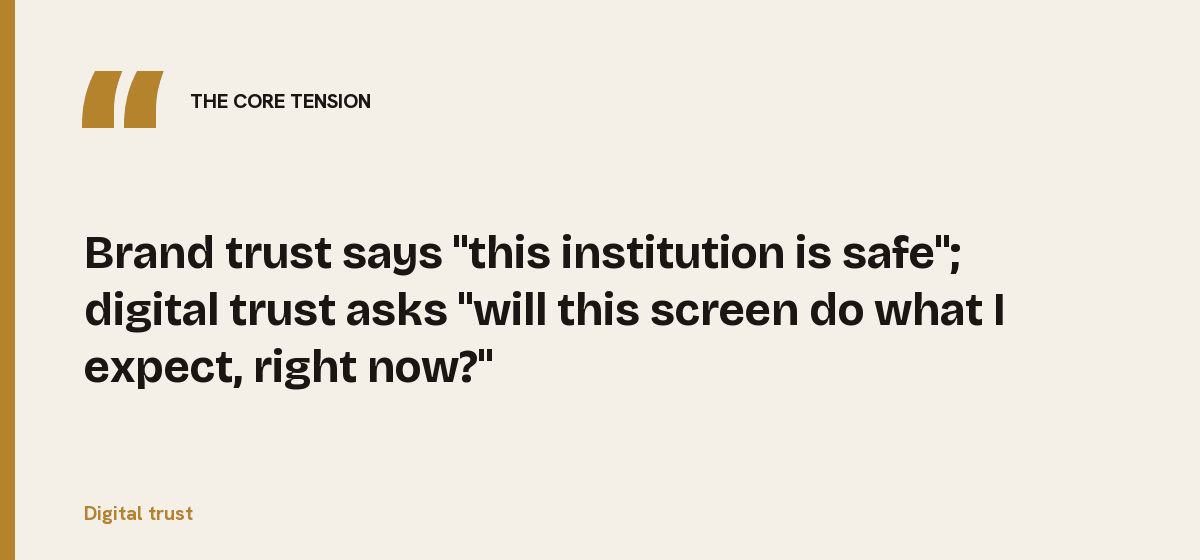
Brand trust says “this institution is safe”; digital trust asks “will this screen do what I expect, right now?”
a long-established insurer with an excellent reputation launches a claims app. The first step asks for permissions customers do not understand, and the status page says “processing” for two weeks. Customers phone the call centre instead. The brand is trusted; the app is not.
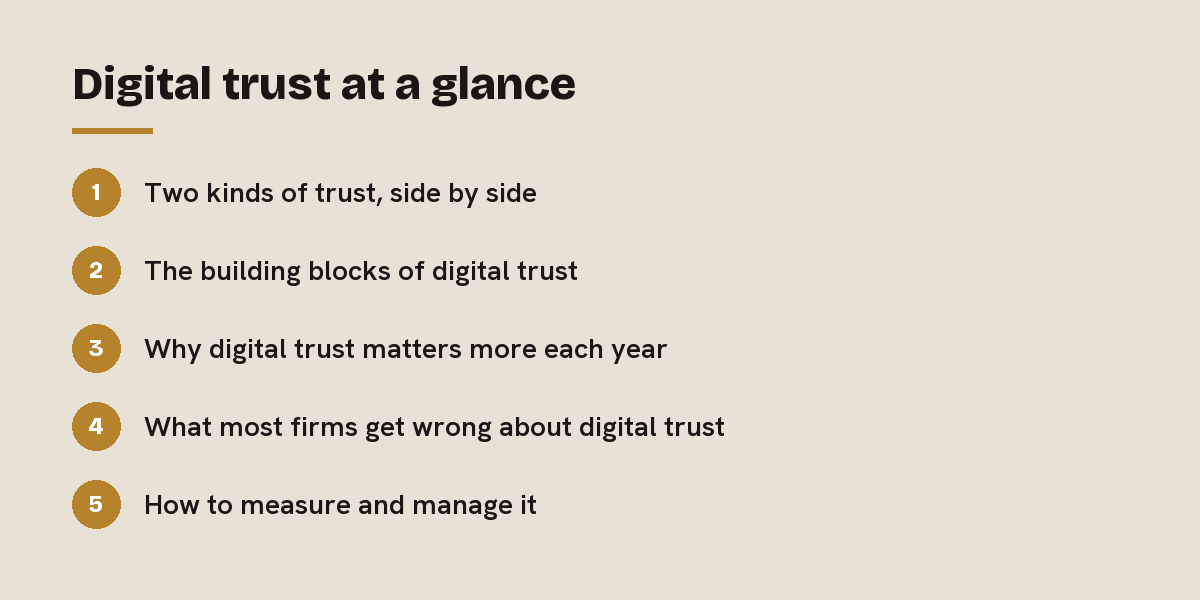
1. Two kinds of trust, side by side
The simplest distinction: brand trust is anchored in safety and reputation, its digital counterpart in usability, transparency and control. The table expands on that.
| Dimension | Brand trust | Digital trust |
|---|---|---|
| Anchored in | Safety, reputation, longevity, regulation | Usability, transparency, control, security |
| Built over | Years and decades | Each interaction |
| Lost through | Scandal, failure, conduct breaches | Confusing screens, silent errors, unexpected charges, fraud |
| Measured by | Reputation surveys, deposit stability | Task completion, repeat use, complaints, fraud losses |
| Owned by | Board, brand and communications | Product, design, engineering and fraud teams |
2. The building blocks of digital trust
This kind of confidence is not a feeling customers bring with them; it is a response to how a service behaves.
- Usability: the task can be completed without guesswork. Every unclear field erodes confidence a little.
- Transparency: the customer can see what is happening, what it costs and what comes next. “Processing” without a timescale is the opposite of transparency.
- Control: customers can freeze a card, withdraw a consent or change a limit themselves, instantly.
- Security that shows: strong authentication, clear confirmation of who is being paid, and fast help when something goes wrong.
The EU has turned part of this into law. Under the Instant Payments Regulation, payment providers must offer a service that checks the payee’s name against the account before a transfer is authorised. It is a regulatory measure against fraud and misdirected payments, and it is also a confidence feature customers can see.
3. Why digital trust matters more each year
The share of activity running through digital channels keeps rising. According to Eurostat, 67 per cent of people aged 16 to 74 in the EU used internet banking in 2024. For most customers, the app is now the institution. When confidence in the app is weak, brand trust has to carry the whole relationship, and it was never designed to.
| Sector | Where it is won or lost | What it looks like on the ground |
|---|---|---|
| Banking | Payments, fraud handling, account access | Instant confirmations, payee checks, quick card controls |
| Insurance | Claims and renewals | Visible claim status, clear explanations of price changes |
| Wealth | Reporting and transactions | Accurate, timely valuations; clear cost disclosure |
| Fintech | Onboarding and money movement | Fast, transparent onboarding; reliable transfers |
4. What most firms get wrong about digital trust
The common assumption is that a strong brand transfers automatically to digital channels. It does not, and the reasons are instructive.
- Treating trust as a marketing message: telling customers a service is secure does less than showing them, through clear confirmations and controls.
- Hiding the bad news: silent failures, vague error messages and unexplained delays do more damage than the problem itself.
- Adding friction in the name of security: security that customers cannot understand feels like obstruction. The best controls are strong and explicable.
- Measuring satisfaction, not behaviour: customers who say they trust an app but phone to confirm every payment are telling you something a survey will miss.
Example: a bank noticed that customers making their first large transfer in the app frequently called the contact centre to check it had arrived. Adding a clear confirmation screen with the payee’s verified name and an estimated arrival time cut those calls sharply. Nothing changed in the payment system; confidence rose because the service explained itself.
5. How to measure and manage it
Because it is earned task by task, it can be measured task by task. A practical scorecard for a bank or insurer includes:
- Completion of key tasks: payments, claims, address changes and consent updates, tracked step by step to show where customers hesitate.
- Confirmation behaviour: how often customers contact the institution to check that something they did in the app has worked. High numbers mean the service is not explaining itself.
- Self-service control use: the share of card freezes, limit changes and consent withdrawals done without help.
- Fraud and dispute signals: losses, reimbursement times and the share of disputes resolved digitally.
- Complaint themes: complaints about confusing screens, unexpected charges or silent errors, categorised and reviewed monthly.
Ownership matters as much as measurement. In many institutions, reputation sits with the board and communications, while the app sits with technology. Bringing the two together, with a named executive accountable for confidence in the digital channel, is often the most important organisational step.
Key takeaways on digital trust
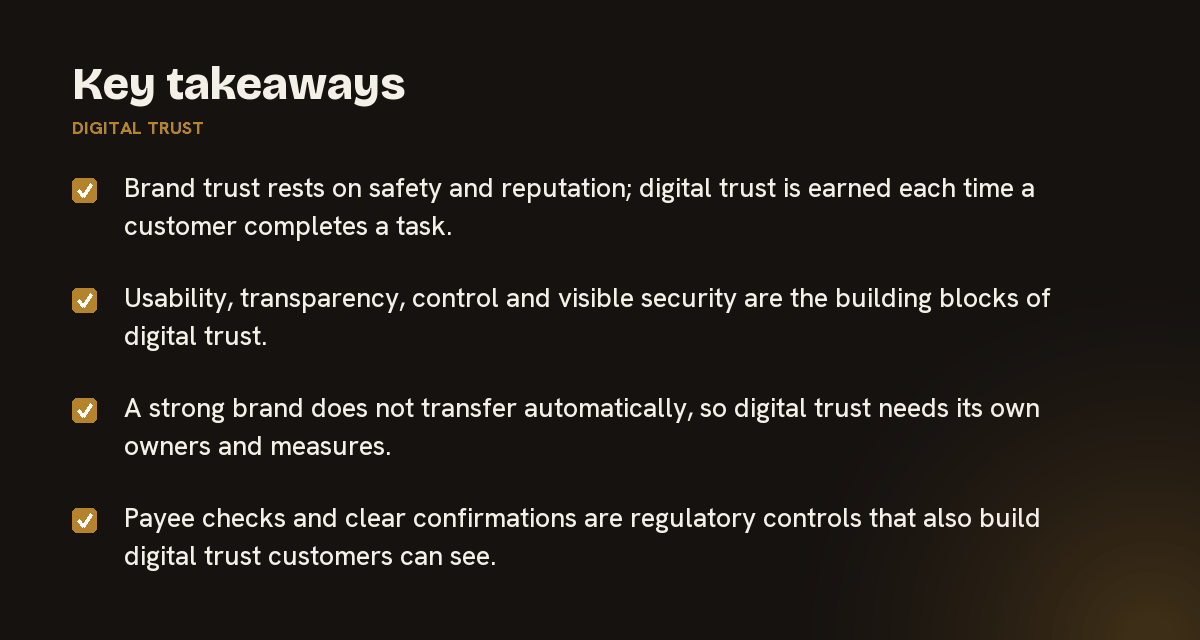
- Brand trust rests on safety and reputation; digital trust is earned each time a customer completes a task.
- Usability, transparency, control and visible security are the building blocks of digital trust.
- A strong brand does not transfer automatically, so digital trust needs its own owners and measures.
- Payee checks and clear confirmations are regulatory controls that also build digital trust customers can see.
The two forms of trust reinforce each other, but they are built by different people with different tools. Boards that want to protect the brand increasingly need to look at task completion rates, complaint themes and fraud losses with the same seriousness they give to reputation surveys.
Optimizium helps financial institutions turn brand trust into digital trust. We respect the reputation and the risk disciplines that institutions have built over decades, because they are exactly what newer competitors lack. And we design with fraud, security and compliance teams as co-authors, so the controls that keep customers safe are also the features that make them feel safe.
Explore how we approach this across Banking, Insurance and Wealth Management, browse the FAQ Hub, or read the related question: Why does customer-centricity matter in financial services?
Related questions
Partner with the experts.
Let's discuss how Optimizium can accelerate your roadmap and navigate complex digital transformation.
Schedule a consultation →