Home › FAQ Hub › What distinguishes direct-to-consumer from intermediary distribution?
Leadership, Change & Operating ModelsWhat distinguishes direct-to-consumer from intermediary distribution?
Direct-to-consumer distribution relies on self-service, seamless onboarding, good user experience and digital trust: the institution owns the customer relationship and the journey. Intermediary distribution, through advisers, brokers or agents, relies on relationships, suitability and regulatory compliance, with the intermediary often holding the customer relationship.
A customer can buy car insurance in three minutes on an app, or spend an hour with a broker reviewing cover for a business. Both are valid routes to market, built on very different foundations.
Direct-to-consumer distribution relies on self-service, seamless onboarding, good user experience and digital trust: the institution owns the customer relationship and the journey. Intermediary distribution, through advisers, brokers or agents, relies on relationships, suitability and regulatory compliance, with the intermediary often holding the customer relationship.
Banks and wealth managers often run hybrid models that balance digital and human touchpoints. Insurance is more broker-dependent, because of risk assessment and commission structures, particularly in commercial lines. Fintechs usually lead with direct-to-consumer and embedded distribution. The right mix depends on product complexity, customer needs and the economics of each channel.
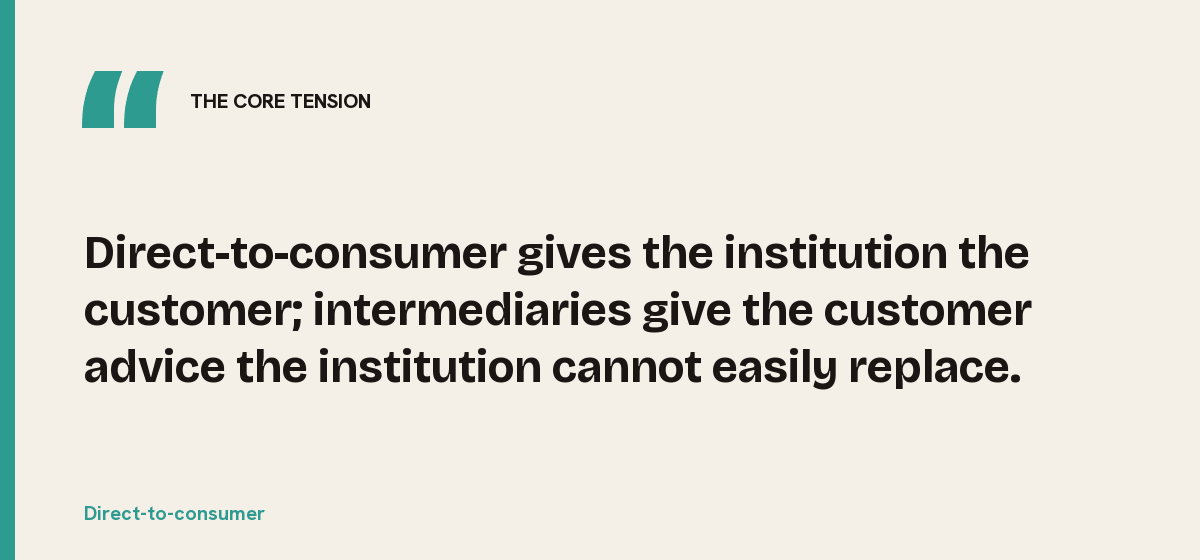
The core tension, in one line:
Direct-to-consumer gives the institution the customer; intermediaries give the customer advice the institution cannot easily replace.
an insurer sells simple home and motor cover direct-to-consumer online, while its commercial policies go through brokers. It gives brokers the same quoting technology as its direct channel and keeps pricing consistent, so customers who start online and later want advice can move to a broker without starting again.
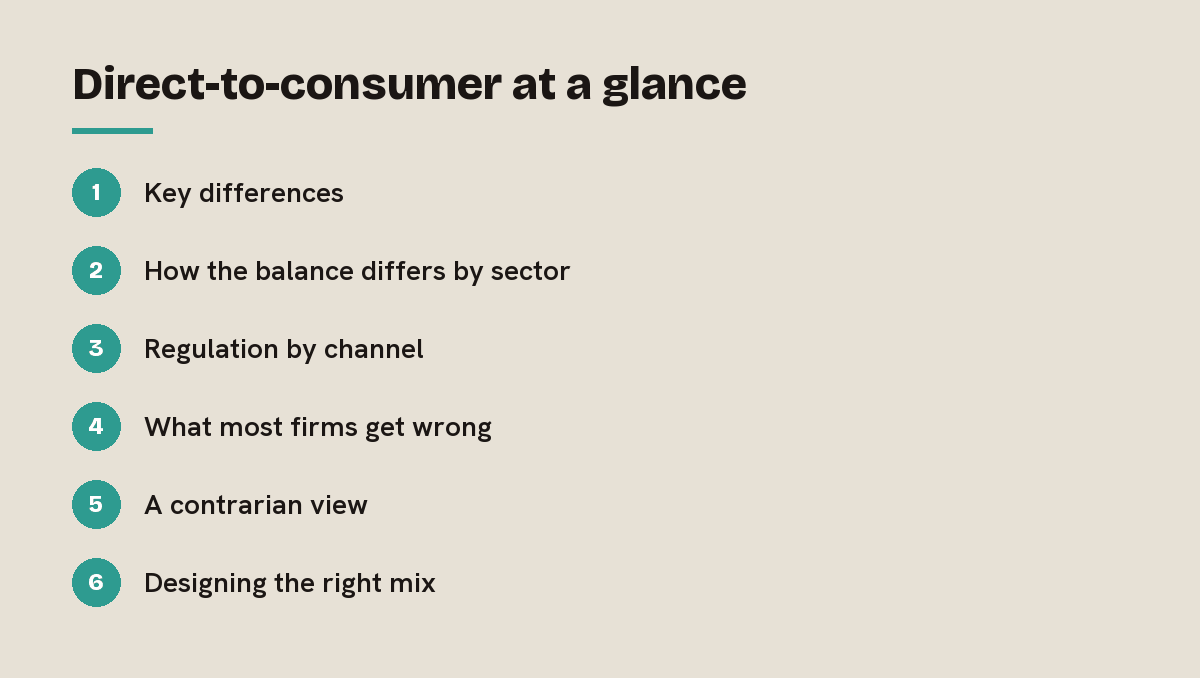
1. Key differences
| Dimension | Direct-to-consumer | Intermediary distribution |
|---|---|---|
| Relationship owner | The institution | Often the adviser or broker |
| Core strengths | Speed, convenience, lower cost | Advice, trust, complex needs |
| Regulatory focus | Disclosure, digital checks | Suitability, demands and needs, oversight |
| Cost structure | Marketing and technology | Commission and advice fees |
| Best suited to | Simple, standard products | Complex or high-value products |
2. How the balance differs by sector
| Sector | Typical mix |
|---|---|
| Banking | Mostly direct-to-consumer, with branches and advisers for complex needs |
| Insurance | Broker-heavy in commercial; direct growing in personal lines |
| Wealth | Adviser-led, with digital self-service for simpler needs |
| Fintech | Direct-to-consumer and embedded |
Market data shows why the balance differs. In banking, Eurostat reports that 67 per cent of people aged 16 to 74 in the EU used internet banking in 2024. In insurance, EIOPA found that digital-only distribution still lags well behind physical or hybrid channels, especially for life products.
3. Regulation by channel
- Direct-to-consumer: clear disclosure, digital identity and appropriateness checks, and evidence of what customers saw.
- Intermediaries: under the Insurance Distribution Directive, distributors must specify customers’ demands and needs; in investments, suitability rules require careful assessment and records.
- Both: the product manufacturer remains responsible for product design and oversight of how it is distributed.
4. What most firms get wrong
- Treating channels as rivals: competing on price against your own intermediaries invites conflict.
- Copying direct-to-consumer playbooks into advice: speed is not the main value in complex decisions.
- Ignoring hand-overs: customers move between channels and expect continuity.
- Neglecting digital tools for intermediaries: brokers and advisers benefit from the same technology as direct customers.
Example: a wealth manager launched a direct-to-consumer investment app aimed at younger savers. Many users later sought advice for larger decisions, but the app had no route to an adviser. Adding a booking option and sharing app data with advisers turned the app into a feeder for advice rather than a competitor to it.
5. A contrarian view
The rise of direct-to-consumer channels is often seen as the end of intermediaries. In practice, both are growing more digital, and the strongest institutions use each where it fits: direct for simple, frequent needs, intermediaries for complex and high-stakes ones, with smooth movement between them.
6. Designing the right mix
- Segment products and needs by complexity and value.
- Give each channel a clear role.
- Share data and journeys across channels.
- Align pricing and incentives to avoid conflict.
Key takeaways on direct-to-consumer
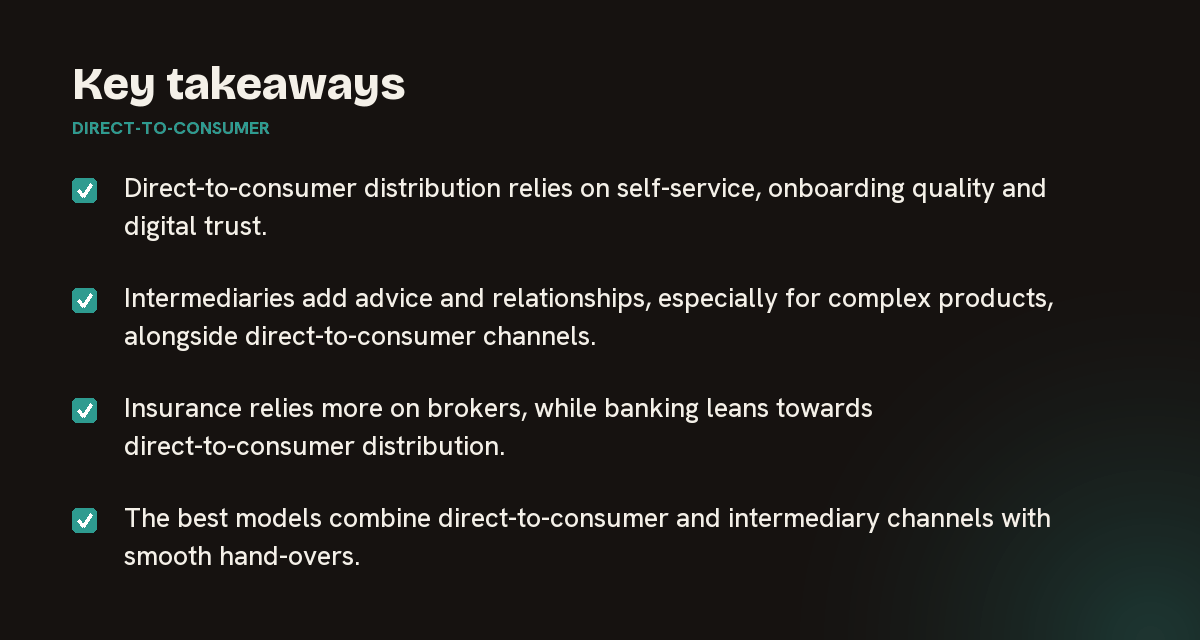
- Direct-to-consumer distribution relies on self-service, onboarding quality and digital trust.
- Intermediaries add advice and relationships, especially for complex products, alongside direct-to-consumer channels.
- Insurance relies more on brokers, while banking leans towards direct-to-consumer distribution.
- The best models combine direct-to-consumer and intermediary channels with smooth hand-overs.
For leadership teams, the question is not whether to choose direct-to-consumer or intermediaries, but how to combine them. Clear roles, shared data and aligned incentives turn two channels into one coherent customer experience.
Optimizium helps banks, insurers and wealth managers design distribution models that combine direct and intermediated channels. We respect the relationships intermediaries hold, because they remain central to many customers’ decisions. And we bring distribution, risk and compliance into the design as co-authors, so each channel is effective and well governed.
Explore how we approach this across Insurance, Wealth Management, Banking and Beyond Banking, browse the FAQ Hub, or read the related question: Why is change management disproportionately important in insurance and wealth?
Partner with the experts.
Let's discuss how Optimizium can accelerate your roadmap and navigate complex digital transformation.
Schedule a consultation →