Home › FAQ Hub › What distinguishes rules-based from algorithmic personalization?
AI, Data & AnalyticsWhat distinguishes rules-based from algorithmic personalization?
Rules-based personalization applies static segmentation and predefined triggers: if a customer matches certain criteria, they receive a particular message or offer.
Two banks can both claim to personalise their customer experience. One sends a mortgage offer to everyone aged 30 to 40 with a salary above a threshold. The other uses a model that estimates, for each customer, how likely they are to need a mortgage this quarter. Both are personalisation; they work very differently.
Rules-based personalization applies static segmentation and predefined triggers: if a customer matches certain criteria, they receive a particular message or offer. Algorithmic personalization uses dynamic propensity models and contextual learning to estimate what each customer is most likely to need or respond to, and it updates as new data arrives. Rules are transparent and easy to govern but limited in precision; algorithms are more precise and adaptive but harder to explain and to control. In financial services, hybrid architectures often outperform either approach alone, combining the governance clarity of rules with the predictive precision of algorithmic personalization, especially where regulation limits what automated decisions may do.
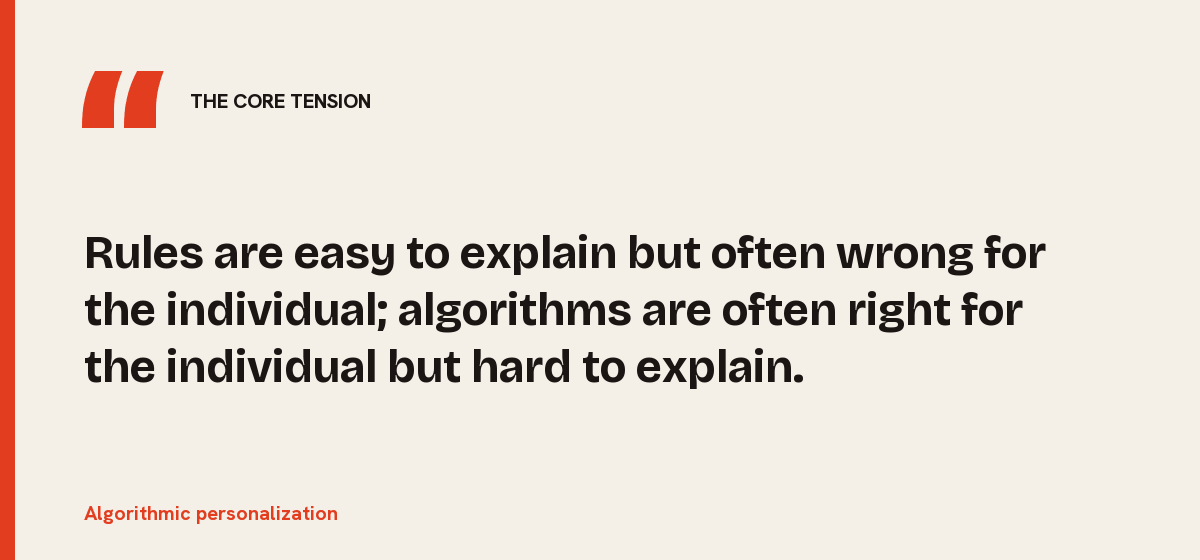
The core tension, in one line:
Rules are easy to explain but often wrong for the individual; algorithms are often right for the individual but hard to explain.
an insurer uses rules to ensure that no customer receives a cross-sell offer within 30 days of a claim, and that vulnerable customers are excluded from automated campaigns. Within those guardrails, a model ranks which product each remaining customer is most likely to value. The rules protect customers; the model improves relevance.
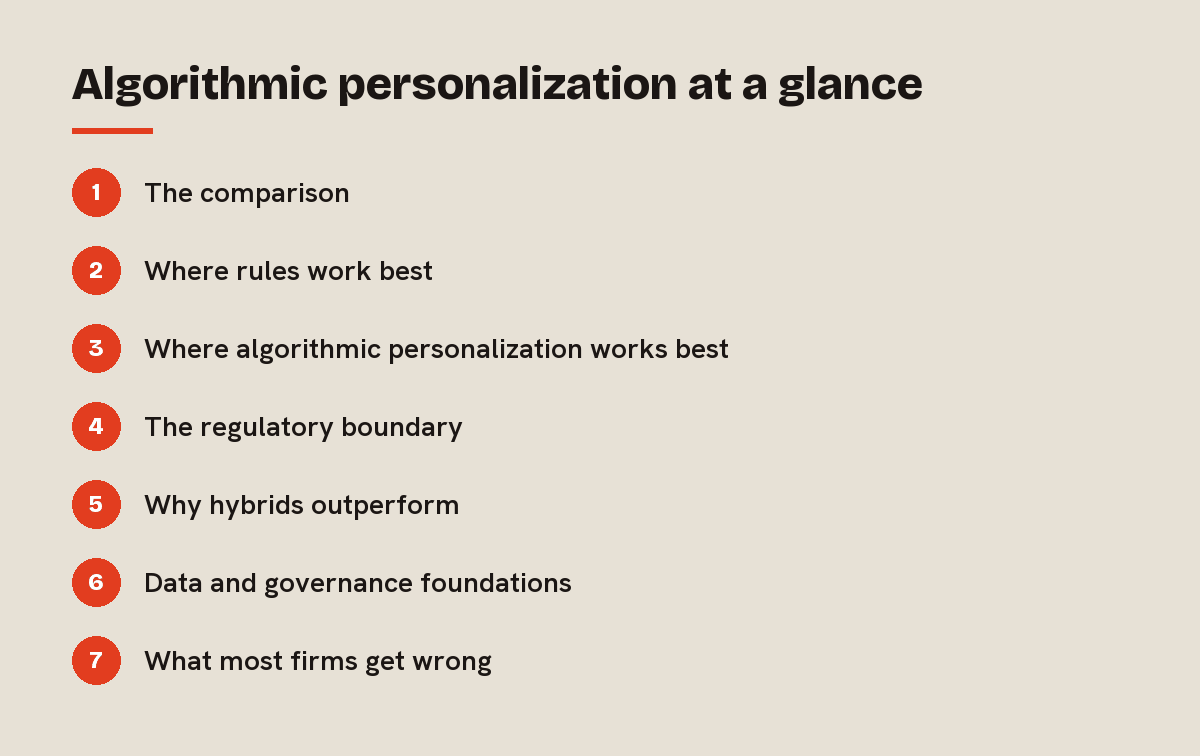
1. The comparison
| Feature | Rules-based | Algorithmic |
|---|---|---|
| Segmentation | Static segments defined by people | Dynamic, individual-level scores |
| Learning | Manual updates | Continuous optimisation from new data |
| Context awareness | Limited | High: time, channel, recent behaviour |
| Transparency | Easy to explain | Requires explainability tools and documentation |
| Governance | Simple approval of rules | Model risk management, monitoring, validation |
| Typical use | Eligibility, exclusions, compliance triggers | Next-best-action, offer ranking, timing |
2. Where rules work best
- Regulatory and conduct guardrails: exclusions for vulnerable customers, cooling-off periods, eligibility criteria.
- Simple lifecycle triggers: a reminder before a fixed rate ends, a renewal notice, a welcome journey.
- Low data environments: where there is too little history to train a reliable model.
- High-stakes decisions: where every outcome must be easily explained.
3. Where algorithmic personalization works best
- Large customer bases with rich data: many interactions allow models to learn patterns rules would miss.
- Ranking many options: choosing which of dozens of messages or products is most relevant.
- Timing: predicting when a customer is most likely to need or engage with something.
- Continuous improvement: models that learn from responses improve over time without manual rewriting.
4. The regulatory boundary
The more a decision affects a customer’s access to financial services, the more scrutiny applies to the model behind it.
- Automated decisions: Article 22 of the GDPR restricts decisions based solely on automated processing that significantly affect individuals. In its SCHUFA judgment of December 2023, the Court of Justice held that a credit score can fall within that rule when it plays a decisive role in a lender’s decision.
- High-risk AI: the EU Artificial Intelligence Act classifies AI used for creditworthiness assessment, and for risk assessment and pricing in life and health insurance, as high-risk, with requirements for data quality, documentation and human oversight.
| Use case | Typical approach | Why |
|---|---|---|
| Marketing content and timing | Algorithmic within rule guardrails | Lower risk, high value from precision |
| Product offers | Hybrid | Relevance matters; suitability and fairness too |
| Credit or insurance pricing decisions | Strongly governed models, explainable | High-risk under regulation |
| Exclusions and protections | Rules | Must be certain and auditable |
5. Why hybrids outperform
The practical answer for most institutions is a layered architecture. Rules define what must and must not happen: eligibility, exclusions, frequency caps, regulatory constraints. Algorithmic personalization then decides what is most relevant within that space. This keeps governance clear while capturing most of the value of prediction. Supervisors are seeing the same pattern in practice: the ECB reports that among banks it examined, decision tree-based models are mainly used for both credit scoring and fraud detection, a family of models that balances predictive power with interpretability.
6. Data and governance foundations
Both approaches depend on data quality, but algorithmic personalization depends on it far more. Models learn from history, so gaps, errors and biases in the data become gaps, errors and biases in the recommendations. Before scaling, institutions need clear data ownership, documented features, monitoring for drift and fairness, and a model inventory that risk teams can review. These foundations take time to build, which is why many firms start with a hybrid: a small number of governed models inside a clear set of rules, expanded as confidence grows.
7. What most firms get wrong
- Jumping to complex models first: without clean data and clear guardrails, sophisticated models amplify problems.
- Letting rules multiply: hundreds of overlapping rules become impossible to manage and conflict with each other.
- Optimising for clicks: models trained only on response rates may push products customers do not need.
- Ignoring monitoring: algorithmic personalization drifts as behaviour changes; without monitoring, quality and fairness erode quietly.
Example: a bank replaced several hundred campaign rules with a hybrid approach: a short set of guardrail rules and a model that ranked offers per customer. Complaints about irrelevant messages fell, campaign management became simpler, and the compliance team found the new setup easier to review because the guardrails were explicit and few.
Key takeaways on algorithmic personalization
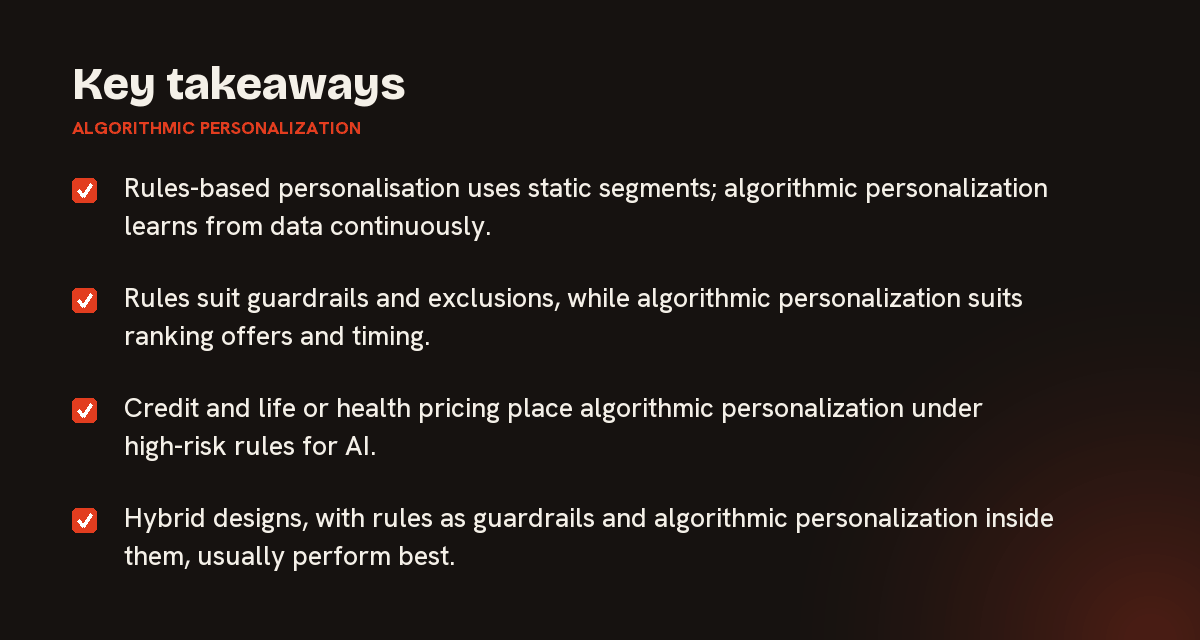
- Rules-based personalisation uses static segments; algorithmic personalization learns from data continuously.
- Rules suit guardrails and exclusions, while algorithmic personalization suits ranking offers and timing.
- Credit and life or health pricing place algorithmic personalization under high-risk rules for AI.
- Hybrid designs, with rules as guardrails and algorithmic personalization inside them, usually perform best.
For leaders, the choice between rules and algorithms is not either-or. The right design depends on data, risk and regulatory exposure, and in most financial institutions the answer is a deliberate combination with clear ownership of each layer.
Optimizium helps banks, insurers and wealth managers design personalisation architectures that are effective and defensible. We respect the business rules institutions have built over years, because they often encode hard-won lessons. And we bring model risk, data protection and compliance colleagues into the design as co-authors, so algorithmic personalization can be explained, monitored and trusted.
Explore how we approach this across Banking, Insurance and Wealth Management, browse the FAQ Hub, or read the related question: How do regulatory regimes shape personalisation limits?
Partner with the experts.
Let's discuss how Optimizium can accelerate your roadmap and navigate complex digital transformation.
Schedule a consultation →