Home › FAQ Hub › What does digital transformation mean in financial services?
Strategy & PositioningWhat does digital transformation mean in financial services?
Digital transformation in financial services is the redesign of how an institution creates, distributes and services its products, using data, technology and new operating models to improve customer experience and financial performance.
Almost every bank, insurer and wealth manager in Europe says it has a strategy for change. Far fewer can say what has changed for the customer, the cost base or the risk profile as a result.
Digital transformation in financial services is the redesign of how an institution creates, distributes and services its products, using data, technology and new operating models to improve customer experience and financial performance. It is not a single project or a new app. It spans digital channels, core systems, pricing, automation, compliance and data, and it only succeeds when those layers move together. The test is simple: does the institution now make decisions, serve customers and manage risk differently, or has it put a new front end on old processes?
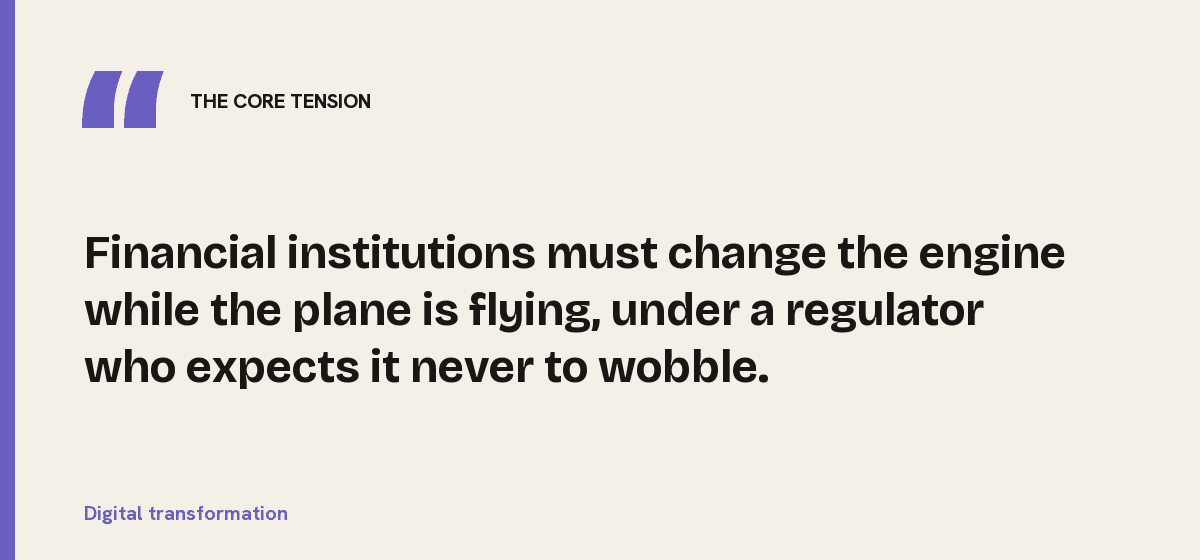
The core tension, in one line:
Financial institutions must change the engine while the plane is flying, under a regulator who expects it never to wobble.
a mid-sized retail bank launches a mobile app with instant account opening, yet credit decisions still route through a batch process that runs overnight. Customers open accounts in minutes and then wait two days for an overdraft. The app is digital; the bank is not yet transformed.
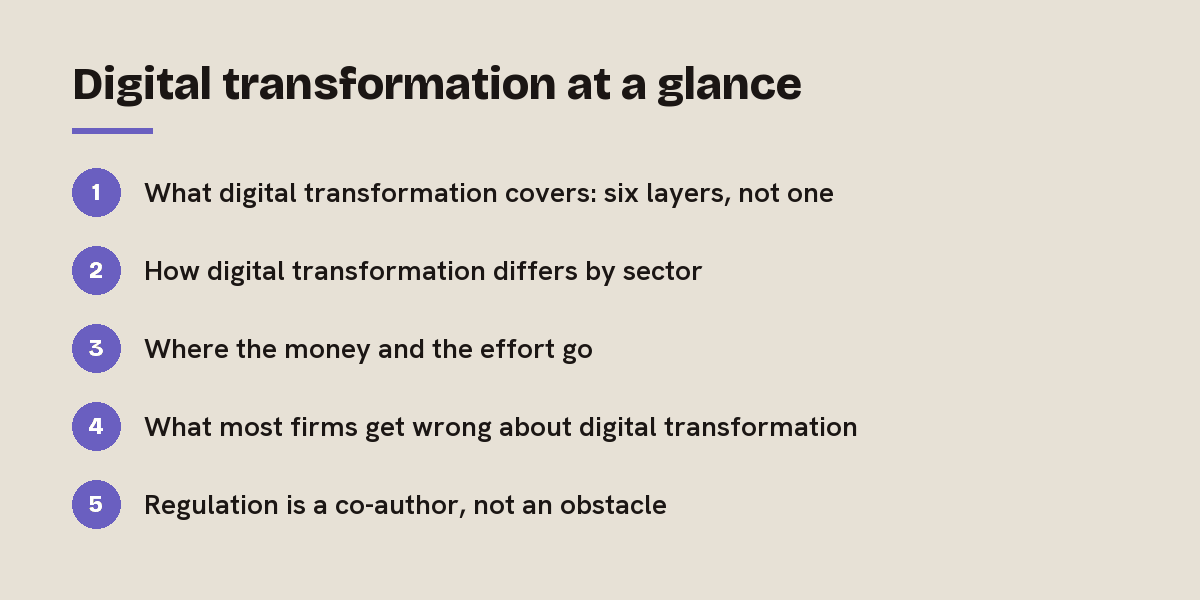
1. What digital transformation covers: six layers, not one
Six areas make up the change. Each is a layer of the same programme, and progress in one exposes weakness in the next.
| Layer | What it looks like on the ground | Why it matters |
|---|---|---|
| Digital channels | Mobile, web and assisted channels that share one view of the customer | Channels are where customers judge the institution; inconsistency erodes trust fast |
| Core systems | Ledgers, policy administration and portfolio platforms that expose real-time services | A modern front end on a batch core produces the overdraft problem above |
| Pricing | Risk- and behaviour-based pricing updated more often than once a year | Pricing is where data turns into margin |
| Automation | Straight-through processing for onboarding, claims and servicing | Reduces cost-to-serve and frees specialists for judgement calls |
| Compliance | Controls built into workflows rather than checked afterwards | Lowers remediation cost and supervisory friction |
| Data | Governed, shared data with clear ownership and lineage | Every other layer depends on it; weak data caps the value of all five |
In plain terms, digital transformation is the point at which these six stop being separate programmes with separate budgets and start being one operating model.
2. How digital transformation differs by sector
The same word hides very different agendas. A bank, an insurer and a wealth manager start from different economics, so their priorities differ even when the technology is similar.
| Sector | Where the focus sits | What it looks like on the ground | Why it matters |
|---|---|---|---|
| Banking | Customer journeys: payments, onboarding, lending | Instant onboarding, real-time payments, automated credit decisions | High transaction volumes reward every second and every cent removed |
| Insurance | Underwriting, claims and distribution enablement | Data-led underwriting, faster claims, digital tools for brokers and agents | Long product lifecycles mean legacy policy systems shape what is possible |
| Wealth | Advisory, reporting and suitability | Adviser workstations, digital reporting, evidenced suitability | Trust is personal; technology must strengthen the adviser, not replace them |
| Fintech | Scale, speed and product innovation | Cloud-native stacks, rapid release cycles, partnership APIs | Speed is the advantage; regulatory maturity is often the gap |
The pace differs too. EIOPA’s 2023 digitalisation survey of European insurers found that artificial intelligence is used by 50 per cent of respondents in non-life insurance and 24 per cent in life, and that digital-only distribution still lags well behind physical or hybrid channels, especially for life products. Banking, by contrast, has moved much of its everyday servicing online already. See how this plays out in practice for banking, insurance and wealth management.
3. Where the money and the effort go
Ambition is easy to state; investment shows what an institution believes. The European Central Bank’s supervisory data gives a useful benchmark for banks:
- Spend: according to ECB Supervisory Board Chair Claudia Buch, banks under ECB supervision invest on average 2.8 per cent of their operating income in digital transformation projects, around one fifth of total IT spending.
- People: roughly 5 per cent of bank staff are allocated to digital transformation initiatives, and institutions report difficulty recruiting technology talent.
- Technology: more than 90 per cent of ECB-supervised banks now integrate AI into their operations, with fraud and cybercrime prevention the leading use.
- Measurement: when the ECB surveyed 105 large banks in 2022, almost all had a digital strategy, yet many lacked adequate indicators to steer it.
That last point is the quiet problem. A programme that cannot be measured cannot be managed, and digital transformation without clear indicators drifts into a portfolio of projects.
4. What most firms get wrong about digital transformation
The common mistake is to treat digital transformation as a technology delivery problem. It is an operating model problem that happens to need technology.
- Confusing modernisation with transformation: replacing a core system on a like-for-like basis lowers risk but rarely changes how the institution competes. Modernisation is a means; transformation is the end.
- Starting with the front end: a new app is visible and quick to fund, but it inherits every constraint of the processes behind it.
- Underestimating the people side: product owners, operations teams and control functions need new roles and decision rights, not only new tools.
- Measuring activity instead of outcomes: releases shipped and features launched say little about cost-to-serve, conversion or risk.
The track record supports the caution. McKinsey’s global research found that only 16 per cent of respondents said their digital transformations had improved performance and equipped the organisation to sustain the change, a lower success rate than for organisational transformations in general.
Example: an insurer replaces its claims front end and cuts first notification time from days to minutes. Settlement time barely moves, because loss adjusters still work from the legacy policy system and manual reserve approvals. The second phase, which rewires approvals and data flows, is where the real gain sits.
5. Regulation is a co-author, not an obstacle
In financial services, digital transformation happens inside a regulatory frame. The Digital Operational Resilience Act (Regulation (EU) 2022/2554), which has applied since 17 January 2025, requires banks, insurers and investment firms to manage ICT risk, report incidents, test resilience and oversee critical technology providers. Cloud migration, outsourcing and new platforms now carry explicit resilience obligations.
Institutions that bring risk and compliance into design from the first sprint move faster overall, because they avoid redesign late in delivery. Those that treat the second line as a final gate tend to discover problems when they are most expensive to fix. The related question on how regulatory environments influence transformation explores this in more depth.
Key takeaways on digital transformation
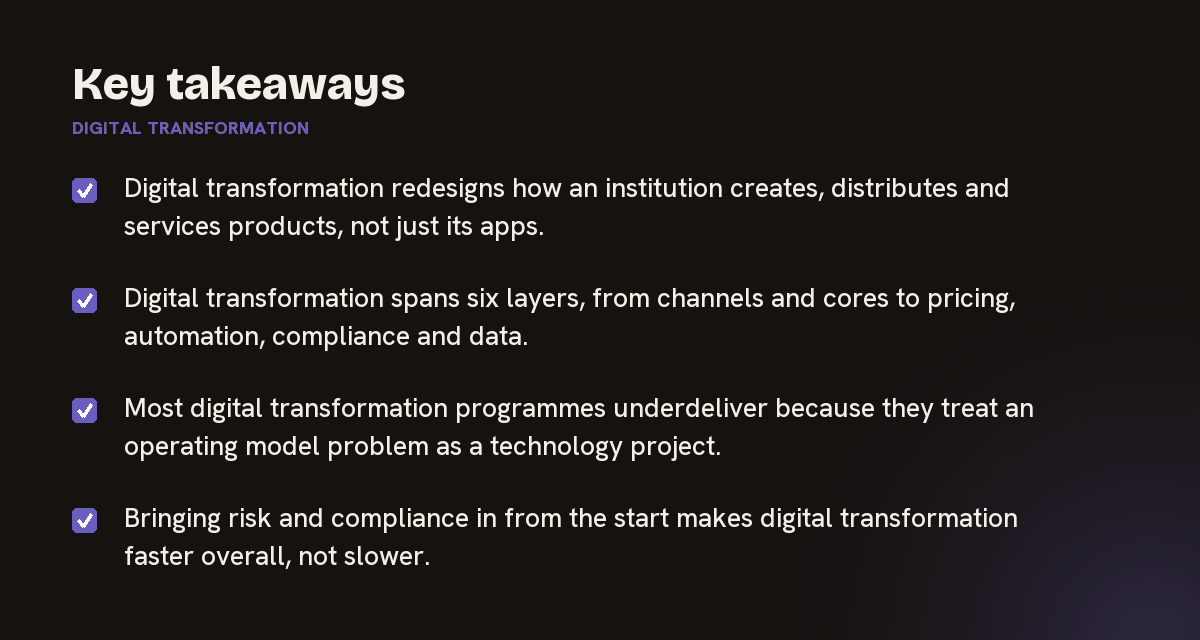
- Digital transformation redesigns how an institution creates, distributes and services products, not just its apps.
- Digital transformation spans six layers, from channels and cores to pricing, automation, compliance and data.
- Most digital transformation programmes underdeliver because they treat an operating model problem as a technology project.
- Bringing risk and compliance in from the start makes digital transformation faster overall, not slower.
For leadership teams, the practical question is less “what does digital transformation mean?” and more “what does it mean for us, in what order, and how will we know it is working?” The answer differs for a regional bank, a life insurer and a private wealth firm, and it should be grounded in the institution’s own economics rather than a generic maturity model.
Optimizium works with banks, insurers and wealth managers as an innovation partner that respects what institutions already know. Legacy systems and long-serving teams hold decades of product, risk and customer knowledge; a sound digital transformation builds on that rather than discarding it. We bring risk, compliance and operations into the design as co-authors, so change arrives with its controls already in place.
Explore how we approach this across Banking, Insurance, Wealth Management and Beyond Banking, browse the FAQ Hub, or read the related question: How do regulatory environments influence transformation?
Related questions
On this page
Partner with the experts.
Let's discuss how Optimizium can accelerate your roadmap and navigate complex digital transformation.
Schedule a consultation →