Home › FAQ Hub › What is a “front-end orchestration layer” and why does it matter?
Tech & IntegrationWhat is a “front-end orchestration layer” and why does it matter?
A front-end orchestration layer is a layer of software that sits between customer channels and the systems behind them, managing the journey, the business logic and the state of each case so that customers and staff never have to deal with core complexity.
Every financial institution has the same problem in a different shape: customers expect one smooth journey, and behind the screen sit a dozen systems built in different decades.
A front-end orchestration layer is a layer of software that sits between customer channels and the systems behind them, managing the journey, the business logic and the state of each case so that customers and staff never have to deal with core complexity. It decides which step comes next, calls the right systems in the right order, remembers where a customer left off, and presents one consistent experience across app, web, branch and broker. The orchestration layer matters because it lets an institution change the experience quickly without rewriting the cores, supports journeys that move between digital and human fulfilment, and raises the speed at which change reaches customers.
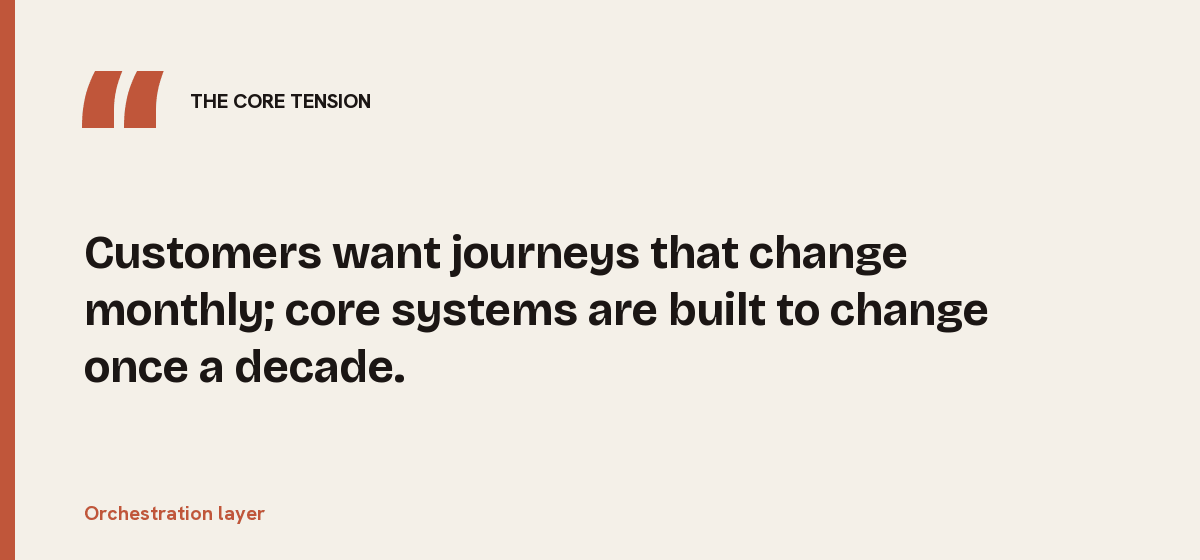
The core tension, in one line:
Customers want journeys that change monthly; core systems are built to change once a decade.
a customer starts a car insurance quote on a phone, stops to find a document, and finishes the next day with a broker. Without an orchestration layer, the broker re-keys everything. With one, the broker opens the same case, sees what has been captured, and completes it in minutes.
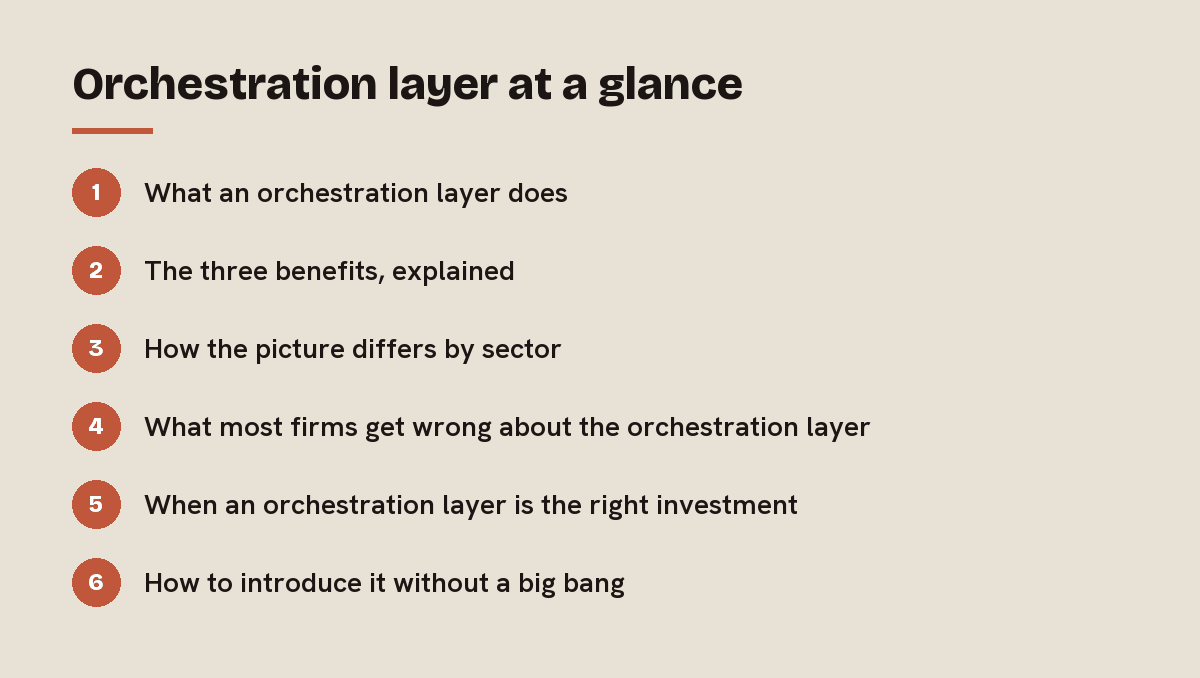
1. What an orchestration layer does
An orchestration layer earns its benefits through four jobs.
| Job | What it looks like on the ground | Why it matters |
|---|---|---|
| Journey management | Defines the steps of onboarding, a claim or a loan as configurable flows | Journeys change without core releases |
| Business logic | Applies eligibility rules, routing and simple decisions in one place | The same rule applies on every channel |
| State management | Remembers where each case is, across sessions and channels | Customers and staff can pick up where anyone left off |
| System calls | Calls cores, data services and third parties in the right order | Channels never talk to the cores directly |
2. The three benefits, explained
- It decouples experience from legacy. The layer gives channels a stable, modern interface even when the system behind it is old. Cores can then be modernised one at a time, behind the layer, without breaking the customer journey. This matters because, as the ECB notes in its digitalisation assessment criteria, supervisors now expect banks to show adequate execution capabilities for their digital strategy, not only the strategy itself.
- It supports hybrid fulfilment. Many financial products start digitally and finish with a person: an adviser, an underwriter, a broker. The layer holds the case so the hand-over is a continuation, not a restart.
- It accelerates change velocity. When journeys live in a configurable layer, a change that used to need a core release becomes a configuration change, tested and deployed in days.
3. How the picture differs by sector
| Sector | Typical journeys orchestrated | What it looks like on the ground |
|---|---|---|
| Banking | Onboarding, lending, disputes | One application flow across app, web and branch, calling credit, fraud and KYC services |
| Insurance | Quote and bind, claims, renewals | Brokers and direct customers share one case, with underwriting referrals built into the flow |
| Wealth | Client onboarding, suitability, rebalancing | Suitability captured once and reused by adviser and client portals |
| Fintech | Partner and embedded journeys | The same flow exposed through partner APIs and the firm’s own app |
4. What most firms get wrong about the orchestration layer
An orchestration layer is powerful, which makes it easy to misuse.
- Turning it into a new monolith: if every rule and calculation drifts into the layer, it becomes the next legacy system. Keep product rules in product engines and use the layer to coordinate.
- Building it per channel: a separate layer for the app and another for the branch recreates the inconsistency it was meant to remove.
- Ignoring staff journeys: colleagues in operations use the same cases. If the layer serves customers but not staff, the hand-over still breaks.
- Forgetting resilience: the layer becomes critical infrastructure. Under the EU’s Digital Operational Resilience Act, which has applied since 17 January 2025, its availability, testing and any third-party provider fall squarely within ICT risk management.
Example: a wealth manager wanted to launch a digital top-up journey for existing clients. Its portfolio system needed nine months to expose a new process. By placing a coordinating layer in front of it, the team reused existing suitability and payment services, built the journey as a configured flow, and launched in ten weeks. The portfolio system was modernised later, behind the same layer, without the client noticing.
5. When an orchestration layer is the right investment
It is tempting to treat this as a universal answer. It is not, and the investment is significant: the layer needs its own team, its own release process and its own resilience testing.
Not every institution needs one immediately. It pays off most when:
- Several channels serve the same products and customers move between them.
- Core replacement is planned over years, not months, so a stable front end is needed in the meantime.
- Journeys change often, because of regulation, pricing or competition.
- Partners and brokers need access to the same journeys as direct customers.
6. How to introduce it without a big bang
The safest route is incremental. Start with one journey that crosses several systems and several channels, such as onboarding or claims notification, and build it end to end through the new layer. Measure the results: completion, hand-over time, cost per case, and the time it takes to ship the next change. Then add journeys one by one, reusing the services already connected.
Three design rules keep the approach healthy over time. First, keep product and pricing rules in the systems that own them, and let the layer coordinate rather than calculate. Second, design for staff and customers together, because the same case passes through both. Third, treat the layer as critical from day one, with monitoring, failover and clear ownership, rather than adding resilience after the first incident.
Key takeaways on orchestration layer
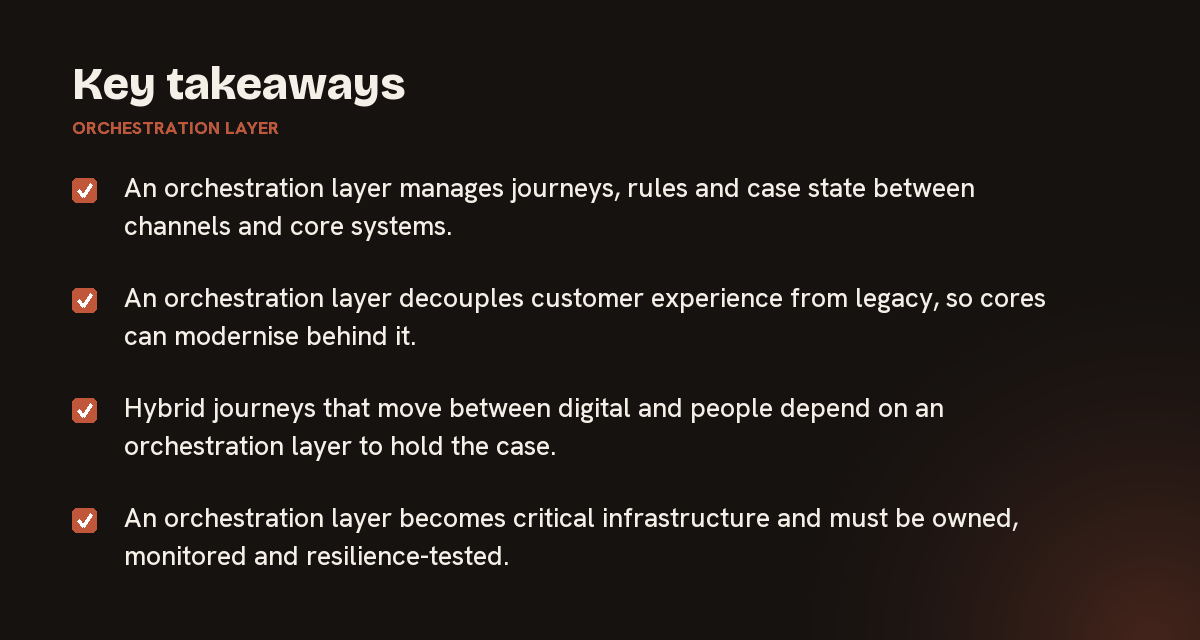
- An orchestration layer manages journeys, rules and case state between channels and core systems.
- An orchestration layer decouples customer experience from legacy, so cores can modernise behind it.
- Hybrid journeys that move between digital and people depend on an orchestration layer to hold the case.
- An orchestration layer becomes critical infrastructure and must be owned, monitored and resilience-tested.
For leadership teams, this is less a technology choice than a sequencing choice. It lets an institution improve the customer experience now and modernise its cores at a pace the business and the regulator can absorb. Done well, it turns a ten-year modernisation into a series of visible improvements, each one funding confidence in the next.
Optimizium helps banks, insurers and wealth managers design and introduce orchestration layers that fit their architecture and their risk appetite. We respect the logic encoded in existing systems, because decades of product and regulatory knowledge live there. And we bring architecture, risk and compliance colleagues into the design as co-authors, so the new layer strengthens resilience rather than adding a new point of failure.
Explore how we approach this across Banking, Insurance, Wealth Management and Beyond Banking, browse the FAQ Hub, or read the related question: Why does employee experience matter for digital transformation?
Related questions
On this page
Partner with the experts.
Let's discuss how Optimizium can accelerate your roadmap and navigate complex digital transformation.
Schedule a consultation →