Home › FAQ Hub › What is the difference between modernisation and transformation in financial services?
Leadership, Change & Operating ModelsWhat is the difference between modernisation and transformation in financial services?
Modernisation focuses on technical enablement: replacing legacy cores, migrating to the cloud, adopting modular architectures and reducing technical risk. Transformation addresses economic and operational design: new pricing models, ecosystem distribution, redesigned journeys and workforce change.
Two programmes can share the same budget, the same technology vendors and the same steering committee, yet produce very different results. One leaves the institution running the same business on better systems; the other changes how the institution competes. That is the difference between modernisation and transformation.
Modernisation focuses on technical enablement: replacing legacy cores, migrating to the cloud, adopting modular architectures and reducing technical risk. Transformation addresses economic and operational design: new pricing models, ecosystem distribution, redesigned journeys and workforce change. A useful distinction is that modernisation improves feasibility, while transformation changes competitiveness.
Both matter, and they depend on each other. Modernisation without transformation produces better systems running the same economics; transformation without modernisation runs into the limits of legacy technology. The best programmes are explicit about which outcomes come from modernisation and transformation, fund both, and sequence them so that each enables the other.
The core tension, in one line:
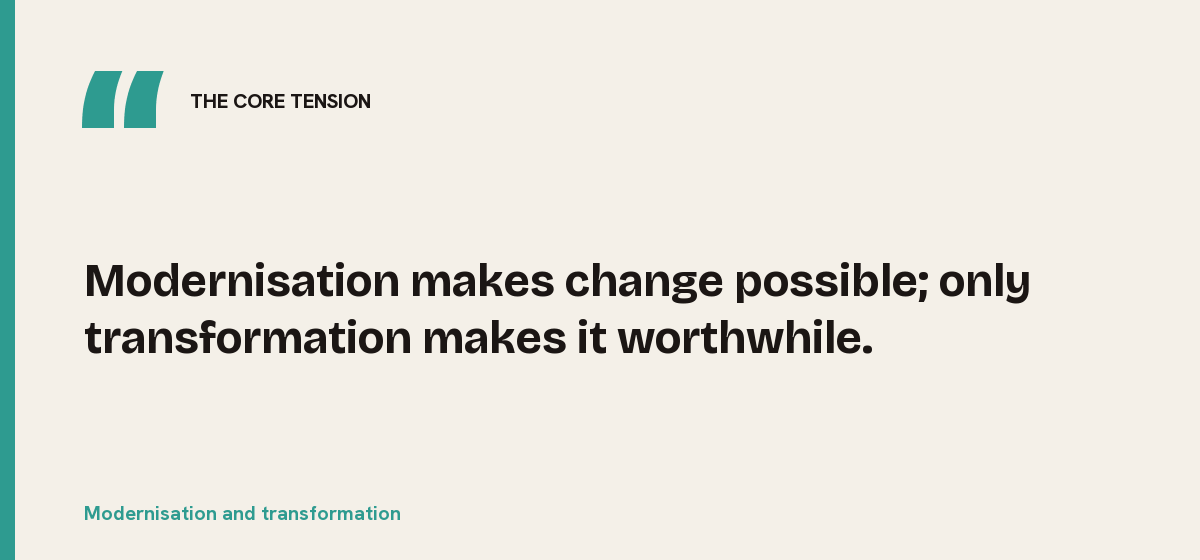
Modernisation makes change possible; only transformation makes it worthwhile.
an insurer replaced its policy administration system over three years, on time and on budget. Products, pricing and broker processes stayed the same, so customers and brokers saw little difference. A second programme used the new platform to simplify products, launch digital broker quoting and introduce usage-based pricing, and only then did growth and margins improve.
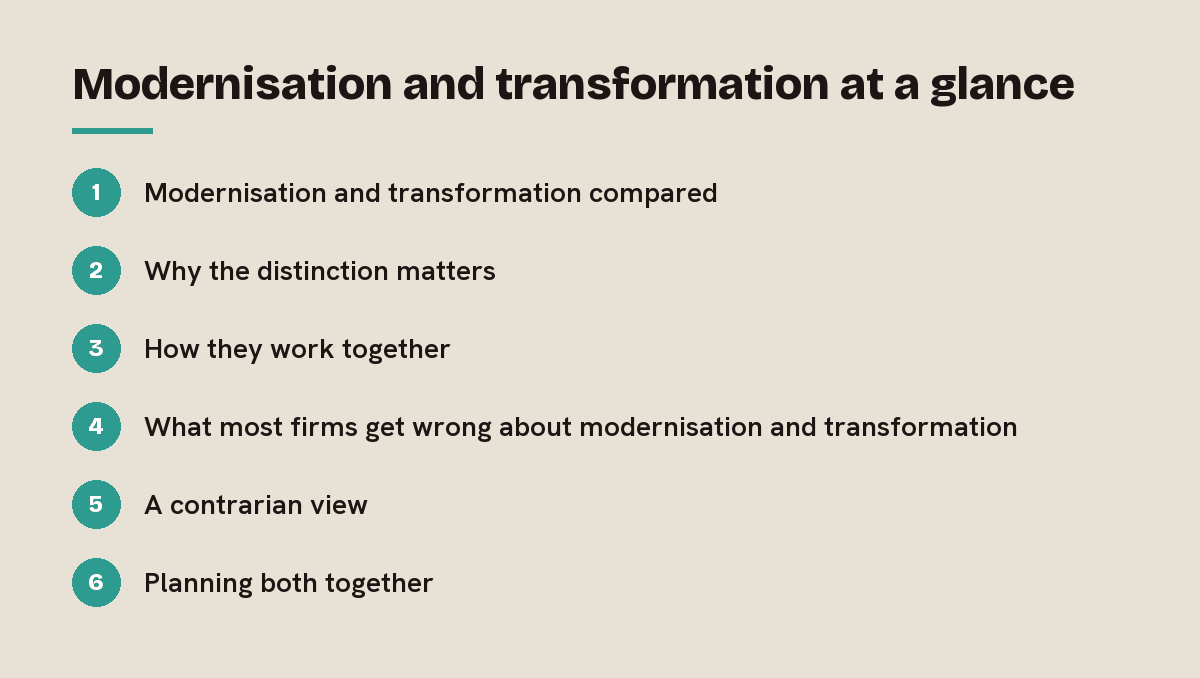
1. Modernisation and transformation compared
| Axis | Modernisation | Transformation |
|---|---|---|
| Objective | Lower risk, resilience, technical capability | Competitiveness, growth, new economics |
| Typical scope | Cores, cloud, architecture, data platforms | Products, pricing, channels, operating model, workforce |
| Owner | Technology leadership | Business leadership with technology |
| Success measure | Systems delivered, incidents, cost of IT | Revenue, margin, customer and cost outcomes |
| Time to value | Often years | Can start within months |
2. Why the distinction matters
- Funding: modernisation is often funded as a cost; transformation should be funded as an investment with returns.
- Governance: modernisation can be run by technology; transformation needs business ownership.
- Measurement: delivered systems are not the same as changed outcomes.
- Expectations: boards expecting transformation from a modernisation programme are usually disappointed.
The track record is sobering. McKinsey found that only 16 per cent of respondents said their digital transformations had improved performance and been sustained. Confusing modernisation and transformation is one reason: programmes deliver technology but not the changes that create value.
3. How they work together
| Modernisation enables | Transformation delivers |
|---|---|
| Real-time data | Personalised offers and faster decisions |
| APIs and modular cores | Partner and embedded distribution |
| Cloud scalability | New products launched quickly |
| Resilient infrastructure | Confidence to change at pace |
Resilience is now a regulatory requirement as well as a modernisation goal: the Digital Operational Resilience Act, applicable since 17 January 2025, sets ICT risk and testing obligations that modern architectures make easier to meet. Supervisors also assess both sides: the ECB’s 2024 review of digitalisation practices looks at strategy and business model alongside execution capability and risk management.
4. What most firms get wrong about modernisation and transformation
- Calling modernisation transformation: a core replacement is not a new business model.
- Waiting for modernisation to finish: transformation can start earlier, using APIs and layers in front of legacy.
- Leaving business leaders out: transformation without business ownership becomes a technology project.
- Measuring only delivery: systems launched say little about competitiveness.
Example: a bank planned to begin customer journey redesign only after its five-year core replacement. It changed course, placing an orchestration layer in front of the old core and redesigning onboarding and lending journeys straight away. Customers saw improvements within a year, while modernisation continued behind the scenes.
5. A contrarian view
Modernisation is often treated as the boring prerequisite. In some institutions, the reverse is true: transformation ambitions run ahead of what the technology can support, and a disciplined modernisation programme is the most valuable thing the board can fund. The skill is knowing which constraint binds first.
6. Planning both together
- Separate the objectives of modernisation and transformation in the business case.
- Sequence them, so each modernisation step unlocks a transformation step.
- Give business leaders ownership of transformation outcomes.
- Measure both: technical risk reduced and business outcomes changed.
Key takeaways on modernisation and transformation
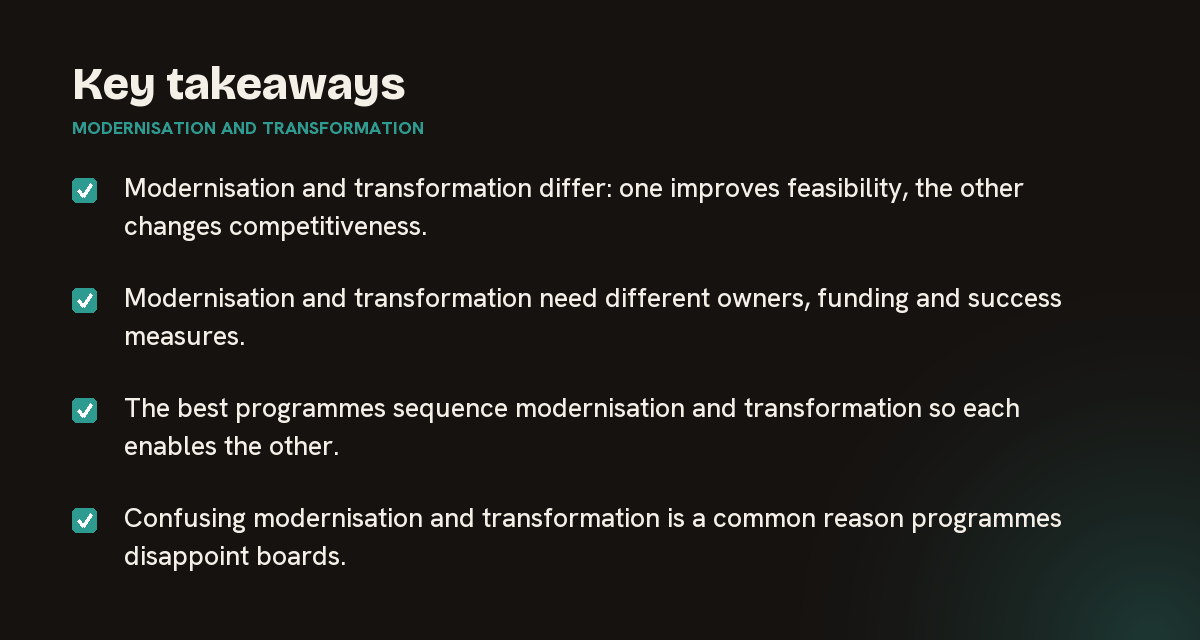
- Modernisation and transformation differ: one improves feasibility, the other changes competitiveness.
- Modernisation and transformation need different owners, funding and success measures.
- The best programmes sequence modernisation and transformation so each enables the other.
- Confusing modernisation and transformation is a common reason programmes disappoint boards.
For leadership teams, being clear about the difference between modernisation and transformation leads to better business cases, better governance and more realistic expectations. Both are needed; neither should be mistaken for the other.
Optimizium helps banks, insurers and wealth managers plan modernisation and transformation together. We respect the technology and operations expertise that keeps institutions running, because it makes change possible. And we bring business, risk and compliance leaders into the design as co-authors, so programmes deliver both resilience and competitiveness.
Explore how we approach this across Banking, Insurance, Wealth Management and Beyond Banking, browse the FAQ Hub, or read the related question: How do platform models reshape distribution economics?
Related questions
Partner with the experts.
Let's discuss how Optimizium can accelerate your roadmap and navigate complex digital transformation.
Schedule a consultation →