Home › FAQ Hub › What is the role of orchestration engines?
Digital Ops & Customer ExperienceWhat is the role of orchestration engines?
Orchestration engines are software components that route tasks, decisions and data across multiple systems so that a business process produces one coherent outcome, such as an opened account, a settled claim or an executed trade.
Behind every “simple” financial journey sits a surprising amount of coordination: identity checks, credit or underwriting decisions, document generation, disclosures, payments and records. Somebody, or something, has to conduct that orchestra.
Orchestration engines are software components that route tasks, decisions and data across multiple systems so that a business process produces one coherent outcome, such as an opened account, a settled claim or an executed trade. They call the right services in the right order, wait for people where human judgement is needed, handle exceptions, and keep a full record of what happened and why. In financial services, orchestration engines are especially valuable for regulated “micro-journeys”, the small, rule-heavy steps such as a suitability check or a disclosure acknowledgement, and for hybrid journeys that move between digital self-service and an adviser or broker.
The core tension, in one line:
Customers experience one journey; the institution runs twenty processes that must agree with each other.
a customer applies for a personal loan. The orchestration engine calls identity verification, then fraud screening, then the credit decision engine, generates the pre-contract information, waits for the customer’s acceptance, triggers the payout and writes the audit trail. If income verification fails, it routes the case to an underwriter’s queue with everything already attached.
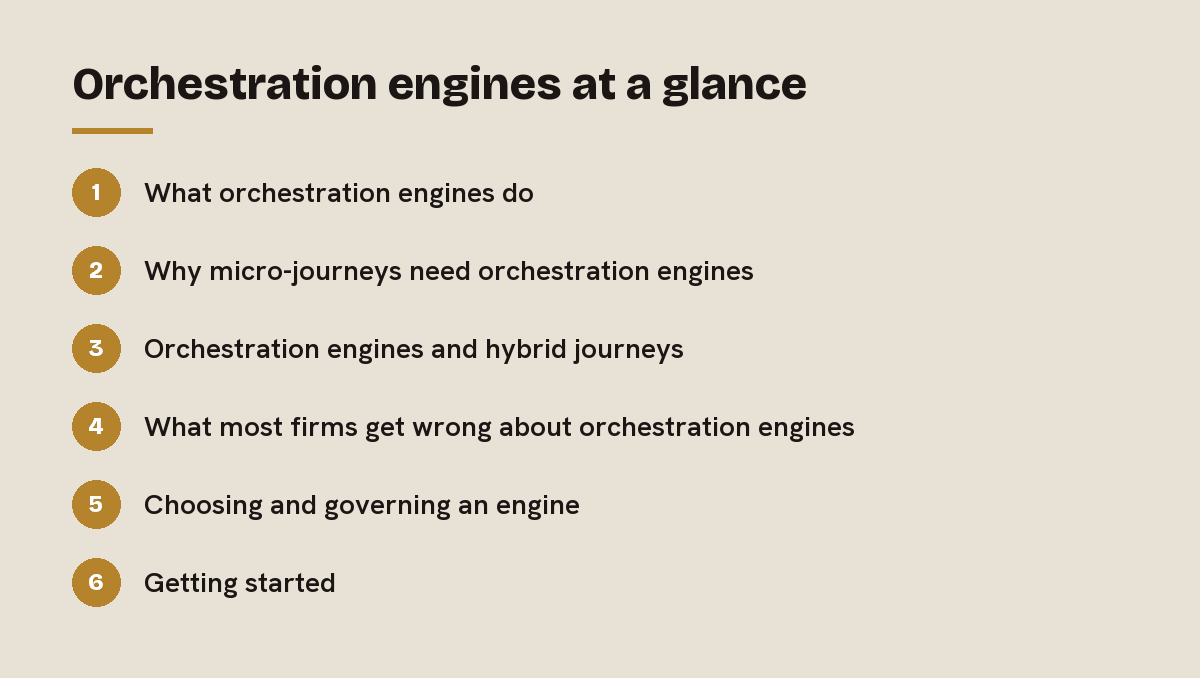
1. What orchestration engines do
| Function | What it looks like on the ground | Why it matters |
|---|---|---|
| Routing | Sends each task to the right system or person | Work does not get stuck between teams |
| Sequencing | Ensures checks happen in the required order | Regulatory steps cannot be skipped |
| Waiting and resuming | Pauses for a document or an approval, then continues | Long-running cases do not need manual chasing |
| Exception handling | Branches when data is missing or a rule fails | Edge cases are handled, not abandoned |
| Audit trail | Records every step, decision and timestamp | Evidence for supervisors, auditors and complaints |
2. Why micro-journeys need orchestration engines
Regulated micro-journeys are the small steps where most compliance risk concentrates.
- Disclosure acknowledgement: the customer must see specific information before proceeding, and the institution must be able to prove it.
- Suitability and appropriateness: investment and insurance-based products require assessments that follow defined rules, such as those in ESMA’s guidelines on MiFID II suitability requirements.
- Consent capture: data-sharing and marketing consents must be recorded and revocable.
- Identity and anti-money-laundering checks: each with its own escalation rules.
Coordinating software makes these steps consistent across channels and leaves an evidential trail behind it, which is why it matters more in finance than in most other industries.
3. Orchestration engines and hybrid journeys
Distribution in financial services is rarely purely digital. A pension transfer may start online, involve an adviser call and finish with a digital signature. The engine holds the case together across those steps.
| Sector | Typical hybrid journey | Role of the orchestration engine |
|---|---|---|
| Banking | Mortgage application with adviser review | Coordinates data capture, valuation, credit decision and adviser sign-off |
| Insurance | Complex claim with loss adjuster | Routes evidence, approvals, reserve updates and payments |
| Wealth | Onboarding with suitability review | Captures risk profile once, routes to adviser, records the recommendation |
| Fintech | Embedded lending through a partner | Orchestrates partner data, decisioning and settlement |
4. What most firms get wrong about orchestration engines
- Confusing orchestration with decisioning: orchestration engines decide what happens next in a process; decision engines decide the answer to a business question, such as “approve or decline”. Mixing the two makes both harder to govern.
- Automating the existing process: orchestrating a poor process simply makes it fail faster. Redesign first.
- One engine per department: separate engines for onboarding, servicing and claims recreate the silos they were meant to bridge.
- Neglecting the human steps: queues, hand-overs and service levels for staff deserve as much design as the automated steps.
Supervisors are watching execution as well as intent. The ECB’s 2024 review of digitalisation practices sets out fourteen assessment criteria covering strategy, governance and risk management, and highlights sound practices such as real-time KPI dashboards and automated data quality checks. Process coordination is what makes that kind of evidence available without manual effort.
Example: an insurer’s motor claims process involved six systems and four teams. Claims handlers spent much of their day chasing status. After introducing an orchestration engine with clear routing and service levels, simple claims settled without human touch, and handlers worked a single queue of complex cases with all evidence attached.
5. Choosing and governing an engine
The technology market offers many options, from business process management suites to cloud workflow services and low-code platforms. The choice matters less than three governance decisions taken early.
- Ownership: a single platform team should own the engine, its standards and its resilience, while product teams own their journeys.
- Change control: journeys will change often, so the institution needs a fast, evidenced way to approve flow changes without a full release cycle.
- Resilience: once journeys depend on the engine, it is critical infrastructure and must be tested, monitored and covered by continuity plans like any core system.
6. Getting started
- Pick one journey with clear pain, such as onboarding or simple claims.
- Map the steps and exceptions, not just the happy path.
- Separate rules from flow, keeping decisions in decision services.
- Design the audit trail up front, with compliance in the room.
Key takeaways on orchestration engines
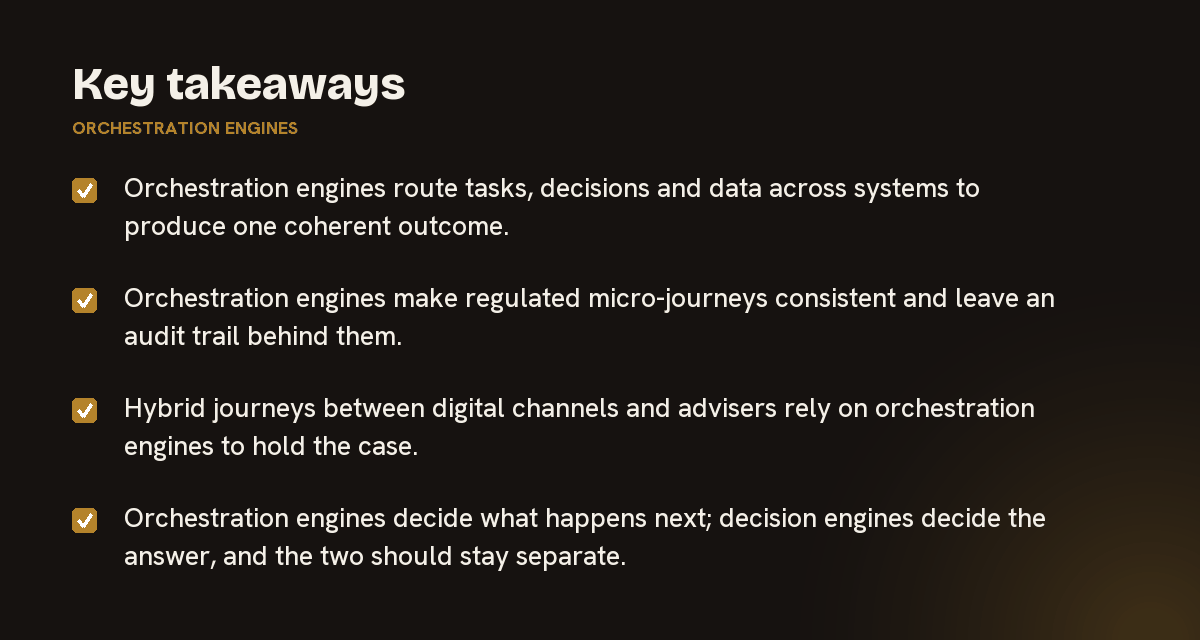
- Orchestration engines route tasks, decisions and data across systems to produce one coherent outcome.
- Orchestration engines make regulated micro-journeys consistent and leave an audit trail behind them.
- Hybrid journeys between digital channels and advisers rely on orchestration engines to hold the case.
- Orchestration engines decide what happens next; decision engines decide the answer, and the two should stay separate.
These engines are rarely visible to customers, yet they decide whether a journey feels coherent or fragmented. For leadership teams, they are one of the most practical levers for lowering cost-to-serve while strengthening control.
Optimizium helps banks, insurers and wealth managers introduce orchestration engines journey by journey. We respect the processes and controls institutions already rely on, because they encode real lessons. And we bring operations, risk and compliance colleagues into the design as co-authors, so automated journeys are faster and easier to evidence at the same time.
Explore how we approach this across Banking, Insurance and Wealth Management, browse the FAQ Hub, or read the related question: Why are disclosures especially difficult in digital?
On this page
Partner with the experts.
Let's discuss how Optimizium can accelerate your roadmap and navigate complex digital transformation.
Schedule a consultation →