Home › FAQ Hub › What role does cybersecurity play in financial digitalization?
Tech & Core ModernisationWhat role does cybersecurity play in financial digitalization?
Cybersecurity plays a foundational role in financial digitalisation: it is what allows institutions to offer digital services that customers and regulators can trust.
Every digital step a financial institution takes, a new app, an API for partners, a move to cloud, opens a new door. Some of those doors are used by customers; others are tried by criminals. Cybersecurity decides which.
Cybersecurity plays a foundational role in financial digitalisation: it is what allows institutions to offer digital services that customers and regulators can trust. Security frameworks protect network traffic, manage credentials, prove customers’ identities and ensure transactions are not altered. As institutions digitalise, the attack surface expands through APIs, cloud workloads, third-party providers, mobile devices and embedded partner journeys. Risk exposure also varies by channel: direct digital channels face credential and transaction fraud; broker and adviser channels face social engineering and data leakage; embedded channels depend on API security and partner controls. Without strong cybersecurity, digitalisation simply moves risk into places the institution cannot see.
The core tension, in one line:
Digitalisation succeeds by opening the institution up; cybersecurity succeeds by controlling every opening.
a bank opens APIs so fintech partners can offer its savings products in their apps. Before launch, it adds strong partner authentication, rate limits, real-time monitoring of unusual API calls and contractual security requirements. When a partner’s credentials are later compromised, the bank detects the abnormal pattern within minutes and suspends access before customer data is exposed.
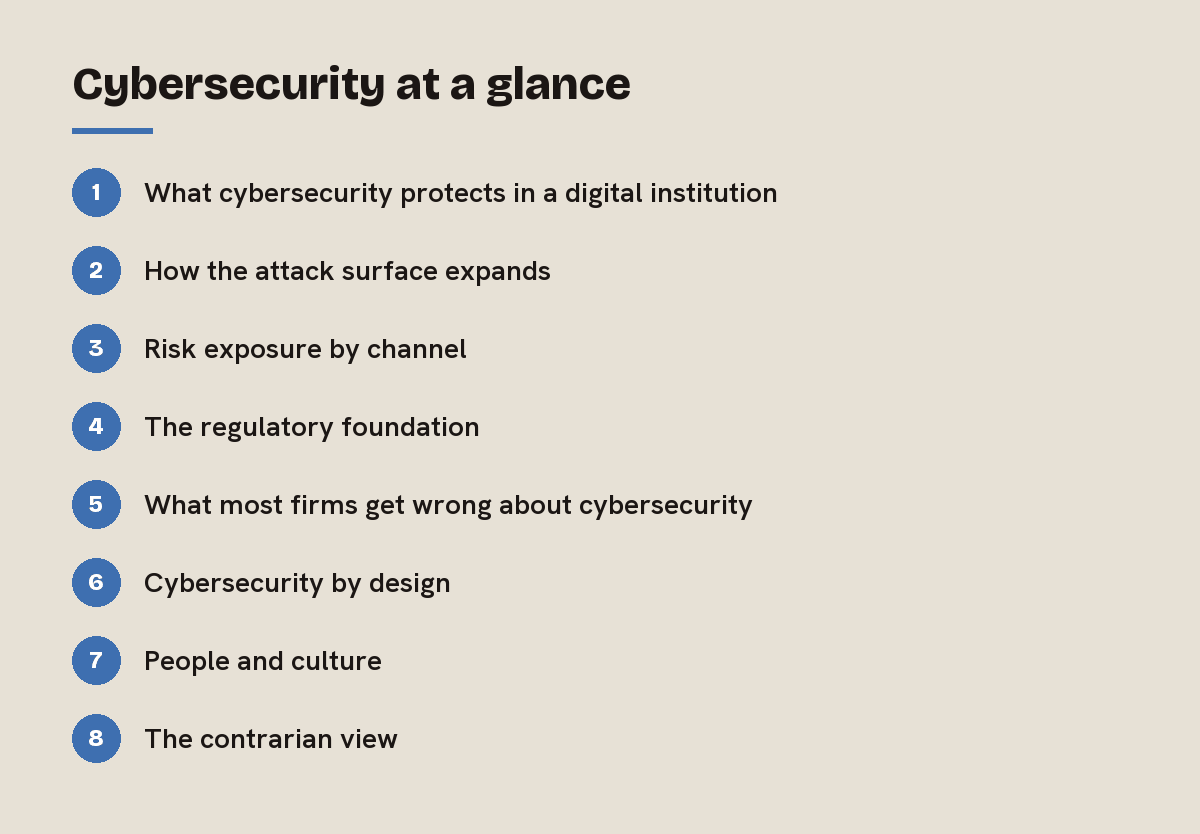
1. What cybersecurity protects in a digital institution
| Area | What it looks like on the ground | Why it matters |
|---|---|---|
| Secure traffic | Encryption, network segmentation, secure APIs | Data cannot be intercepted or altered |
| Credential management | Strong authentication, secrets management, privileged access control | Stolen passwords do not open the vault |
| Identity proofing | Verifying customers and staff are who they claim | Stops fraudulent accounts and insider misuse |
| Transaction integrity | Signing, monitoring and reconciliation | Payments and records cannot be tampered with |
| Resilience | Backup, recovery and testing | Services return quickly after an incident |
2. How the attack surface expands
- APIs: every interface for partners or apps is a potential entry point.
- Cloud workloads: misconfiguration is a common cause of exposure.
- Third parties: suppliers and partners bring their own vulnerabilities.
- Mobile endpoints: customer and staff devices sit outside the institution’s control.
- Embedded models: financial services running inside other firms’ apps depend on those firms’ security.
The trend is clear at the macro level. The IMF’s April 2024 Global Financial Stability Report found that while cyber incidents have so far not been systemic, the probability of severe cyber incidents has increased, posing an acute threat to macrofinancial stability.
3. Risk exposure by channel
| Channel | Main exposure | Typical controls |
|---|---|---|
| Direct digital | Credential theft, account takeover, transaction fraud | Strong authentication, behavioural monitoring |
| Broker and adviser | Social engineering, data leakage | Secure portals, training, access controls |
| Embedded | API abuse, partner compromise | API security, partner due diligence, monitoring |
| Cloud and suppliers | Misconfiguration, supply chain attacks | Configuration management, third-party oversight |
4. The regulatory foundation
In the EU, the Digital Operational Resilience Act, which has applied since 17 January 2025, requires banks, insurers, investment firms and other financial entities to manage ICT risk, report major incidents, test their digital resilience and oversee critical ICT third-party providers. Third-party exposure is significant: the ECB notes that roughly two-thirds of euro area banks have cooperation agreements with external cloud providers. Cybersecurity is therefore a matter of regulatory compliance and board accountability, not only of technology.
5. What most firms get wrong about cybersecurity
- Adding security at the end: reviewing a new channel just before launch leads to delays or compromises.
- Focusing on perimeter only: in a world of APIs, cloud and partners, there is no single perimeter.
- Underestimating third parties: suppliers and partners are often the weakest link.
- Treating it as an IT issue: cyber risk is business risk and needs board attention.
- Making security unusable: controls customers or staff cannot follow are bypassed.
Example: an insurer planned to launch a broker portal and a set of partner APIs. Security architects joined the product teams from the start, defining authentication, logging and monitoring as part of the design. The launch went ahead on time, and the first penetration test found far fewer issues than the insurer’s previous projects, where security had been reviewed at the end.
6. Cybersecurity by design
- Threat-model each new journey before building it.
- Use strong, user-friendly authentication for customers and staff.
- Secure APIs with authentication, authorisation, rate limits and monitoring.
- Govern third parties with due diligence, contracts and ongoing oversight.
- Test resilience regularly, including recovery from severe scenarios.
- Report clearly to the board on cyber risk and resilience.
7. People and culture
Technology controls only go so far. Many successful attacks begin with a convincing email, a phone call to a contact centre or a message to a broker. Regular, practical training for staff and intermediaries, clear procedures for verifying unusual requests, and a culture in which people feel able to report mistakes quickly all reduce the impact of these attacks. Customers need help too: plain warnings about common scams at the moments they are most likely to be targeted, such as adding a new payee or changing contact details, prevent losses that no firewall could stop.
8. The contrarian view
Security teams are often seen as the department that says no. In leading institutions, it is the department that makes yes possible: by building secure platforms and patterns that product teams can reuse, it allows new channels and partners to launch faster and with confidence.
Key takeaways on cybersecurity
- Cybersecurity is what allows institutions to offer digital services customers and regulators can trust.
- APIs, cloud, third parties and mobile devices all widen the surface cybersecurity must protect.
- Under DORA, cybersecurity and ICT resilience are board-level obligations for EU financial entities.
- Cybersecurity designed into journeys from the start speeds launches instead of delaying them.
For leadership teams, cybersecurity is inseparable from digital strategy. Every new channel, partner and platform should be judged by the value it creates and the risk it introduces, and both should be designed together.
Optimizium helps banks, insurers and wealth managers build cybersecurity into their digital transformation from the first design session. We respect the expertise of security and resilience teams, because they understand the threats institutions face. And we bring risk, compliance and technology colleagues together as co-authors, so digital growth and cyber resilience advance hand in hand.
Explore how we approach this across Banking, Insurance, Wealth Management and Beyond Banking, browse the FAQ Hub, or read the related question: How do APIs enable ecosystem distribution?
Related questions
On this page
Partner with the experts.
Let's discuss how Optimizium can accelerate your roadmap and navigate complex digital transformation.
Schedule a consultation →