Home › FAQ Hub › Why are bancassurance and bank-led distribution increasingly digital?
Leadership, Change & Operating ModelsWhy are bancassurance and bank-led distribution increasingly digital?
Bancassurance and bank-led distribution are increasingly digital because banks hold two assets insurers prize: customer trust and rich data. Integrating insurance into digital banking journeys reduces friction in quoting, documentation and underwriting, because much of the information is already known.
Banks have sold insurance for decades, usually across a branch desk alongside a mortgage or a loan. As customers moved their everyday banking to apps, the natural question followed: why not offer cover in the same place, at the moment it is needed?
Bancassurance and bank-led distribution are increasingly digital because banks hold two assets insurers prize: customer trust and rich data. Integrating insurance into digital banking journeys reduces friction in quoting, documentation and underwriting, because much of the information is already known. Digital bancassurance raises attachment rates, the share of bank customers who also take insurance, and improves renewals through timely reminders and analytics.
The model also aligns incentives between banks and insurers through commission sharing or performance-based arrangements. Direct digital sales grow, while relationship managers remain important for complex products such as life and protection cover. Digital bank-led distribution succeeds when it is useful to customers and transparent about what they are buying.
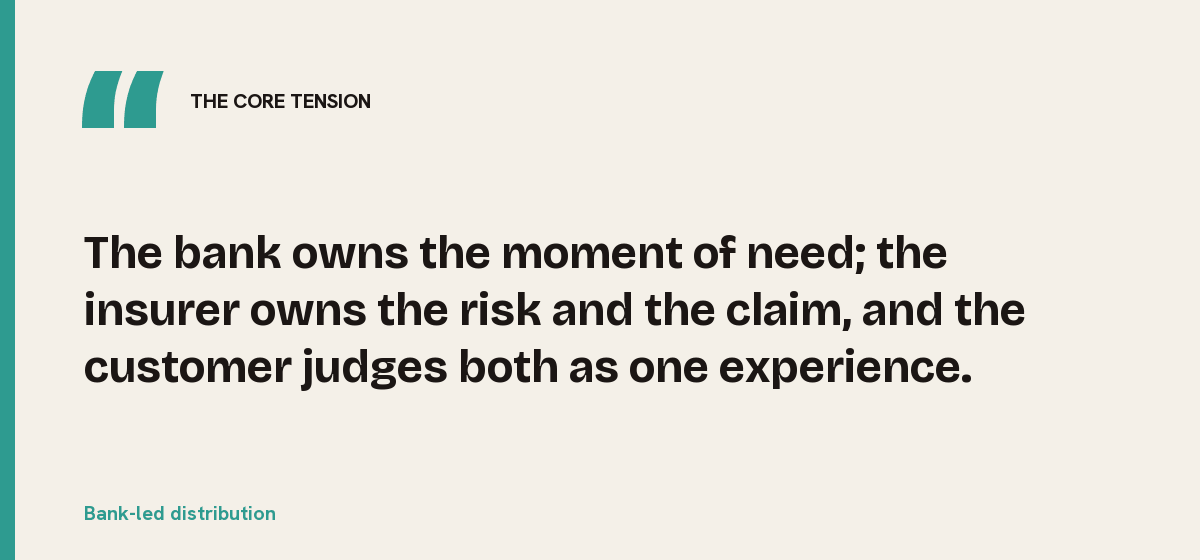
The core tension, in one line:
The bank owns the moment of need; the insurer owns the risk and the claim, and the customer judges both as one experience.
a bank customer completes a mortgage application in the app. At the final step, the bank offers home insurance pre-filled with the property details it already holds, with a clear price and a separate option to decline. Take-up is higher than in the branch, and customers who bought it rate the process highly.
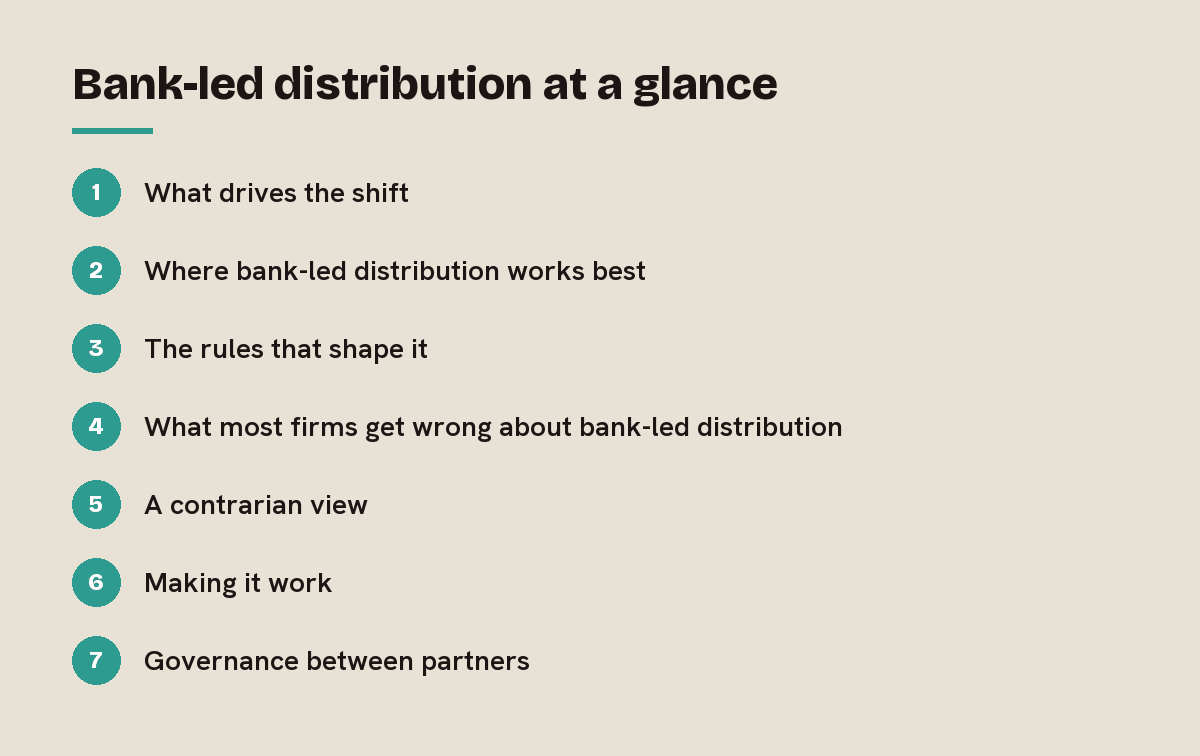
1. What drives the shift
| Driver | What it looks like on the ground | Effect |
|---|---|---|
| Trust | Customers already rely on their bank | Higher willingness to buy cover |
| Data | Address, property, income and spending known | Faster, pre-filled quotes |
| Moments of need | Mortgage, car loan, travel spending | Relevant, timely offers |
| Digital journeys | Insurance embedded in the app | Lower friction, higher attachment |
2. Where bank-led distribution works best
- Home insurance with mortgages: the property data is already in the application.
- Payment protection and credit-related cover: offered alongside loans, with clear explanations.
- Travel and device insurance: triggered by spending patterns or card benefits.
- Life and protection: started digitally, with relationship managers for complex needs.
| Product | Digital fit | Role of the adviser |
|---|---|---|
| Home | High | Limited |
| Travel and device | High | Rarely needed |
| Credit-related protection | Medium | Explanation of terms |
| Life and income protection | Lower | Often essential |
3. The rules that shape it
Bank-led distribution sits within insurance distribution law. Article 24 of the Insurance Distribution Directive requires that, when insurance is offered together with another product or service, customers are told whether they can buy the components separately and receive a description and separate evidence of the costs of each. Digital journeys make this easier to do well, because the information can be shown clearly at the right step.
Customer behaviour supports the move online in banking, where Eurostat reports that 67 per cent of people aged 16 to 74 in the EU used internet banking in 2024. In insurance more broadly, EIOPA found that digital-only distribution still lags well behind physical or hybrid channels, especially for life products, which is why the hybrid role of bank staff persists.
4. What most firms get wrong about bank-led distribution
- Pushing cover at the wrong moment: offers that interrupt an unrelated task feel like sales pressure.
- Unclear pricing and choice: bundled cover without transparent costs invites complaints and regulatory challenge.
- Ignoring the claim: the bank’s brand suffers if the insurer’s claims experience is poor.
- Misaligned incentives: commission structures that reward volume over suitability create conduct risk.
Example: a bank and its insurance partner noticed high cancellation rates on payment protection sold in the app. Reviewing the journey, they found customers did not understand the exclusions. A redesigned summary, a short comprehension check and a cooling-off reminder reduced cancellations and complaints, and long-term take-up improved.
5. A contrarian view
Digital bancassurance is often measured by attachment rate. A better measure is retained, well-understood cover: customers who keep the policy, understand what it covers and have good claims experiences. Chasing attachment alone can produce short-lived sales that harm both brands.
6. Making it work
- Design around moments of need, not campaign calendars.
- Use known data to pre-fill and simplify, with consent.
- Show costs and choices clearly, in line with cross-selling rules.
- Align incentives with retention and customer outcomes.
- Connect the claims experience to the bank’s service standards.
7. Governance between partners
Bank-led distribution depends on two firms acting as one in the customer’s eyes. Clear agreements on data sharing, complaint handling, service levels and conduct monitoring prevent gaps. Regular joint reviews of sales, cancellations, complaints and claims outcomes help both partners catch problems early and protect the shared brand.
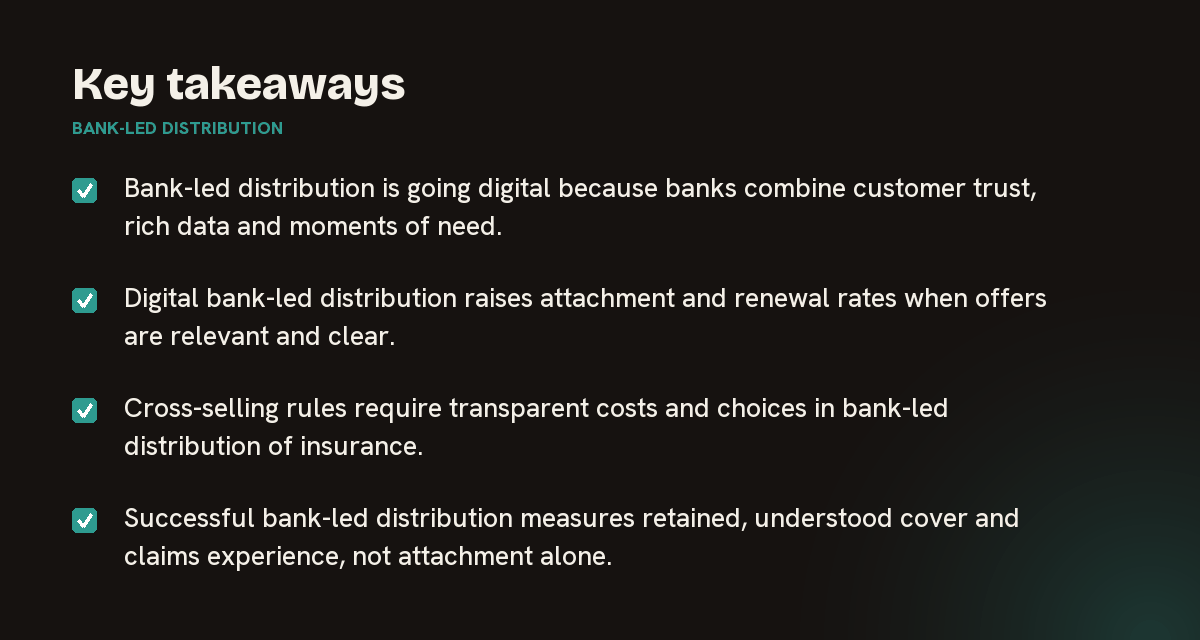
Key takeaways on bank-led distribution
- Bank-led distribution is going digital because banks combine customer trust, rich data and moments of need.
- Digital bank-led distribution raises attachment and renewal rates when offers are relevant and clear.
- Cross-selling rules require transparent costs and choices in bank-led distribution of insurance.
- Successful bank-led distribution measures retained, understood cover and claims experience, not attachment alone.
For leaders in banks and insurers, digital bancassurance is a significant growth opportunity, but only when designed around customers’ needs, clear choices and a strong claims experience. Done well, it deepens relationships for both partners.
Optimizium helps banks and insurers design digital distribution partnerships that grow sustainably. We respect the customer trust banks have built and the underwriting expertise insurers bring. And we bring distribution, risk and compliance teams from both partners into the design as co-authors, so growth comes with good conduct.
Explore how we approach this across Banking, Insurance and Beyond Banking, browse the FAQ Hub, or read the related question: What is the role of cross-sell in digital distribution?
Related questions
Partner with the experts.
Let's discuss how Optimizium can accelerate your roadmap and navigate complex digital transformation.
Schedule a consultation →