Home › FAQ Hub › Why are core product factories needed for digital?
Tech & Core ModernisationWhy are core product factories needed for digital?
Core product factories are central engines that hold the definition, pricing, risk rules and compliance logic of financial products in one place, so that every channel, from apps and branches to brokers and partner APIs, sells and services the same product in the same way.
In many financial institutions, the same loan, policy or investment product exists several times over: once in the branch system, once in the app, once in the broker portal, each with slightly different rules. Every change has to be made in every copy. That is the problem a central factory solves.
Core product factories are central engines that hold the definition, pricing, risk rules and compliance logic of financial products in one place, so that every channel, from apps and branches to brokers and partner APIs, sells and services the same product in the same way. They decouple manufacturing (risk, pricing, compliance) from distribution (channels, user experience, APIs). Banks centralise lending, payments and deposits into product engines; insurers centralise underwriting, pricing and claims; wealth firms centralise portfolio construction and product shelves. Centralising in this way improves reuse, speed and governance, which is why it is a foundation for digital distribution rather than an optional architecture choice.
The core tension, in one line:
Digital distribution multiplies channels; without a single factory, it multiplies products and errors too.
a bank wants to offer its personal loan in its app, through a car dealer partner and via a comparison site. Because its lending rules sit in one product factory, all three channels call the same engine for eligibility, pricing and documentation. A pricing change goes live everywhere in one release.
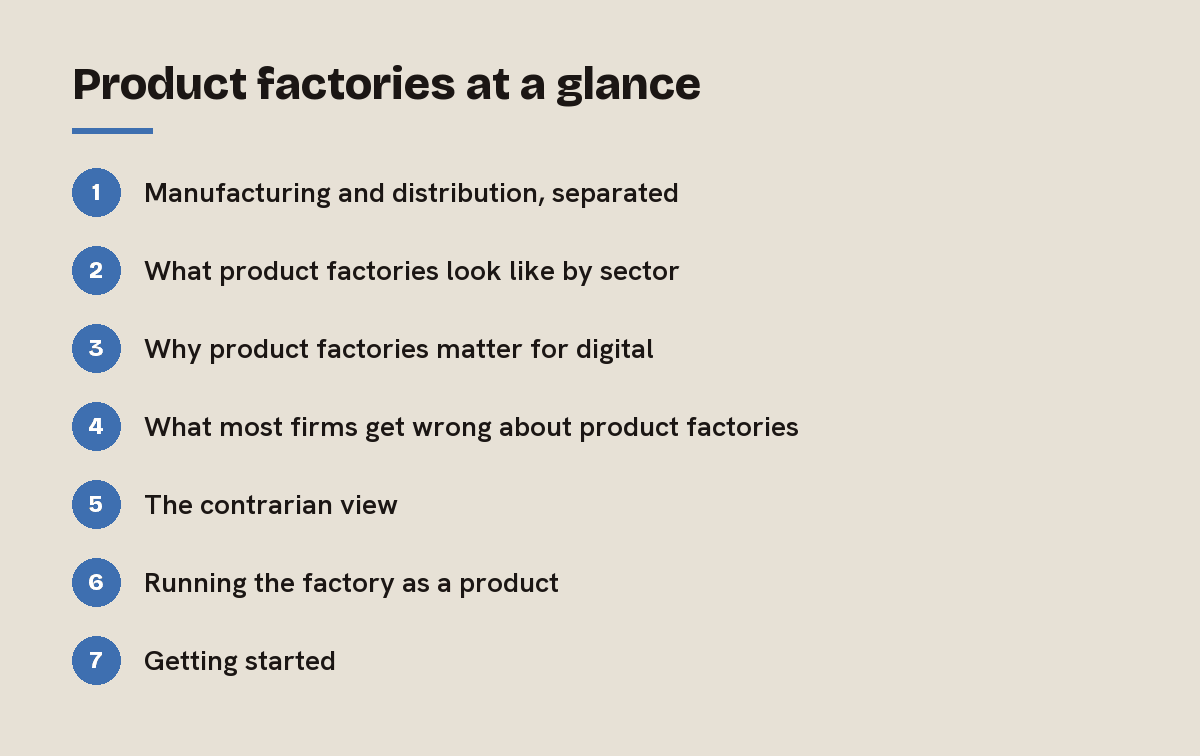
1. Manufacturing and distribution, separated
| Layer | What it includes | Who owns it |
|---|---|---|
| Manufacturing (the factory) | Product definitions, pricing, risk rules, compliance logic, documents | Product, pricing, risk and compliance |
| Distribution | Channels, user experience, APIs, partner integrations | Channel and digital teams |
| The interface between them | Well-defined services: quote, eligibility, issue, service | Shared standards and governance |
2. What product factories look like by sector
- Banking: lending, payments and deposit engines that hold product terms, pricing and limits, exposed as services to every channel.
- Insurance: underwriting, rating and claims engines shared by direct, broker and embedded channels.
- Wealth: portfolio construction and product shelf management, with model portfolios and fund lists used by advisers and digital platforms alike.
- Fintech: often consumes other firms’ product factories through partnerships, adding its own distribution on top.
| Sector | Factory focus | Digital benefit |
|---|---|---|
| Banking | Lending, payments, deposits | One price and one decision across channels |
| Insurance | Underwriting, pricing, claims | Faster product launches, consistent broker and direct offers |
| Wealth | Portfolio construction, product shelves | Scalable advice and consistent suitability |
| Fintech | Partner factories | Speed to market without building manufacturing |
3. Why product factories matter for digital
- Reuse: one product definition serves every channel, so new channels cost less to add.
- Speed: changes to pricing or terms are made once and released everywhere.
- Governance: product, pricing and compliance rules sit in one controlled place, with clear ownership and audit trails.
- Partnership readiness: embedded and API distribution depend on clean, callable product services.
The direction of regulation supports this. The European Commission’s Financial Data Access proposal would require standardised, API-based access to a much broader range of financial data, from investments to insurance. Institutions whose products live in scattered channel systems will find that much harder to support than those with one source of product truth.
4. What most firms get wrong about product factories
- Building a factory per channel: a “digital product engine” next to the branch engine recreates duplication.
- Moving everything at once: migrating every legacy product into a new factory can take years. Start with new and high-volume products.
- Putting channel logic in the factory: user experience rules belong in distribution; product rules belong in the factory. Mixing them makes both rigid.
- Neglecting governance: a central factory needs a clear process for product change, with risk and compliance built in.
Supervisors pay close attention to these foundations. The ECB’s 2024 review of digitalisation practices lists adequate execution capabilities, data governance and updated risk models among its key criteria. Product factories make all three easier to demonstrate.
Example: an insurer had home insurance rated in three places: its direct website, its broker system and an aggregator integration. Prices drifted, and broker complaints grew. Consolidating rating into one product factory took nine months, after which a pricing change took days rather than weeks, and price consistency across channels became a selling point with brokers.
5. The contrarian view
Some argue that a central factory adds a layer of central control that slows innovation. The opposite tends to be true when they are well designed: by making the stable part of the product reusable, they free distribution teams to experiment with journeys, partners and propositions. Innovation slows when every experiment requires a new copy of the product.
6. Running the factory as a product
A factory is not a one-off build. It needs a dedicated team, a roadmap and service levels agreed with the channels that depend on it. Channel teams should be able to request new features, see what is planned and understand how quickly changes will be delivered. Performance and availability matter too: when every channel calls the same engine, an outage affects every channel at once, so resilience testing and monitoring are part of the design from the start.
7. Getting started
- Inventory products and where their rules live across channels.
- Choose a first product with high volume and many channels.
- Define the service interface: quote, eligibility, issue, service.
- Set governance for product and pricing change, with risk and compliance.
- Migrate channels one by one to the new factory.
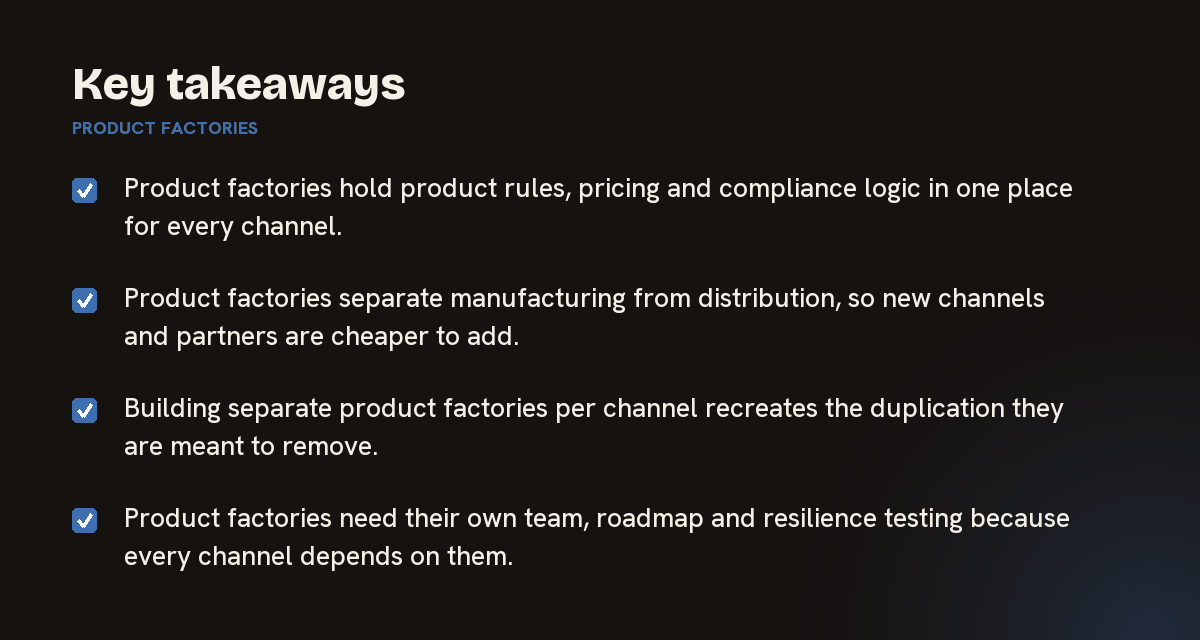
Key takeaways on product factories
- Product factories hold product rules, pricing and compliance logic in one place for every channel.
- Product factories separate manufacturing from distribution, so new channels and partners are cheaper to add.
- Building separate product factories per channel recreates the duplication they are meant to remove.
- Product factories need their own team, roadmap and resilience testing because every channel depends on them.
For executives planning digital distribution, product factories are one of the most important foundations to get right. They decide whether new channels and partnerships can be added in weeks or require a fresh build each time, and whether pricing and compliance stay consistent as distribution grows.
Optimizium helps banks, insurers and wealth managers design and implement product factories. We respect the product and pricing knowledge embedded in today’s systems, because it defines what the factory must do. And we bring pricing, risk and compliance colleagues into the design as co-authors, so the factory becomes the single, trusted source of how products work.
Explore how we approach this across Banking, Insurance, Wealth Management and Beyond Banking, browse the FAQ Hub, or read the related question: How do APIs enable ecosystem distribution?
Related questions
On this page
Partner with the experts.
Let's discuss how Optimizium can accelerate your roadmap and navigate complex digital transformation.
Schedule a consultation →