Home › FAQ Hub › Why are legacy policy admin systems a transformation bottleneck for insurers?
Tech & Core ModernisationWhy are legacy policy admin systems a transformation bottleneck for insurers?
Legacy policy admin systems are a transformation bottleneck because they encode decades of actuarial, underwriting, claims and regulatory logic, often undocumented, in platforms that are hard to change and harder to replace.
Insurers often have modern websites, capable broker portals and growing data teams. Then a new product or a pricing change needs to reach the policy record, and progress slows to the pace of a system built decades ago.
Legacy policy admin systems are a transformation bottleneck because they encode decades of actuarial, underwriting, claims and regulatory logic, often undocumented, in platforms that are hard to change and harder to replace. Modernising them requires migrating products and policies, converting data, and reintegrating broker portals, claims systems and finance. Replacement also disrupts pricing, product and operational governance, because so many processes depend on how the old system behaves. For these reasons, most carriers now adopt coexistence architectures, running new and old policy admin systems side by side and moving products in stages, to reduce risk while still making progress.
The core tension, in one line:
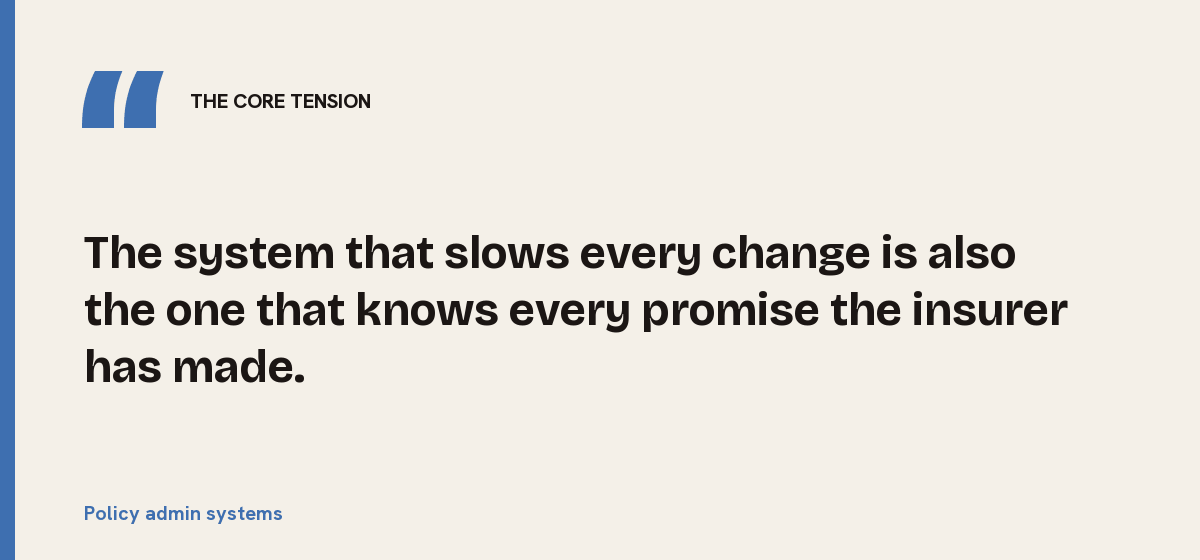
The system that slows every change is also the one that knows every promise the insurer has made.
a life insurer wants to launch a simplified protection product online. Its policy system can only handle new products through a nine-month release cycle. The insurer launches the product on a new cloud-based platform, keeps existing policies on the old one, and connects both to its customer portal and finance systems.
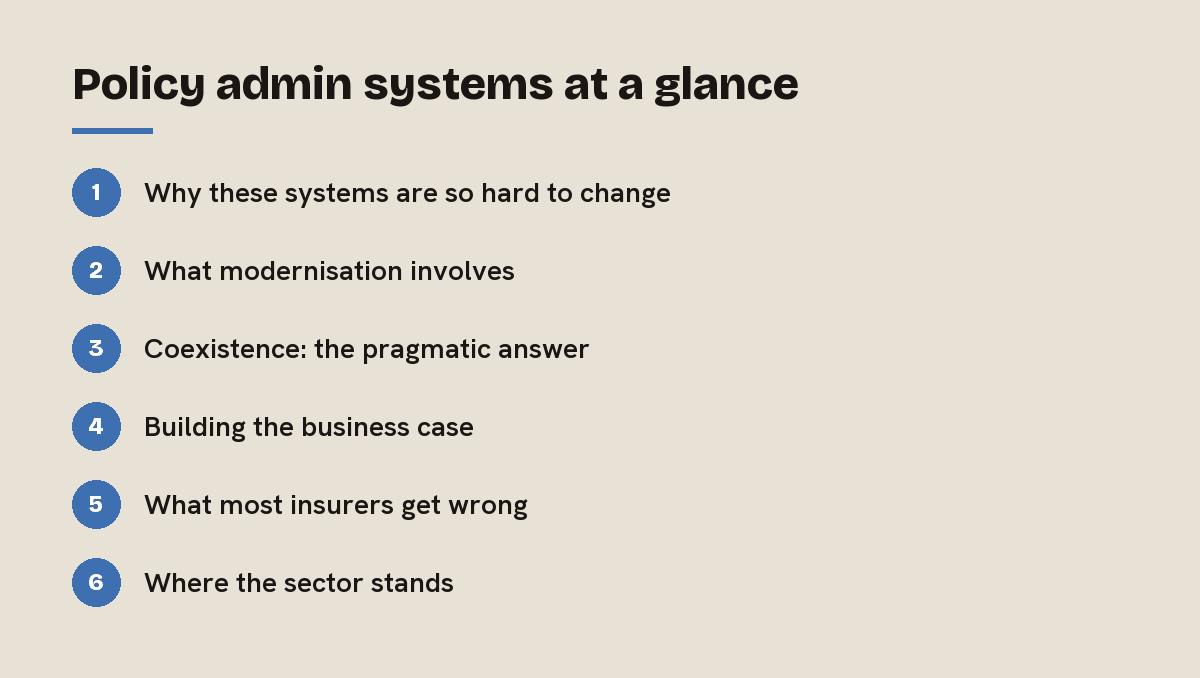
1. Why these systems are so hard to change
| Factor | What it looks like on the ground | Why it creates a bottleneck |
|---|---|---|
| Embedded actuarial logic | Premium, reserve and benefit calculations coded over decades | Changes risk unintended financial effects |
| Underwriting and claims rules | Rules scattered across code and tables | Hard to find, test and change safely |
| Regulatory logic | Tax, reporting and disclosure rules for many product generations | Errors carry conduct and regulatory risk |
| Long-lived policies | Contracts lasting decades, many closed to new business | Old products must be supported indefinitely |
| Scarce skills | Few people understand older technologies | Every change depends on a small team |
2. What modernisation involves
Replacing or modernising policy admin systems is not a single project. It typically includes:
- Product migration: rebuilding each product’s rules, calculations and documents on the new platform, and proving the results match.
- Data conversion: cleansing and converting policy, customer and transaction history, often across many product generations.
- Integration: reconnecting broker portals, claims, billing, finance, reinsurance and regulatory reporting.
- Governance change: new ways of approving product and pricing changes, because the old constraints no longer apply.
Accounting change has added to the pressure. IFRS 17, effective for annual periods beginning on or after 1 January 2023, required insurers to produce much more granular contract data, and many found their policy admin systems could not supply it without extensive workarounds.
3. Coexistence: the pragmatic answer
| Approach | How it works | Main risk |
|---|---|---|
| Big-bang replacement | All products and policies move at once | Very high delivery and operational risk |
| New business only | New products on a new platform; old book stays | Two platforms to run, possibly for decades |
| Progressive migration | Products move in waves after new business | Long programme needing sustained sponsorship |
| Outsource closed books | Closed books moved to a specialist administrator | Third-party dependency and oversight |
Coexistence architectures typically combine the second and third approaches: new products start on modern platforms immediately, while existing books migrate in planned waves, with a common integration layer so customers, brokers and staff see one experience.
4. Building the business case
Business cases for replacing policy admin systems often fail because they promise savings that arrive only after full migration, years away. Stronger cases separate three sources of value. The first is growth: new products launched faster on a modern platform, often within the first year. The second is cost: lower run costs as legacy books are migrated or outsourced, and fewer manual workarounds. The third is risk reduction: fewer dependencies on scarce skills, better data for reporting, and stronger resilience. Presenting value in waves, tied to specific products and books, gives boards a programme they can monitor and adjust rather than a single, distant promise.
5. What most insurers get wrong
- Underestimating data: conversion usually takes longer and costs more than the new platform itself.
- Recreating every quirk: copying old product logic exactly onto a new system carries old complexity forward. Use migration as a chance to simplify.
- Ignoring the closed book: closed products often hold most policies and most operational cost.
- Forgetting resilience: new platforms, often cloud-based and supplied by third parties, fall under the EU’s Digital Operational Resilience Act, which has applied since 17 January 2025. Third-party risk and exit plans need attention from day one.
6. Where the sector stands
European insurers are still early in this journey. EIOPA’s 2023 digitalisation survey of European insurers found that the level of digitalisation in the European insurance sector is varied and in most cases still at an early stage, with nearly 80 per cent of respondents using large technology companies for cloud storage. The opportunity is large, but so is the complexity inherited in older policy admin systems.
Example: a general insurer planned a full replacement of its policy system over four years. After a review, it changed course: new digital products went live on a modern platform within a year, the largest legacy product moved in the second year, and small closed books were moved to a specialist administrator. The insurer reached its digital goals earlier and spread the risk over smaller steps.
Key takeaways on policy admin systems
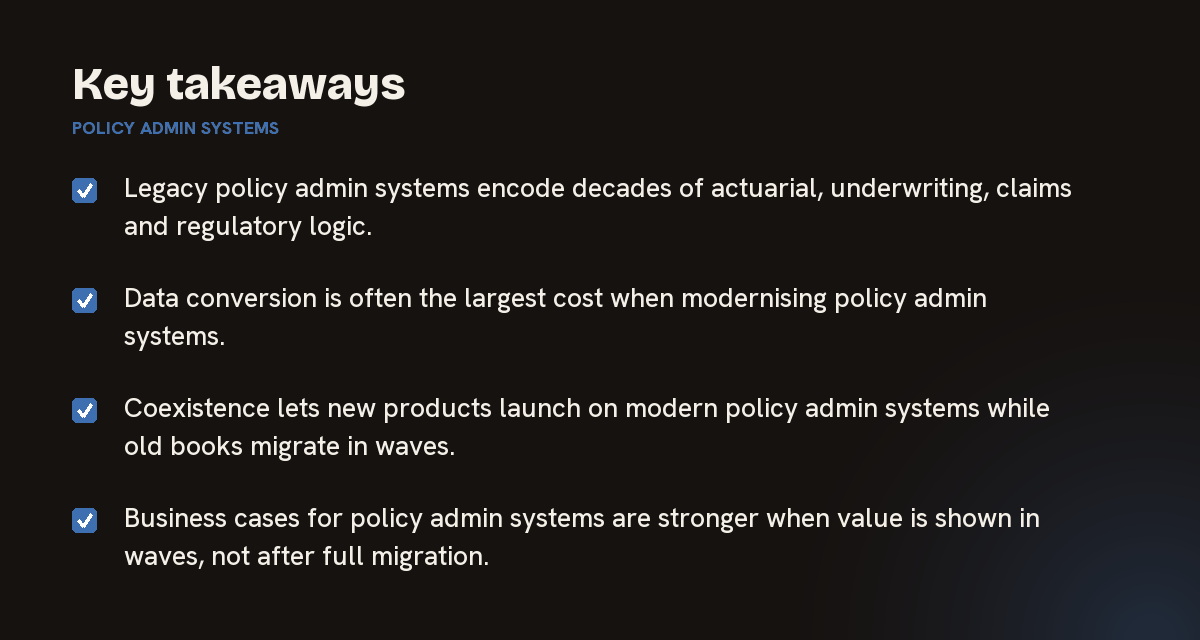
- Legacy policy admin systems encode decades of actuarial, underwriting, claims and regulatory logic.
- Data conversion is often the largest cost when modernising policy admin systems.
- Coexistence lets new products launch on modern policy admin systems while old books migrate in waves.
- Business cases for policy admin systems are stronger when value is shown in waves, not after full migration.
For insurance executives, the question is not whether to modernise legacy policy admin systems but how to sequence it so the business keeps moving. A clear coexistence plan, honest data assessment and simplified products make the difference between a programme that delivers in waves and one that disappears into a decade-long replacement.
Optimizium helps insurers plan and deliver policy administration modernisation. We respect the actuarial and operational knowledge embedded in existing systems, because it represents commitments to customers that must be honoured. And we bring actuarial, finance, risk and compliance teams into the design as co-authors, so migration strengthens control rather than putting it at risk.
Explore how we approach this across Insurance, Wealth Management and Beyond Banking, browse the FAQ Hub, or read the related question: Why are data platforms foundational?
Related questions
Partner with the experts.
Let's discuss how Optimizium can accelerate your roadmap and navigate complex digital transformation.
Schedule a consultation →