Home › FAQ Hub › Why do digital financial journeys fail at the final steps?
Digital Ops & Customer ExperienceWhy do digital financial journeys fail at the final steps?
Digital financial journeys often fail at the final steps because that is where the hardest requirements are concentrated: compliance checks, identity and anti-money-laundering controls, data validation, exception handling and, in some sectors, health or suitability questions.
Customers often get through the first screens of digital financial journeys with ease. Then, just before the finish line, something goes wrong: an unexpected document request, a disclosure they do not understand, a check that fails without explanation. The customer who was almost won is lost.
Digital financial journeys often fail at the final steps because that is where the hardest requirements are concentrated: compliance checks, identity and anti-money-laundering controls, data validation, exception handling and, in some sectors, health or suitability questions. Late-stage friction usually reflects regulatory over-caution, manual back-office dependencies, gaps between the journey and the system of record, and a lack of progressive disclosure that prepares customers for what is coming.
Each sector has its own pinch point: in insurance, health and medical disclosures; in wealth, risk and suitability checks; in banking, KYC, AML and credit rules. Because final-step abandonment comes after most of the acquisition cost has been spent, it is among the most expensive failures a journey can have.
The core tension, in one line:
The steps that matter most to the regulator often arrive at the moment the customer’s patience is lowest.
a customer completes most of a life insurance application in ten minutes, then reaches a long set of medical questions and a request for a doctor’s contact details. Unsure how long it will take or why it is needed, she abandons. When the insurer moves short screening questions earlier and explains the medical step upfront, completion improves.
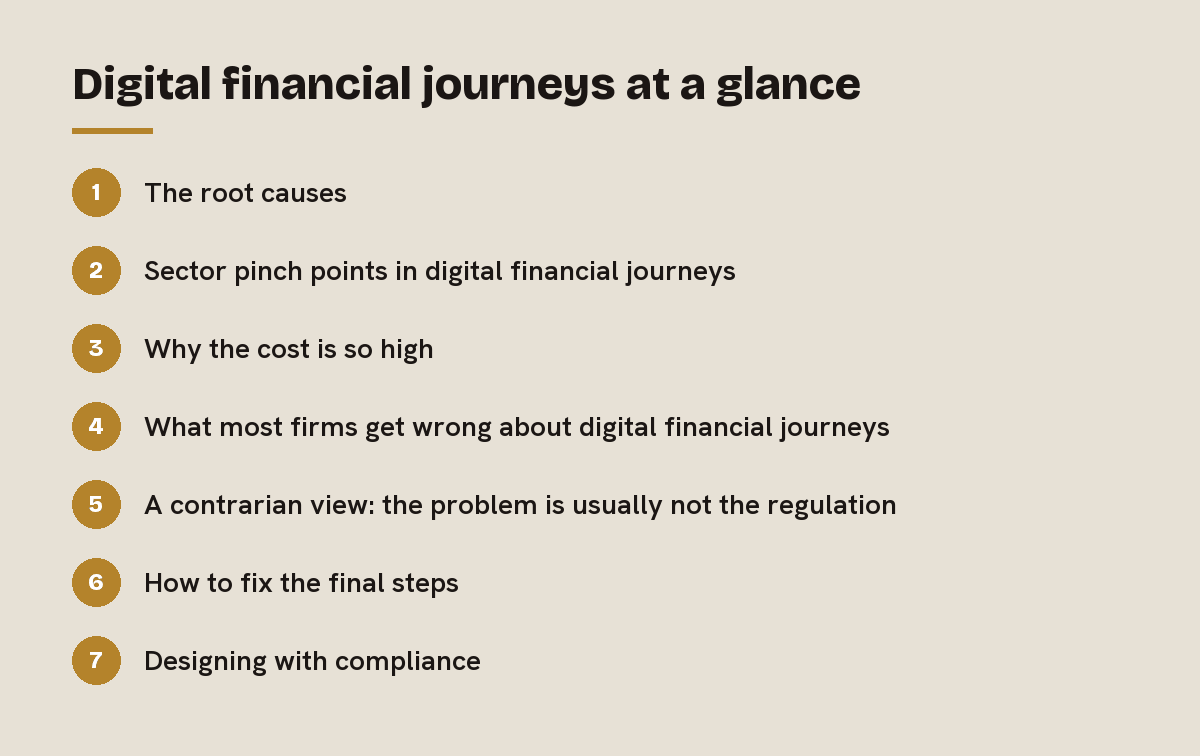
1. The root causes
| Root cause | What it looks like on the ground | Why it hits at the end |
|---|---|---|
| Regulatory over-caution | Every possible check run for every applicant | Controls are added at the end of the design |
| Manual back-office dependencies | Applications queued for manual review | The digital journey ends in a waiting room |
| System-of-record gaps | Data rejected by core systems at submission | Validation happens only when data reaches the core |
| Lack of progressive disclosure | Surprise requests late in the journey | Customers were not prepared for what is needed |
| Unclear exception handling | Generic error messages, no next step | Exceptions are designed as dead ends |
2. Sector pinch points in digital financial journeys
- Insurance: health and medical disclosures. Long medical questionnaires and evidence requests block completion, especially in life and protection.
- Wealth: risk and suitability checks. Suitability assessments interrupt transactions when they arrive unexpectedly or are hard to understand.
- Banking: KYC, AML and credit rules. Identity documents, source-of-funds questions and credit decisions concentrate at the end of applications.
| Sector | Typical final-step blocker | Better approach |
|---|---|---|
| Insurance | Medical questionnaire | Short screening early; explain later steps; tele-underwriting option |
| Wealth | Suitability assessment | Profile captured early and reused; clear explanation of purpose |
| Banking | Document upload and manual review | Digital identity, pre-filled data, instant decisions where possible |
3. Why the cost is so high
By the final steps of digital financial journeys, the institution has already paid to attract the customer and the customer has invested time. Signicat’s survey of 7,600 European consumers found that 68 per cent had abandoned a financial services application in the previous year. Late-stage abandonment wastes the most money and leaves the strongest negative impression.
There is a conduct dimension too. The FCA’s Consumer Duty asks firms to give customers information at the right time and in a way they can understand. A journey that surprises customers with complex requirements at the last moment struggles to meet that standard.
4. What most firms get wrong about digital financial journeys
- Designing the happy path first and compliance last: controls bolted on at the end create the worst friction at the worst time.
- Validating late: data that could have been checked on the first screen is rejected on submission.
- Hiding what is coming: customers abandon when they cannot see how many steps remain or what will be needed.
- Ending in a queue: a “thank you, we’ll be in touch” page after a manual referral is often the real end of the journey.
Example: a bank’s personal loan journey lost many applicants at the final document upload. Analysis showed most uploads failed because of image quality or wrong document types. The bank added guidance at the start, accepted digital bank statements through open banking and checked documents instantly with clear feedback. Final-step completion rose markedly.
5. A contrarian view: the problem is usually not the regulation
It is common to blame regulation for late-stage friction. In practice, most regulatory requirements can be met far more smoothly than they are. The real problem is usually where and how checks are placed, how they are explained and how exceptions are handled. Regulation sets what must be done; design decides how painful it is.
6. How to fix the final steps
- Move checks earlier where possible, and validate data as it is entered.
- Use progressive disclosure: show customers upfront what will be needed and why.
- Reuse data from previous interactions, open banking or digital identity.
- Design exceptions as paths, not dead ends, with clear next steps, so digital financial journeys can continue rather than stop.
- Reduce manual dependencies through automation and instant decisions.
- Measure step by step, focusing on the last three steps.
7. Designing with compliance
The most effective teams bring compliance, financial crime and underwriting specialists into the design of digital financial journeys from the start. Together they decide which checks are essential, which can be simplified, and where they should sit. This collaboration usually produces journeys that are both smoother and better evidenced than those designed separately.
Key takeaways on digital financial journeys
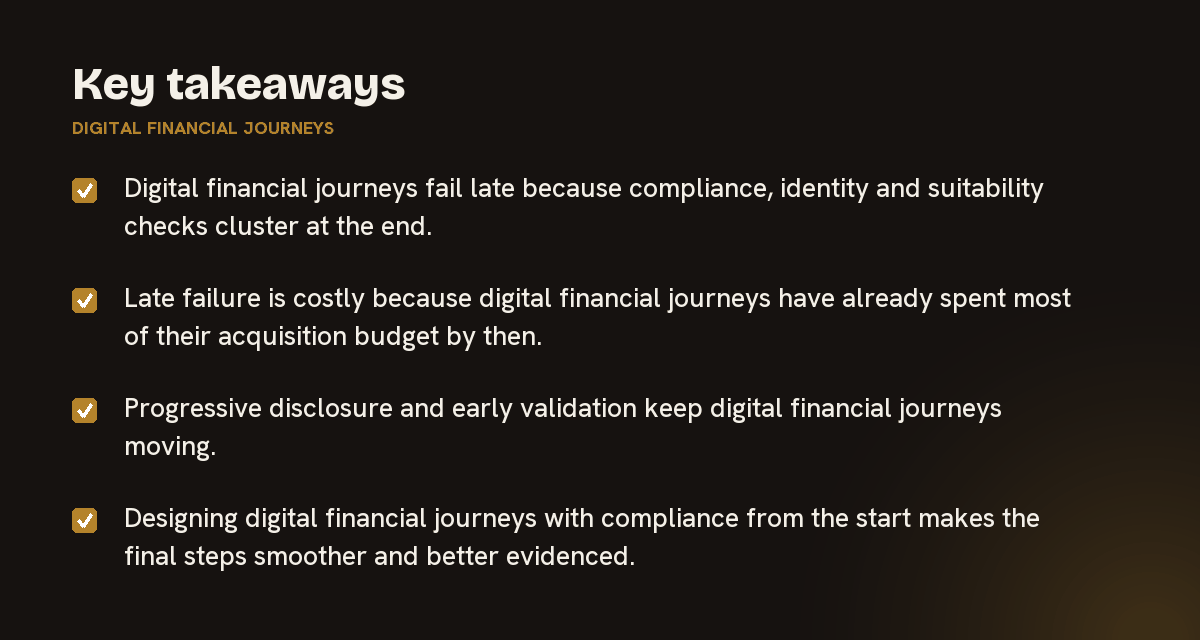
- Digital financial journeys fail late because compliance, identity and suitability checks cluster at the end.
- Late failure is costly because digital financial journeys have already spent most of their acquisition budget by then.
- Progressive disclosure and early validation keep digital financial journeys moving.
- Designing digital financial journeys with compliance from the start makes the final steps smoother and better evidenced.
For leadership teams, late-stage failure is one of the clearest and most fixable sources of lost revenue. Measuring it, understanding its causes and redesigning the final steps with compliance at the table can lift conversion quickly without weakening control.
Optimizium helps banks, insurers and wealth managers redesign digital financial journeys from first click to final confirmation. We respect the regulatory and underwriting knowledge behind each check, because it protects customers and the institution. And we bring compliance, financial crime and operations teams into the design as co-authors, so the final steps become smooth, clear and well controlled.
Explore how we approach this across Banking, Insurance and Wealth Management, browse the FAQ Hub, or read the related question: Why do many digital journeys require human reassurance?
Related questions
On this page
Partner with the experts.
Let's discuss how Optimizium can accelerate your roadmap and navigate complex digital transformation.
Schedule a consultation →