Home › FAQ Hub › Why do digital transformations require cultural change, not only technology change?
Leadership, Change & Operating ModelsWhy do digital transformations require cultural change, not only technology change?
Digital transformations require cultural change because they alter decision velocity, accountability structures, risk tolerance and the logic of how value is created. Technology provides the capability; culture decides whether that capability is used.
Financial institutions are good at buying technology. They can sign contracts, migrate systems and launch apps. What they find much harder is changing how people decide, take risks and work together, and that is where most transformations succeed or stall.
Digital transformations require cultural change because they alter decision velocity, accountability structures, risk tolerance and the logic of how value is created. Technology provides the capability; culture decides whether that capability is used. In financial services, deeply embedded control cultures, hierarchical approval chains and strong risk aversion often conflict with iterative experimentation, product ownership and fast decisions.
Cultural change does not mean abandoning control. It means changing how control works: involving risk early instead of at the end, delegating decisions within clear limits, rewarding learning as well as delivery, and making cross-functional collaboration normal rather than exceptional.
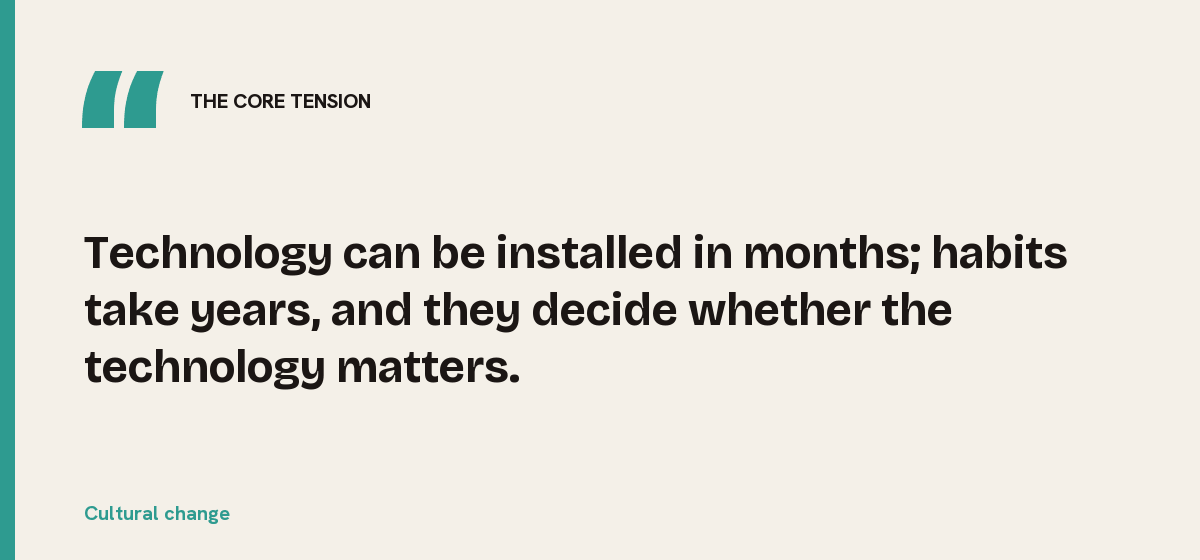
The core tension, in one line:
Technology can be installed in months; habits take years, and they decide whether the technology matters.
a bank equipped its teams with modern tools and agile training, but every change still needed approval from five committees, and failed experiments were treated as mistakes. After leaders delegated decisions within agreed limits and began reviewing what teams learned from tests, delivery sped up and teams proposed bolder ideas.
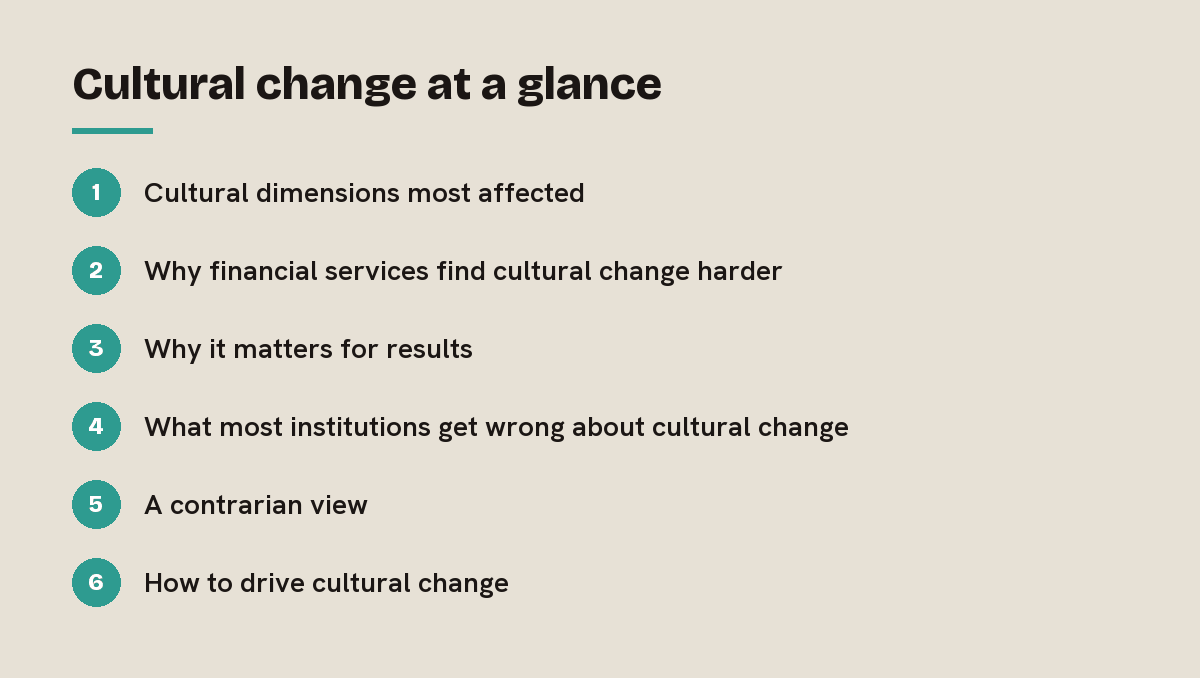
1. Cultural dimensions most affected
| Dimension | Traditional culture | Digital culture |
|---|---|---|
| Decision speed | Long approval chains | Decisions close to the work |
| Accountability | Functional, for parts | Product teams, for outcomes |
| Risk tolerance | Avoid all failure | Small, controlled experiments |
| Collaboration | Hand-offs between functions | Cross-functional teams |
| Value logic | Projects delivered | Customer and business outcomes |
2. Why financial services find cultural change harder
- Control cultures: strong controls are essential, but they can become reflexive and slow.
- Hierarchy: decisions escalate by default.
- Personal accountability: regulation places responsibility on named individuals, which encourages caution.
- Long careers in one model: people have succeeded by following established ways of working.
The skills context adds pressure. The World Economic Forum found that employers expect 39 per cent of workers’ core skills to change by 2030. In banking, around 5 per cent of staff are allocated to digital transformation initiatives, according to the ECB, so most employees experience transformation through changes in their own work rather than in dedicated programmes.
3. Why it matters for results
Technology-led programmes often disappoint. McKinsey found that only 16 per cent of respondents said their digital transformations had improved performance and been sustained. Where culture does not change, new tools are used in old ways.
| Signal of cultural change | What to look for |
|---|---|
| Delegation | Teams decide within limits without escalation |
| Early risk involvement | Risk partners in teams from the start |
| Learning | Tests and their lessons reviewed openly |
| Outcome focus | Leaders ask about customer and business results |
4. What most institutions get wrong about cultural change
- Running culture as a communications campaign: posters and town halls do not change incentives or decision rights.
- Expecting change below, not above: leaders’ behaviour sets the tone.
- Treating control and agility as opposites: controls can be redesigned to support speed.
- Ignoring incentives: people follow how they are measured and rewarded.
Example: an insurer changed its performance objectives so that product teams were measured on claims outcomes and cycle time, not just project milestones, and leaders began attending sprint reviews. Within a year, teams were proposing changes to processes and rules, not only to screens, and claims performance improved.
5. A contrarian view
Cultural change is often presented as the soft side of transformation. It is in fact the hardest and most concrete part: it is visible in who decides, how risk is involved, what gets measured and what leaders spend their time on. Changing those structures changes culture far more reliably than any culture programme.
6. How to drive cultural change
- Change decision rights, delegating within clear limits.
- Embed risk and compliance in teams early.
- Align incentives with outcomes and learning.
- Make leaders visible role models of new ways of working.
- Celebrate useful lessons, not only successes.
Key takeaways on cultural change
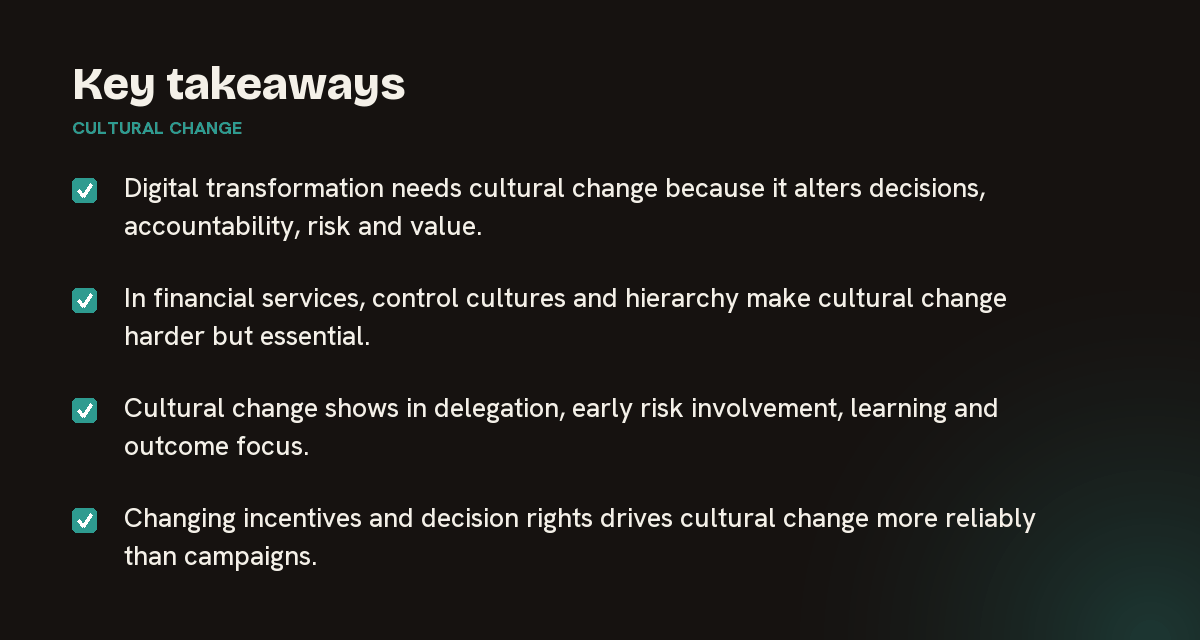
- Digital transformation needs cultural change because it alters decisions, accountability, risk and value.
- In financial services, control cultures and hierarchy make cultural change harder but essential.
- Cultural change shows in delegation, early risk involvement, learning and outcome focus.
- Changing incentives and decision rights drives cultural change more reliably than campaigns.
For leadership teams, cultural change is not a parallel workstream but the core of transformation. The technology investment pays off only when people decide, collaborate and manage risk in ways that use it.
Optimizium helps banks, insurers and wealth managers change ways of working alongside technology. We respect the control and risk cultures that keep institutions safe, because they are worth preserving in a modern form. And we bring risk, compliance and HR into the design as co-authors, so cultural change strengthens control rather than weakening it.
Explore how we approach this across Banking, Insurance, Wealth Management and Beyond Banking, browse the FAQ Hub, or read the related question: What differentiates “sponsorship” from “ownership” in transformation?
Related questions
Partner with the experts.
Let's discuss how Optimizium can accelerate your roadmap and navigate complex digital transformation.
Schedule a consultation →