Home › FAQ Hub › Why do incumbents struggle with speed-to-market?
Strategy & PositioningWhy do incumbents struggle with speed-to-market?
Speed-to-market is the time it takes an institution to move from an approved idea to a product or change that customers can use, and incumbents struggle with it because every change has to pass through layers of architecture, control, incentive and channel that newer firms never built.
A fintech can launch a new savings feature in a quarter. An established bank with more money, more customers and more expertise often needs a year for something similar. The difference is rarely talent.
Speed-to-market is the time it takes an institution to move from an approved idea to a product or change that customers can use, and incumbents struggle with it because every change has to pass through layers of architecture, control, incentive and channel that newer firms never built. Four inhibitors do most of the damage: core integration, regulatory compliance processes, legacy channels and architectural debt. Governance and integration overheads then amplify each delay. Fintech product squads are faster mainly because they own fewer dependencies, not because they work harder. Improving speed-to-market therefore means removing dependencies, not asking teams to run faster.
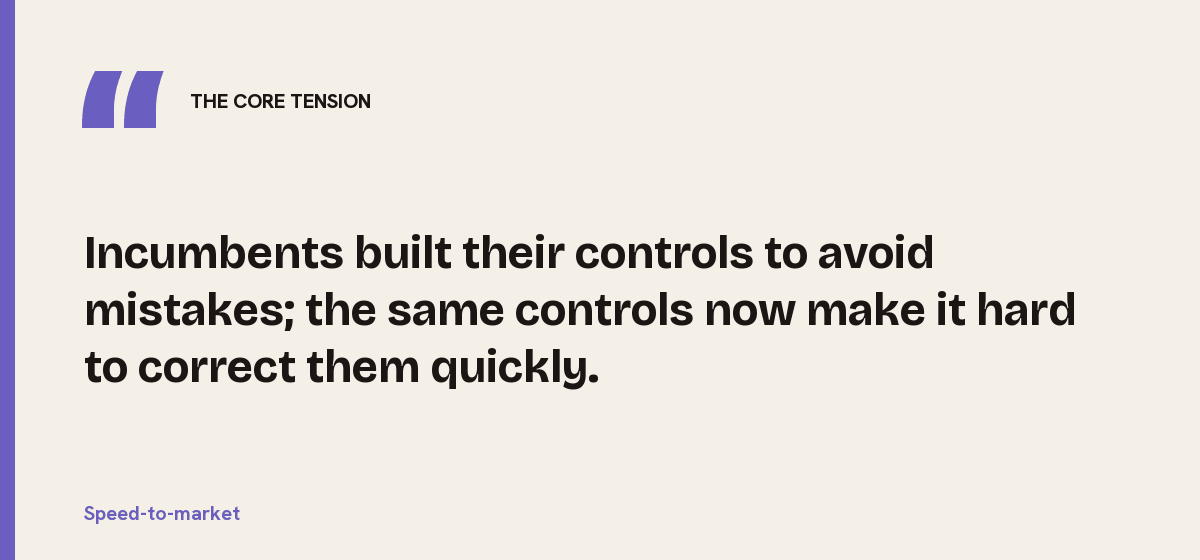
The core tension, in one line:
Incumbents built their controls to avoid mistakes; the same controls now make it hard to correct them quickly.
a bank decides to let customers change a direct debit date in the app. The change touches the payments engine, the core account system, the app, the contact-centre script and the terms. Five teams, three release calendars and two committees later, it ships in eleven months. A challenger bank with one product team does the same in six weeks.
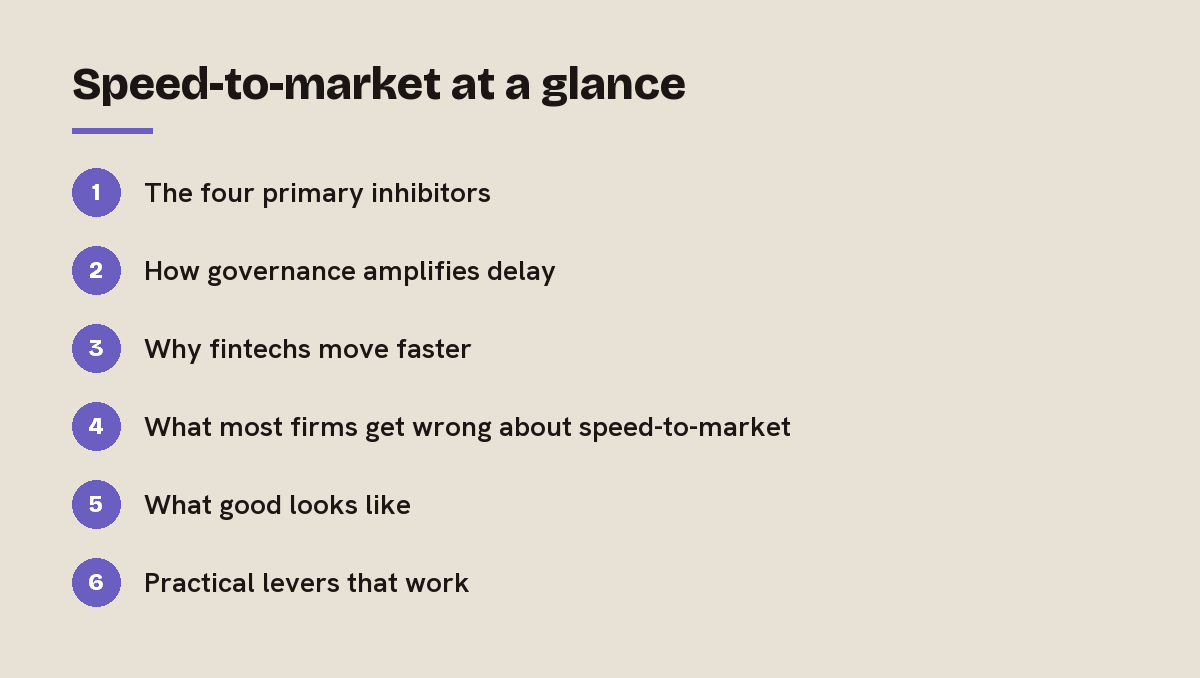
1. The four primary inhibitors
Four inhibitors do most of the damage, each in a different way.
| Inhibitor | What it looks like on the ground | Why it slows delivery |
|---|---|---|
| Core integration | Every change needs a release of a central system with a quarterly calendar | The slowest system sets the pace for everyone |
| Regulatory compliance | Reviews happen at the end, in sequence, by separate teams | Late findings force rework |
| Legacy channels | Branch, broker and contact-centre processes must all be updated | Digital changes wait for the slowest channel |
| Architectural debt | Tightly coupled systems where one change has unpredictable effects | Testing expands and confidence shrinks |
2. How governance amplifies delay
Each inhibitor alone adds weeks. Governance turns weeks into months.
- Sequential approvals: risk, legal, compliance, security and architecture each review in turn, rarely together.
- Annual budgeting: funding is tied to projects approved a year in advance, so new opportunities wait for the next cycle.
- Fragmented incentives: product, technology and channel leaders are measured on different goals, so no one owns the end-to-end speed-to-market.
- Release trains: monthly or quarterly release windows set a floor on how fast anything can change.
The ECB’s survey of large banks found that almost all had a digital strategy, yet many lacked adequate indicators to steer it. Few incumbents measure speed-to-market at all, which makes it hard to improve.
3. Why fintechs move faster
| Factor | Incumbent | Fintech |
|---|---|---|
| Team structure | Functional teams hand work to each other | Cross-functional squads own a product end to end |
| Architecture | Shared cores, tight coupling | Modular services, cloud-native |
| Channels | Many, including physical | Mostly one or two digital channels |
| Control model | Review at the end | Controls built into the pipeline |
| Scale of impact | Millions of customers per change | Smaller base, smaller blast radius |
The last row matters. Incumbents are slower partly for good reasons: a mistake affects far more customers. The aim is not to copy fintech risk appetite but to make change safe and fast at the same time.
4. What most firms get wrong about speed-to-market
- Buying agile training instead of removing dependencies: teams that still wait on five other teams will not speed up because of a new ceremony.
- Treating compliance as the bottleneck: compliance reviews are slow mainly because they arrive late. Involving risk and compliance from the first sprint usually shortens the total time.
- Modernising everything at once: a full core replacement can take years before it improves speed-to-market at all.
- Ignoring the channel tail: a digital feature that requires branch retraining will wait for the training.
The record on large programmes is sobering. McKinsey’s research found that only 16 per cent of digital transformations both improved performance and were sustained. Programmes that target speed-to-market through dependency removal tend to show results earlier than those that wait for a new core.
Example: an insurer cut the time to launch a new product variant from nine months to seven weeks. It did not replace its policy system. Instead it created a configurable product layer for common variants, set up a standing review forum where compliance, legal and pricing met weekly with the product team, and agreed a set of pre-approved wording blocks. Most launches no longer needed bespoke review.
5. What good looks like
Institutions that have improved their pace share some recognisable habits. Product, technology, risk and operations colleagues sit in the same team or meet weekly, so questions are answered in days. Lead time is reported to the executive committee alongside cost and risk measures. Teams can release small changes on their own schedule because automated tests and controls give everyone confidence. And funding follows outcomes, so a team that discovers a better idea in March does not wait until next year to pursue it.
None of this removes the need for careful control. It moves control earlier, makes it continuous and shares it across disciplines, which is exactly what regulators increasingly expect.
6. Practical levers that work
- Measure lead time from approval to customer availability, and publish it.
- Create stable product teams with the skills to deliver end to end.
- Decouple channels from cores with APIs and an orchestration layer.
- Build controls into delivery pipelines, with automated testing and evidence.
- Fund products, not projects, so teams can respond within the year.
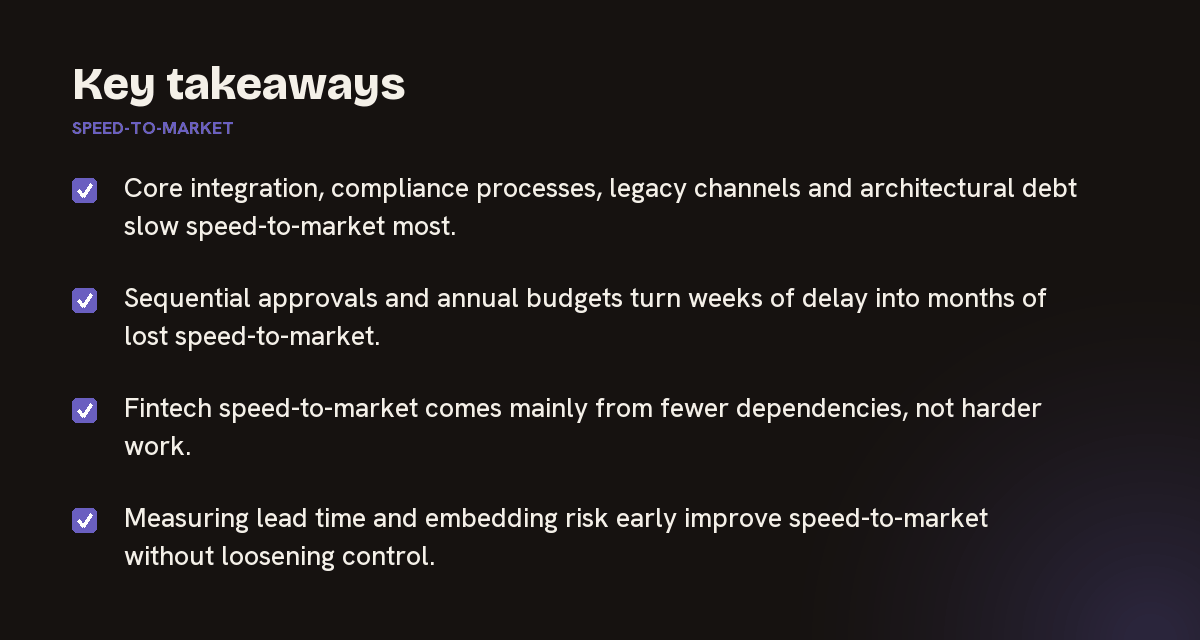
Key takeaways on speed-to-market
- Core integration, compliance processes, legacy channels and architectural debt slow speed-to-market most.
- Sequential approvals and annual budgets turn weeks of delay into months of lost speed-to-market.
- Fintech speed-to-market comes mainly from fewer dependencies, not harder work.
- Measuring lead time and embedding risk early improve speed-to-market without loosening control.
Speed-to-market is one of the clearest tests of whether a transformation is working. If the time from idea to customer is falling, the operating model is changing; if it is not, the programme is probably producing documents rather than outcomes.
Optimizium helps incumbents shorten that path without loosening control. We respect the risk disciplines that make established institutions trustworthy, because they are an asset rather than an obstacle. And we bring compliance, risk and architecture into delivery as co-authors, so speed-to-market improves because the right people decide together, early.
Explore how we approach this across Banking, Insurance, Wealth Management and Beyond Banking, browse the FAQ Hub, or read the related question: How do regulatory environments influence transformation?
Related questions
Partner with the experts.
Let's discuss how Optimizium can accelerate your roadmap and navigate complex digital transformation.
Schedule a consultation →