Home › FAQ Hub › Why do institutions invest in segmentation analytics?
Leadership, Change & Operating ModelsWhy do institutions invest in segmentation analytics?
Institutions invest in segmentation analytics because well-built segments predict channel preference, product needs, risk and the likelihood that a customer will leave.
Every financial institution segments its customers in some way: by age, income, product holding or branch. The question is whether those segments reflect how customers really behave and what they need next, or simply how the institution has always organised its reports.
Institutions invest in segmentation analytics because well-built segments predict channel preference, product needs, risk and the likelihood that a customer will leave. That knowledge supports targeted marketing, cross-sell, pricing, service design and retention, and it helps institutions spend money where it changes outcomes rather than spreading it evenly.
The approaches differ. Fintechs often build real-time, behavioural segments from app and transaction data, while many incumbents still rely on historical and actuarial segments refreshed a few times a year. Advanced segmentation analytics also support dynamic pricing and predictive retention, which is where regulators look most closely at fairness.
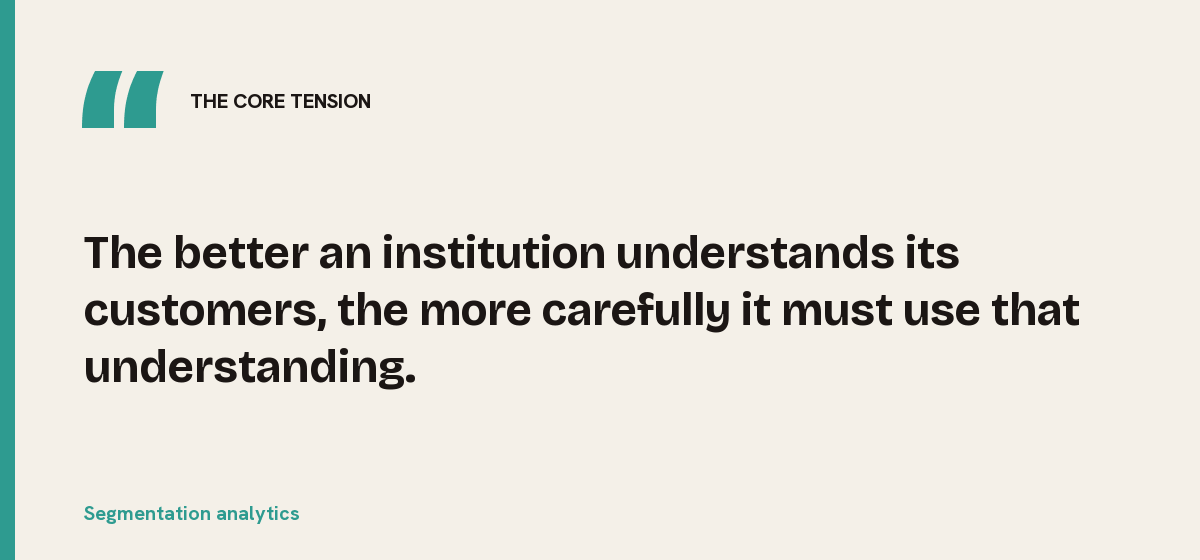
The core tension, in one line:
The better an institution understands its customers, the more carefully it must use that understanding.
a bank’s traditional segments grouped customers by age and income. Behavioural segmentation analytics revealed a group of younger customers with rising salaries and no mortgage who were researching property online. A timely, clearly explained mortgage offer converted far better than the bank’s usual campaigns, and complaints did not rise.
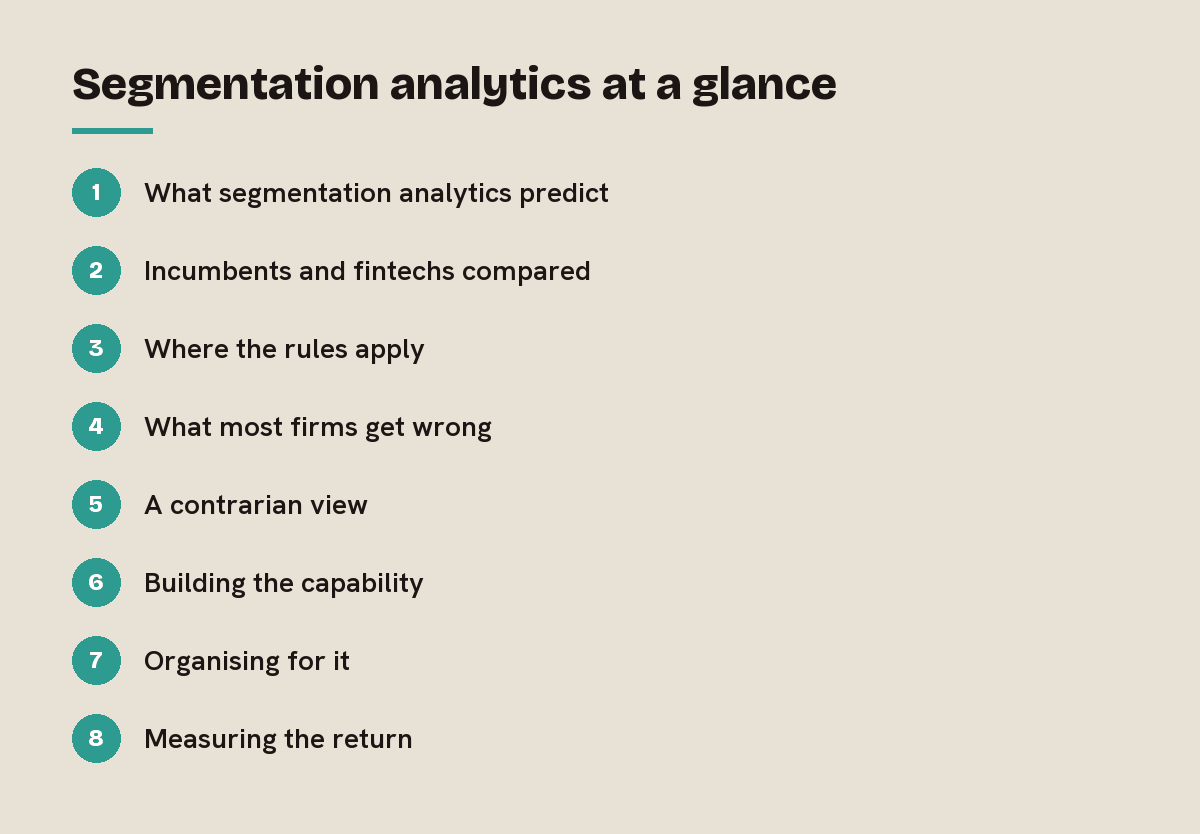
1. What segmentation analytics predict
| Prediction | What it looks like on the ground | Business use |
|---|---|---|
| Channel preference | Who prefers app, phone, branch or adviser | Routing and channel design |
| Product need | Who is likely to need credit, cover or advice soon | Timely, relevant offers |
| Risk | Who shows early signs of financial stress | Earlier support, lower losses |
| Churn | Who is likely to leave | Retention actions before it is too late |
2. Incumbents and fintechs compared
| Aspect | Many incumbents | Many fintechs |
|---|---|---|
| Basis | Demographics, product holding, actuarial classes | Behaviour, transactions, app events |
| Refresh | Quarterly or annual | Continuous |
| Use | Campaign planning | Real-time decisions in journeys |
| Governance | Mature, slower | Fast, sometimes thinner |
Digital behaviour gives segmentation analytics much richer inputs than before. Eurostat reports that 67 per cent of people aged 16 to 74 in the EU used internet banking in 2024, so most customers now leave a continuous digital trail.
3. Where the rules apply
Segmentation that drives decisions about individuals is regulated.
- Automated decisions and profiling: in its SCHUFA judgment of December 2023, the Court of Justice confirmed that a score can count as an automated decision under the GDPR when it plays a decisive role.
- Fair treatment: the UK’s Consumer Duty requires firms to consider customers’ needs, characteristics and behaviour at every stage of the journey, including characteristics of vulnerability.
Segmentation analytics used for marketing timing carry less risk than segments that drive pricing or credit decisions, which need clear governance and fairness testing.
4. What most firms get wrong
- Segments nobody uses: beautiful models that never reach a journey or a frontline team.
- Static segments in a dynamic world: customers move between needs faster than annual refreshes capture.
- Optimising for sales only: segments built to sell more can harm vulnerable customers and invite regulatory challenge.
- Ignoring explainability: staff must be able to say why a customer received an offer.
Example: an insurer used segmentation analytics to identify policyholders likely to lapse at renewal. Instead of discounting automatically, it contacted them with a review of their cover and clearer pricing explanations. Retention improved, and the insurer avoided offering better prices only to customers likely to switch, a practice that raises fairness concerns.
5. A contrarian view
The value of segmentation analytics is often measured in conversion uplift. The bigger prize is often in service and risk: routing complex needs to the right people, spotting financial difficulty early and avoiding products that do not fit. Institutions that use segments to serve customers better tend to see commercial results follow.
6. Building the capability
- Start from decisions: which journeys or teams will use each segment?
- Combine behavioural and historical data with clear consent and purpose.
- Refresh segments continuously where behaviour changes quickly.
- Test fairness before segments drive pricing or credit.
- Measure outcomes for customers as well as revenue.
7. Organising for it
Segmentation works best when analytics, product, marketing, risk and frontline teams share ownership. Analysts build the models; product and marketing decide how they are used; risk and compliance set the limits; frontline teams feed back what customers say. Without that loop, segments drift away from reality.
8. Measuring the return
Useful measures include conversion and retention by segment compared with a control group, complaint and cancellation rates for targeted offers, early arrears in segments flagged for support, and the share of segments in active use by journeys or teams. Reviewing these quarterly shows whether the models are improving decisions or simply producing reports.
Key takeaways on segmentation analytics
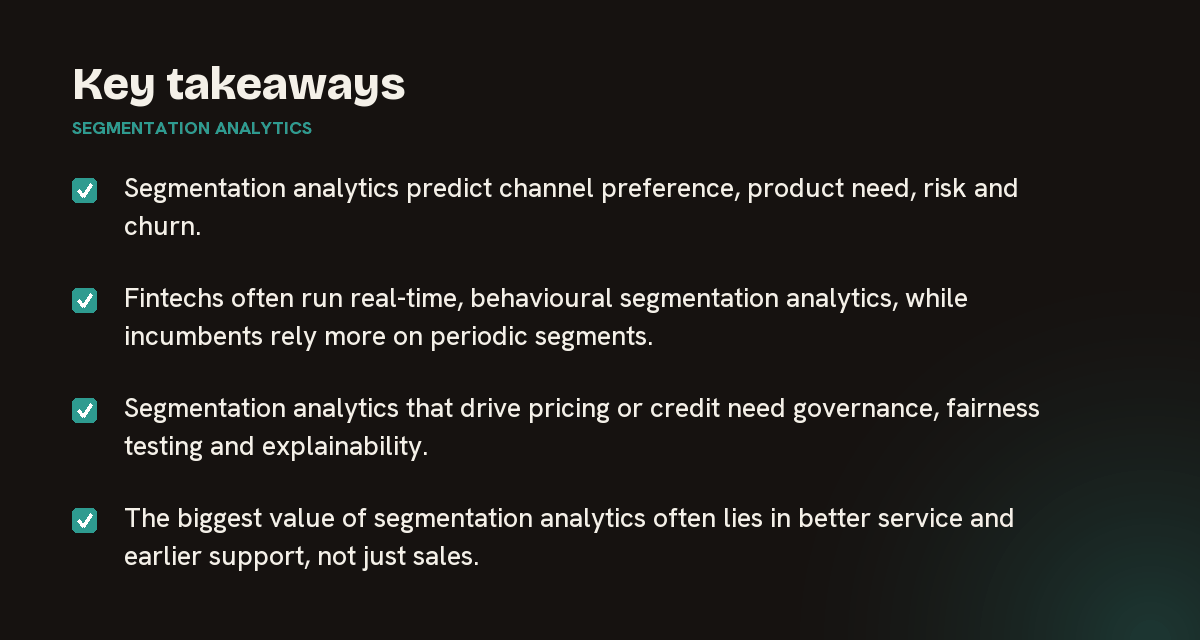
- Segmentation analytics predict channel preference, product need, risk and churn.
- Fintechs often run real-time, behavioural segmentation analytics, while incumbents rely more on periodic segments.
- Segmentation analytics that drive pricing or credit need governance, fairness testing and explainability.
- The biggest value of segmentation analytics often lies in better service and earlier support, not just sales.
For leadership teams, segmentation analytics are one of the most direct ways to turn data into better decisions. The investment pays off when segments are used across journeys and teams, and when their use is fair and explainable.
Optimizium helps banks, insurers and wealth managers build and govern segmentation that improves outcomes for customers and the business. We respect the actuarial and customer knowledge institutions already hold, because it is the foundation of meaningful segments. And we bring data protection, risk and compliance into the design as co-authors, so every segment can be explained and defended.
Explore how we approach this across Banking, Insurance and Wealth Management, browse the FAQ Hub, or read the related question: How should transformation be governed in regulated financial institutions?
Partner with the experts.
Let's discuss how Optimizium can accelerate your roadmap and navigate complex digital transformation.
Schedule a consultation →