Home › FAQ Hub › Why do insurers face slower transformation velocity?
Tech & Core ModernisationWhy do insurers face slower transformation velocity?
Insurers face slower transformation velocity because their core cycles, underwriting, policy administration and claims, depend on actuarial, regulatory, medical and distribution factors that banks rarely face to the same degree.
Compared with banking, insurance transformation often looks slow: fewer fully digital journeys, more paper, longer timelines. The comparison is understandable but misleading. Insurers face structural reasons for slower progress, and understanding them is the first step towards moving faster.
Insurers face slower transformation velocity because their core cycles, underwriting, policy administration and claims, depend on actuarial, regulatory, medical and distribution factors that banks rarely face to the same degree. Product complexity and broker-heavy distribution slow the digitisation of quotes and claims. Life and health lines add medical underwriting and long-tail claims that can run for decades. Property lines involve physical evidence, repair networks and fraud controls. Each of these creates dependencies outside the insurer’s direct control, so change takes longer to design, approve and deliver. Raising transformation velocity means managing those dependencies deliberately, not simply working faster.
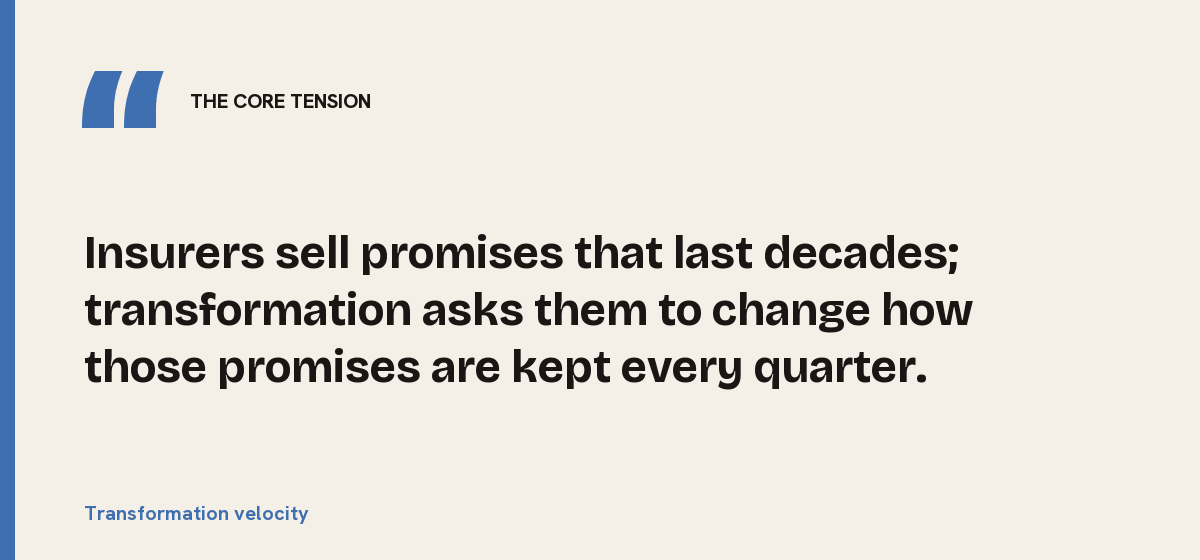
The core tension, in one line:
Insurers sell promises that last decades; transformation asks them to change how those promises are kept every quarter.
a property insurer wants to settle simple water-damage claims within 48 hours. Doing so depends on photo evidence, repairer availability, fraud checks and reserving rules, each owned by a different team or partner. The digital front end takes weeks to build; aligning the rest takes a year.
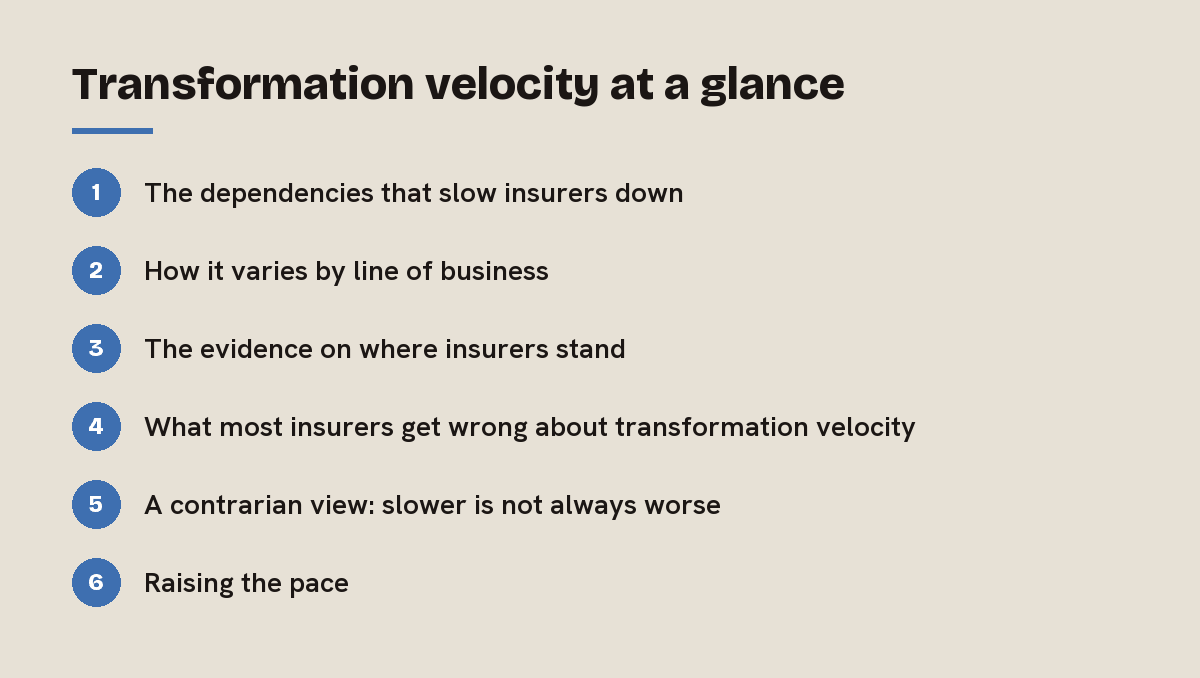
1. The dependencies that slow insurers down
| Dependency | What it looks like on the ground | Effect on transformation velocity |
|---|---|---|
| Actuarial | Pricing, reserving and capital models with long validation cycles | Product and pricing changes need careful review |
| Regulatory | Solvency, conduct and reporting obligations | Changes require documentation and approval |
| Medical | Health evidence and specialist underwriting in life and health | Journeys wait for third-party information |
| Distribution | Brokers and agents with their own systems | Changes must work across many intermediaries |
| Physical world | Repairs, surveys and evidence in property and motor | Claims depend on partners and logistics |
2. How it varies by line of business
- Life and health: medical underwriting and long-tail claims mean policies and processes must work for decades. Legacy products remain on the books long after they are closed to new business.
- Property and casualty: claims involve evidence, repair networks and fraud controls, so speed depends on an ecosystem of partners.
- Commercial lines: bespoke risks and broker negotiation limit standardisation.
- Personal lines: the fastest to digitise, particularly motor and home, where products are simpler and volumes high.
3. The evidence on where insurers stand
EIOPA’s 2023 digitalisation survey of European insurers found that the level of digitalisation is varied and in most cases still at an early stage. It also found that AI was used by 50 per cent of respondents in non-life but only 24 per cent in life, a clear sign of how line-of-business complexity affects transformation velocity.
Accounting change has absorbed capacity as well. IFRS 17, effective for annual periods beginning on or after 1 January 2023, required major changes to data, systems and processes, drawing actuarial, finance and IT resources away from customer-facing transformation for several years.
4. What most insurers get wrong about transformation velocity
- Benchmarking against banks: comparing transformation velocity with retail banking leads to unrealistic plans and disappointment.
- Digitising the front end only: online quote and claims forms without changes to underwriting and claims operations create faster starts but not faster outcomes.
- Leaving brokers out: digital programmes that bypass intermediaries meet resistance in the channel that writes most business.
- Treating all lines alike: a single programme for life, health and property usually moves at the pace of the slowest line.
| Lever | What it looks like on the ground |
|---|---|
| Segment by line | Separate roadmaps for personal lines, commercial and life |
| Simplify products | Standard products for digital and embedded channels |
| Broker enablement | Portals and APIs that make intermediaries faster |
| Ecosystem integration | Direct links to repairers, medical data providers and surveyors |
| Coexistence architecture | New platforms for new products while legacy books migrate in waves |
Example: a composite insurer split its transformation into three tracks. Personal motor and home moved to a modern platform within eighteen months, with straight-through processing for most simple claims. Commercial lines focused on broker portals and data exchange. Life concentrated on digital underwriting evidence and customer servicing. Overall transformation velocity rose because each line moved at its own realistic pace.
5. A contrarian view: slower is not always worse
There is a case for insurers moving deliberately. Their products protect people at the worst moments of their lives, and errors in claims or underwriting have serious consequences. The aim is not to match the speed of a payments app but to remove unnecessary delay while protecting what must be careful. Insurers that distinguish between the two can move much faster than they do today without taking reckless risks.
6. Raising the pace
A useful first step is a frank map of every dependency on a priority journey, with an owner and a target time for each. It often shows that much of the waiting comes from internal hand-offs rather than from regulators, doctors or repairers.
- Measure lead times for product changes and claims outcomes by line.
- Remove avoidable dependencies, especially duplicated reviews and manual hand-offs.
- Prioritise high-volume, simpler lines for early wins.
- Work with brokers and partners as part of the design.
- Fund product teams, not projects, so learning carries forward.
Key takeaways on transformation velocity
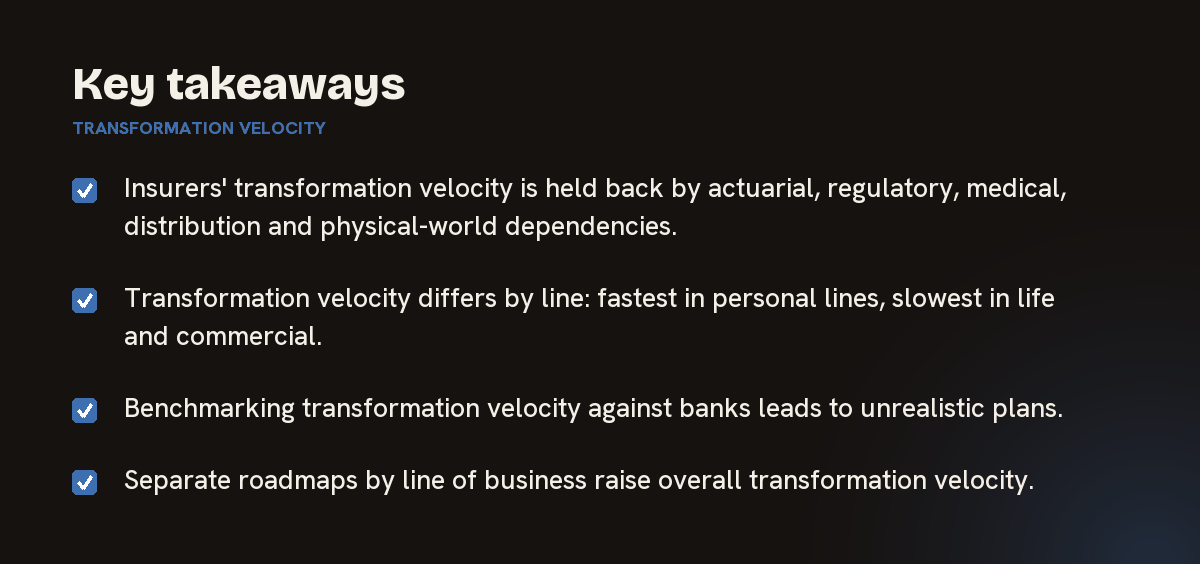
- Insurers’ transformation velocity is held back by actuarial, regulatory, medical, distribution and physical-world dependencies.
- Transformation velocity differs by line: fastest in personal lines, slowest in life and commercial.
- Benchmarking transformation velocity against banks leads to unrealistic plans.
- Separate roadmaps by line of business raise overall transformation velocity.
For insurance leaders, transformation velocity is best improved by understanding where slowness is necessary and where it is inherited. Separating the two, line by line, turns a frustrating comparison with banking into a practical plan.
Optimizium helps insurers raise transformation velocity across underwriting, claims and distribution. We respect the actuarial and underwriting expertise that keeps insurers sound, because it is the foundation of every promise they make. And we bring actuarial, risk and compliance colleagues into the design as co-authors, so faster change is also safe change.
Explore how we approach this across Insurance, Banking and Beyond Banking, browse the FAQ Hub, or read the related question: How does digital impact actuarial and underwriting functions?
Related questions
On this page
Partner with the experts.
Let's discuss how Optimizium can accelerate your roadmap and navigate complex digital transformation.
Schedule a consultation →