Home › FAQ Hub › Why do frontline and middle management often resist to digital?
Leadership, Change & Operating ModelsWhy do frontline and middle management often resist to digital?
Frontline staff and middle management often resist digital because it can threaten things they are measured and rewarded on: channel volumes, product margins, team size, compliance comfort and personal influence.
Senior leaders announce a digital strategy; customers welcome the new app; and somewhere in between, progress slows. Branch managers keep steering customers to the counter, team leaders keep the old spreadsheet, and adoption targets slip. This is rarely stubbornness. It is usually a rational response to how the organisation is set up.
Frontline staff and middle management often resist digital because it can threaten things they are measured and rewarded on: channel volumes, product margins, team size, compliance comfort and personal influence. Fears of channel cannibalisation, margin erosion, automation of their roles and new compliance exposure are common, and incentive structures and career paths frequently conflict with digital efficiency and direct channels. The observed inhibitors are consistent across banking, insurance and wealth: misaligned KPIs, legacy compensation models, perceived disintermediation and training friction. Resistance from middle management is therefore a signal that the operating model has not caught up with the strategy, not a problem of attitudes.
The core tension, in one line:
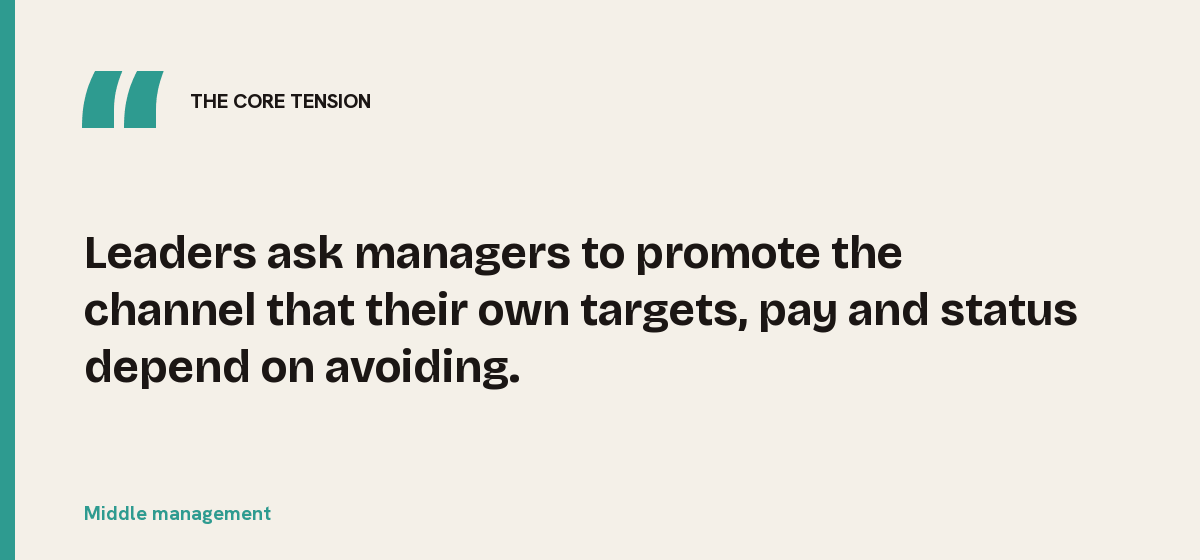
Leaders ask managers to promote the channel that their own targets, pay and status depend on avoiding.
a bank launches digital mortgage applications. Branch managers are still measured on mortgages originated in the branch, so they encourage customers to apply in person. Digital adoption stalls until the bank credits branches for digital applications from their customers and changes its targets.
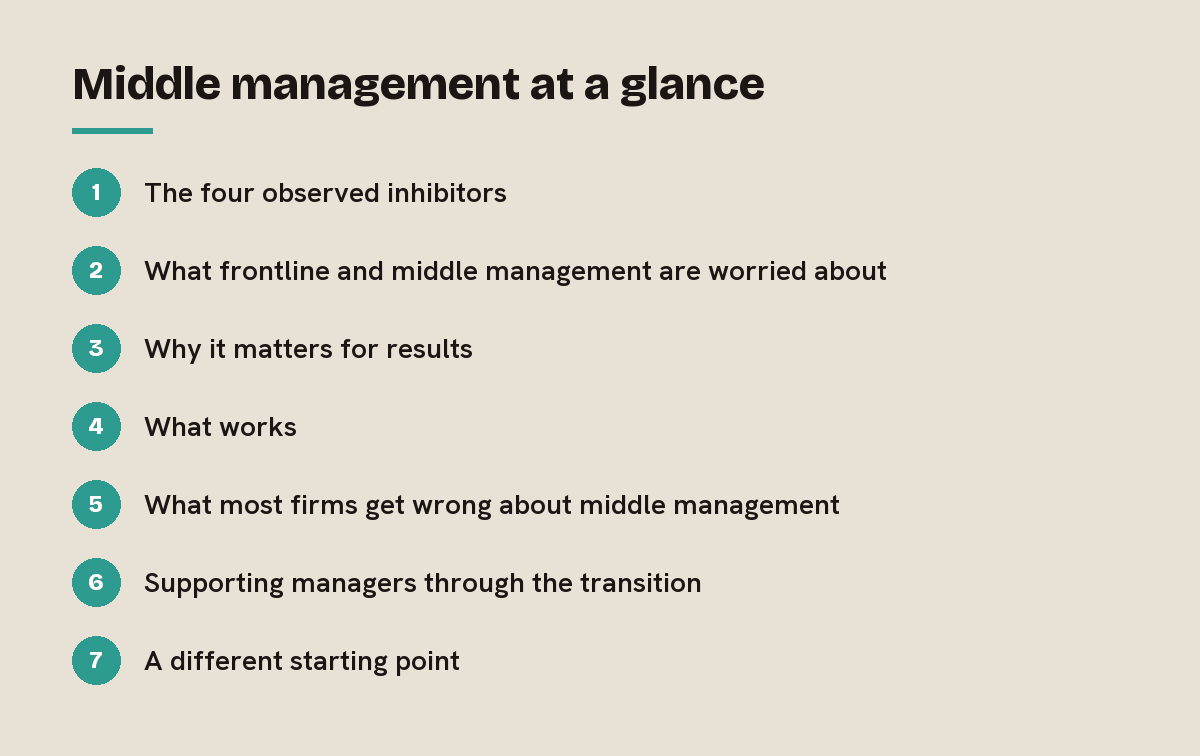
1. The four observed inhibitors
| Inhibitor | What it looks like on the ground | Why it drives resistance |
|---|---|---|
| Misaligned KPIs | Targets for branch sales, call volumes or broker business | Digital success shows up as a miss on the manager’s scorecard |
| Legacy compensation models | Commission or bonus tied to channel volume | Customers moving online reduce income |
| Perceived role disintermediation | Fear that automation removes jobs or the manager’s team | Managers protect their teams and relevance |
| Training friction | New tools introduced with little time to learn | Staff fall back on familiar processes under pressure |
2. What frontline and middle management are worried about
- Channel cannibalisation: digital sales may reduce branch, adviser or broker volumes that managers are accountable for.
- Margin erosion: digital products often carry lower prices, which can reduce the revenue a team is credited with.
- Automation: staff see routine tasks disappearing and worry their roles will follow.
- Compliance exposure: managers remain accountable for conduct and fear that new journeys create risks they cannot see.
- Loss of influence: decisions move to product squads and central digital teams.
These concerns are reasonable. Treating them as resistance to be overcome, rather than as design requirements, is why many programmes struggle.
3. Why it matters for results
Large programmes fail more often than they succeed, and people issues are a major reason. McKinsey’s research found that only 16 per cent of respondents said their digital transformations had improved performance and been sustained. Middle management sits at the point where strategy becomes daily behaviour, so its support is often decisive.
Measurement is part of the problem. When the ECB surveyed 105 large banks, it found that almost all had a digital strategy, yet many lacked adequate indicators to steer it. If the organisation cannot measure digital contribution properly, managers will keep being judged on traditional measures.
4. What works
| Lever | What it looks like on the ground |
|---|---|
| Shared credit | Branches, advisers and brokers credited for digital sales from their customers |
| New KPIs | Customer outcomes, digital adoption and total relationship value alongside volumes |
| Clear role futures | Defined new roles, such as advice specialists or digital coaches, with training paths |
| Early involvement | Managers help design journeys and pilot them with their teams |
| Time to learn | Protected training time and floor support during rollout |
5. What most firms get wrong about middle management
- Communicating instead of changing incentives: town halls and videos do not override a scorecard.
- Bypassing managers: sending digital initiatives directly to staff undermines the people who run daily operations.
- Ignoring the compliance question: managers who remain accountable need confidence that new journeys are well controlled.
- Treating resistance as a personality problem: replacing a few managers rarely helps if the system that shaped their behaviour remains.
Example: an insurer struggled to get its broker-facing sales managers to promote a new digital quoting portal. Interviews revealed that managers were measured on premium written through their own relationships, while portal business was credited centrally. Once portal business was attributed to the managing team and a small bonus element was linked to portal adoption, usage rose steadily within two quarters.
6. Supporting managers through the transition
Managers need practical help as well as new targets. That includes regular data on how their customers use digital channels, coaching on leading teams through changing roles, and a direct line to the digital teams to report what is not working. Peer networks, where managers who have succeeded share what they did, are often more persuasive than any central message.
7. A different starting point
The most effective programmes start by asking frontline and middle management what would need to be true for them to champion digital. The answers, about targets, roles, training and controls, usually form a precise change agenda. Leaders who act on it find that resistance turns into practical expertise about how journeys should work.
Key takeaways on middle management
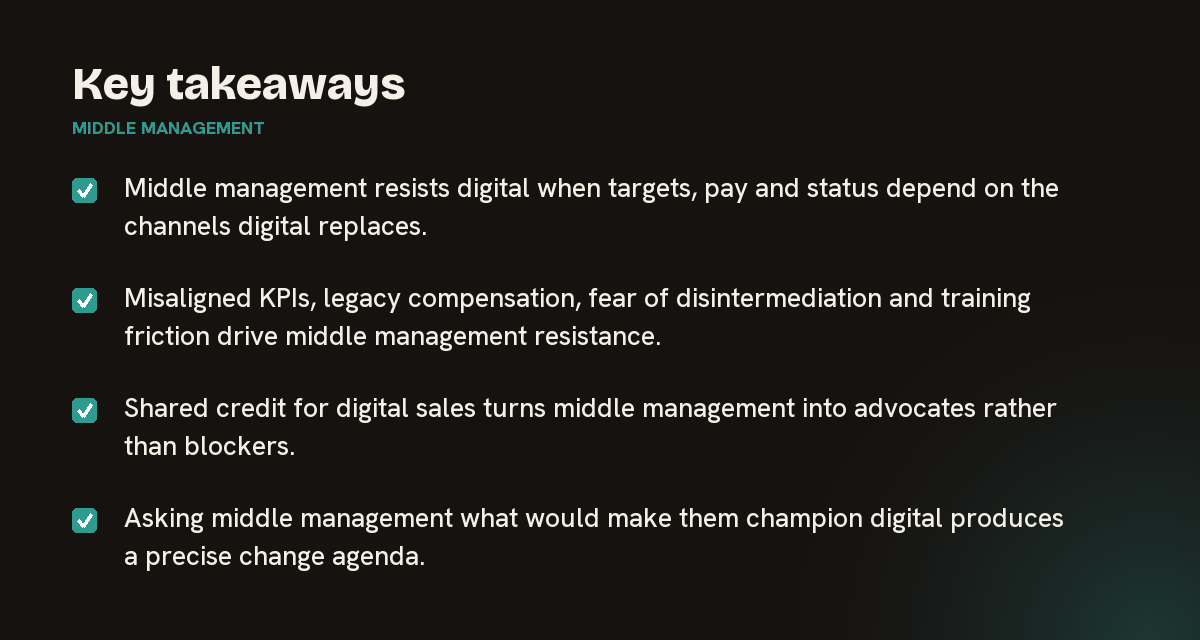
- Middle management resists digital when targets, pay and status depend on the channels digital replaces.
- Misaligned KPIs, legacy compensation, fear of disintermediation and training friction drive middle management resistance.
- Shared credit for digital sales turns middle management into advocates rather than blockers.
- Asking middle management what would make them champion digital produces a precise change agenda.
For executive teams, the lesson is to align the system before asking for new behaviour. When scorecards, pay, roles and training point in the same direction as the digital strategy, frontline staff and middle management become its strongest advocates, because they understand customers and operations better than anyone in head office.
Optimizium helps banks, insurers and wealth managers design operating models, incentives and change programmes that bring managers with them. We respect the experience of frontline leaders, because they know where journeys break in practice. And we bring HR, risk and compliance into the design as co-authors, so new roles and incentives are fair, controlled and sustainable.
Explore how we approach this across Banking, Insurance and Wealth Management, browse the FAQ Hub, or read the related question: How does distribution strategy influence operating models in financial services?
On this page
Partner with the experts.
Let's discuss how Optimizium can accelerate your roadmap and navigate complex digital transformation.
Schedule a consultation →