Home › FAQ Hub › Why is advisor productivity central to wealth transformation?
Tech & Core ModernisationWhy is advisor productivity central to wealth transformation?
Advisor productivity is central to wealth transformation because adviser labour dominates both the cost structure and the revenue engine of most wealth firms, so every hour freed from administration can be spent with clients or on more clients.
In wealth management, the adviser is both the largest cost and the main source of revenue. Any transformation that does not change how advisers spend their time is unlikely to change the economics of the firm.
Advisor productivity is central to wealth transformation because adviser labour dominates both the cost structure and the revenue engine of most wealth firms, so every hour freed from administration can be spent with clients or on more clients. Digital platforms raise advisor productivity by improving portfolio analytics, research access, client communication, onboarding, suitability documentation and execution. Hybrid advice models increase scale by letting clients self-serve for simple needs while preserving the trust of a human relationship for complex decisions. Digital tooling also improves compliance traceability, which reduces the hidden time advisers spend evidencing their work. The result is multi-book capacity: each adviser can serve more clients well.
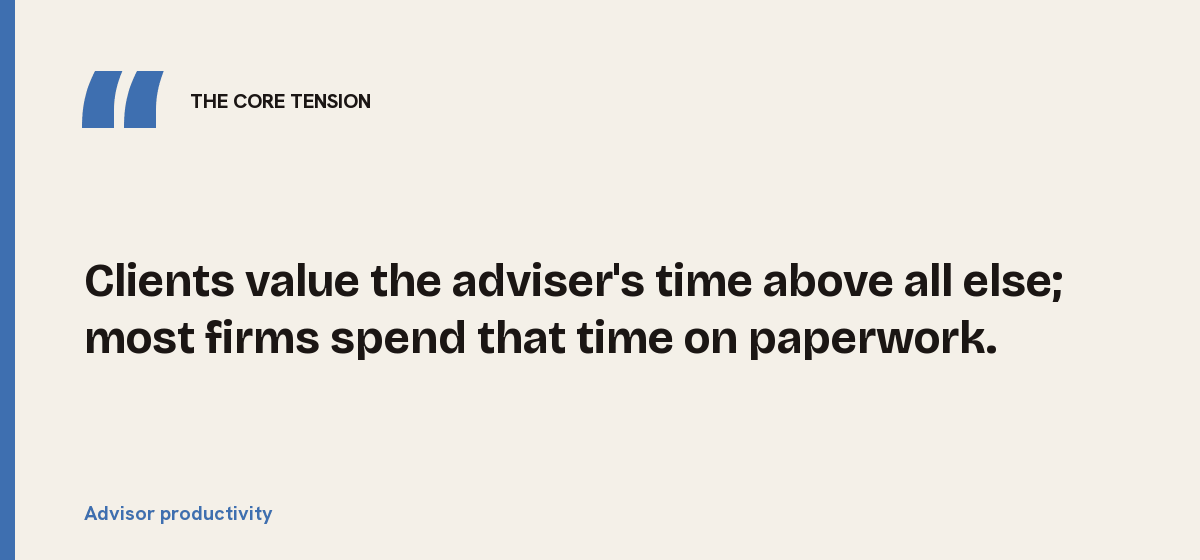
The core tension, in one line:
Clients value the adviser’s time above all else; most firms spend that time on paperwork.
an advisory firm measures how its advisers spend a typical week and finds that less than half is client-facing. After introducing digital onboarding, pre-populated suitability reports and automated review packs, client-facing time rises substantially and each adviser takes on additional households without extra support staff.
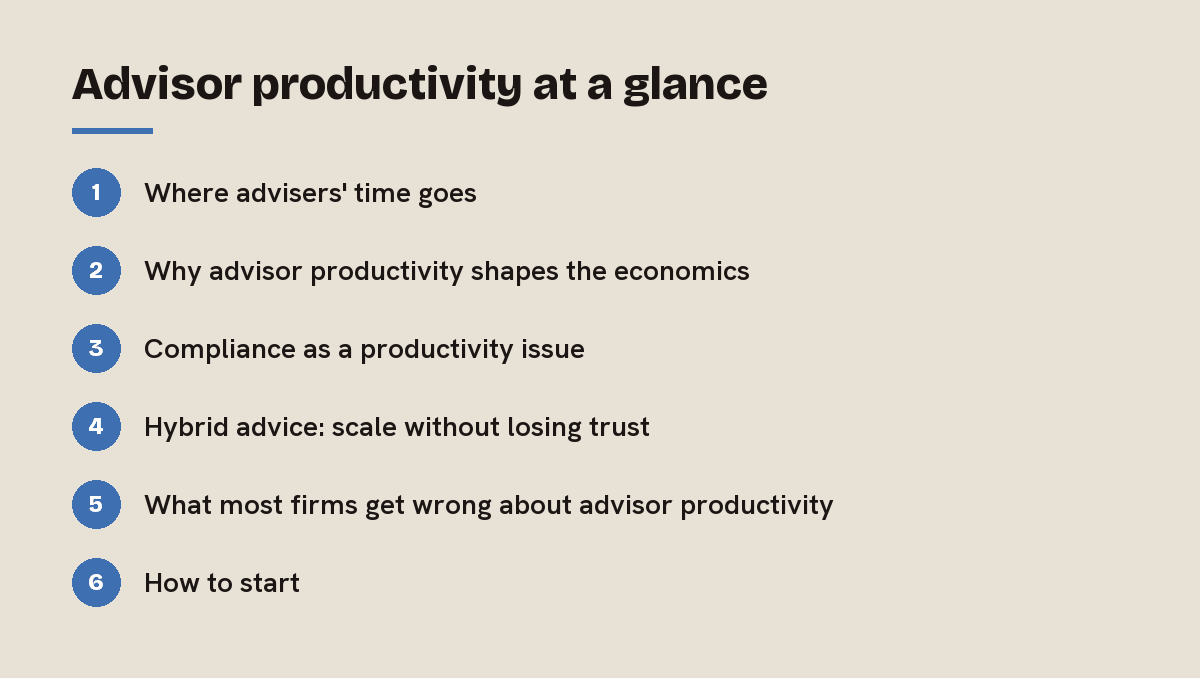
1. Where advisers’ time goes
| Activity | What it looks like on the ground | Digital lever |
|---|---|---|
| Onboarding | Collecting documents, KYC, risk profiling | Digital onboarding with pre-filled data |
| Research and analysis | Gathering fund and market information | Integrated research and portfolio analytics |
| Suitability documentation | Writing reports and recording rationale | Templates generated from structured data |
| Execution | Placing and checking trades | Model portfolios and bulk rebalancing |
| Client communication | Updates, reviews, ad hoc questions | Client portals, secure messaging, scheduled reviews |
| Administration | Chasing paperwork, correcting data | Single data platform, workflow automation |
2. Why advisor productivity shapes the economics
- Revenue: more client-facing time means more reviews, more referrals and more assets advised.
- Cost: fewer manual tasks mean fewer support staff per adviser and lower error costs.
- Capacity: firms can grow without hiring advisers in direct proportion, which matters when experienced advisers are scarce.
- Quality: advisers with time to think give better advice and catch more issues.
The talent constraint is real across financial services. The ECB notes that institutions report difficulty recruiting technology talent for transformation work, and experienced advisers are just as hard to find, which makes the productivity of existing teams the main growth lever.
3. Compliance as a productivity issue
Suitability requirements are essential to good advice, yet they absorb a large share of adviser time when supported by manual processes. ESMA’s guidelines on the MiFID II suitability requirements set out what firms must gather, assess and record, including clients’ sustainability preferences since 2022. When those steps are built into the workflow, captured once and reused, compliance quality rises and adviser effort falls.
| Approach | Adviser experience | Compliance outcome |
|---|---|---|
| Manual | Re-keying data into documents; chasing signatures | Inconsistent records, hard to review |
| Digitally supported | Data captured once, reports generated, e-signatures | Consistent, searchable, auditable evidence |
4. Hybrid advice: scale without losing trust
Hybrid models let clients handle simple tasks, such as top-ups, statements and basic questions, digitally, while advisers focus on planning, complex decisions and life events. This raises advisor productivity without reducing the human relationship that clients value. The design challenge is the hand-over: the adviser must see everything the client did digitally, and the client must never have to repeat themselves.
5. What most firms get wrong about advisor productivity
- Adding tools without removing tasks: a new system that sits alongside old processes adds work.
- Ignoring adviser input: tools designed without advisers are rarely adopted by them.
- Measuring activity instead of capacity: the goal is more client time and more clients served well, not more logins.
- Fearing that digital replaces advisers: in practice, firms that digitise well tend to need their best advisers more, not less.
Example: a private bank asked its relationship managers to log every manual task for a month. The top three were re-keying client data between systems, preparing review packs and chasing missing documents. The bank addressed those three first, before any client-facing change, and its relationship managers gained enough time to run an additional review each week.
6. How to start
The most effective programmes start with evidence rather than technology. Ask a representative group of advisers to log their time for a few weeks, and categorise every task as client-facing, preparation, compliance or administration. The results usually surprise leadership, and they create a shared baseline.
Next, pick the three largest sources of avoidable effort and fix them end to end, with advisers involved in the design. Typical candidates are duplicate data entry, review preparation and document chasing. Measure the time released, and decide explicitly how it will be used: more reviews for existing clients, capacity for new households, or development time for junior advisers.
Only then move on to larger platform or client-facing changes. Early, visible wins build adviser trust, and that trust is what drives adoption of everything that follows.
Key takeaways on advisor productivity
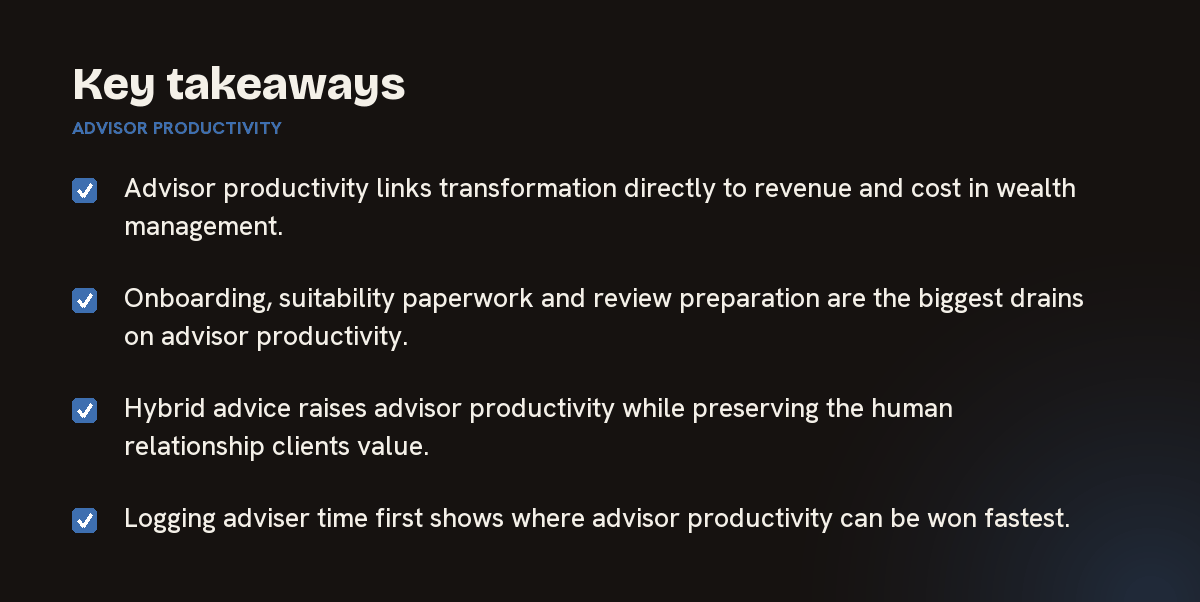
- Advisor productivity links transformation directly to revenue and cost in wealth management.
- Onboarding, suitability paperwork and review preparation are the biggest drains on advisor productivity.
- Hybrid advice raises advisor productivity while preserving the human relationship clients value.
- Logging adviser time first shows where advisor productivity can be won fastest.
For wealth leaders, advisor productivity is the most direct link between transformation spending and financial results. It can be measured, it can be improved in months rather than years, and it is noticed immediately by clients and advisers alike.
Optimizium helps wealth managers, private banks and advisory firms raise advisor productivity through better platforms, workflows and hybrid models. We respect the judgement and client relationships that advisers have built, because they are the heart of the business. And we bring compliance and risk colleagues into the design as co-authors, so efficiency and suitability improve together.
Explore how we approach this across Wealth Management, Banking and Beyond Banking, browse the FAQ Hub, or read the related question: Why are data platforms foundational?
Why is channel strategy central to digital transformation?
Related questions
Partner with the experts.
Let's discuss how Optimizium can accelerate your roadmap and navigate complex digital transformation.
Schedule a consultation →