Home › FAQ Hub › Why is cross-functional governance particularly difficult in financial services?
Leadership, Change & Operating ModelsWhy is cross-functional governance particularly difficult in financial services?
Cross-functional governance is particularly difficult in financial services because institutions operate under overlapping regulatory regimes, covering capital, conduct, anti-money laundering, suitability and solvency, that create several layers of control. Independent risk and compliance functions, internal audit, regulatory documentation requirements, capital approval processes and fragmented data ownership all add decision points.
Agile delivery promises small, empowered teams making decisions quickly. Financial institutions promise supervisors that every material decision is controlled, documented and independently challenged. Reconciling the two is one of the hardest parts of transformation.
Cross-functional governance is particularly difficult in financial services because institutions operate under overlapping regulatory regimes, covering capital, conduct, anti-money laundering, suitability and solvency, that create several layers of control. Independent risk and compliance functions, internal audit, regulatory documentation requirements, capital approval processes and fragmented data ownership all add decision points.
The result is a density of governance that conflicts with agile delivery models, where teams are meant to decide and release quickly. The answer is not to remove controls, but to redesign how they work: earlier involvement, clearer decision rights, automated evidence and standing forums that replace sequential approvals.
The core tension, in one line:
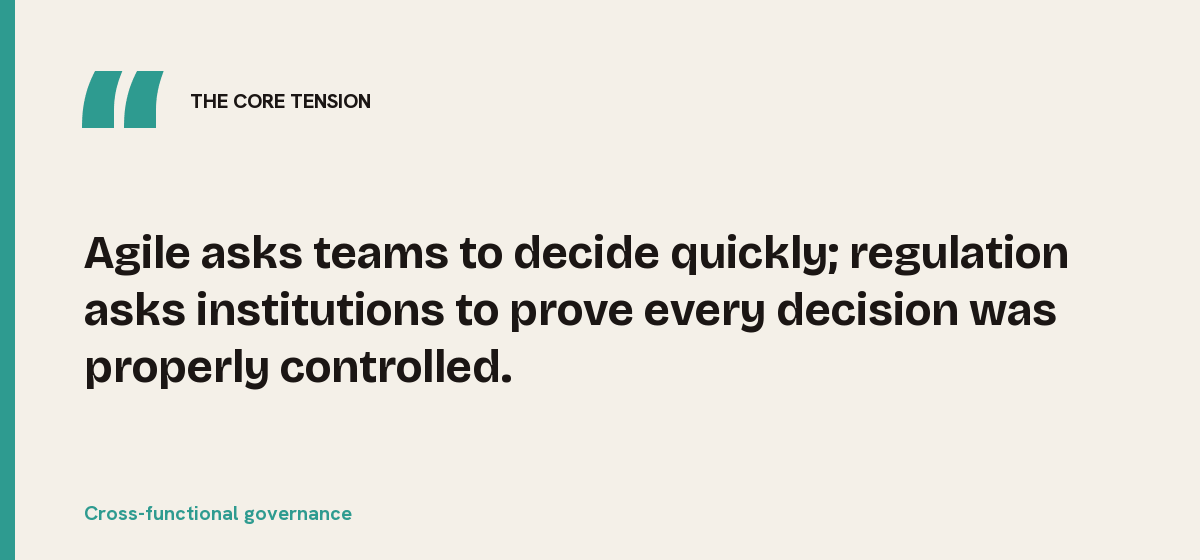
Agile asks teams to decide quickly; regulation asks institutions to prove every decision was properly controlled.
a bank’s product team needed approvals from risk, compliance, legal, security and architecture for each release, in sequence. Releases took months. A weekly cross-functional forum, pre-approved patterns for common changes and automated control evidence cut lead time to weeks, with fewer issues found after launch.
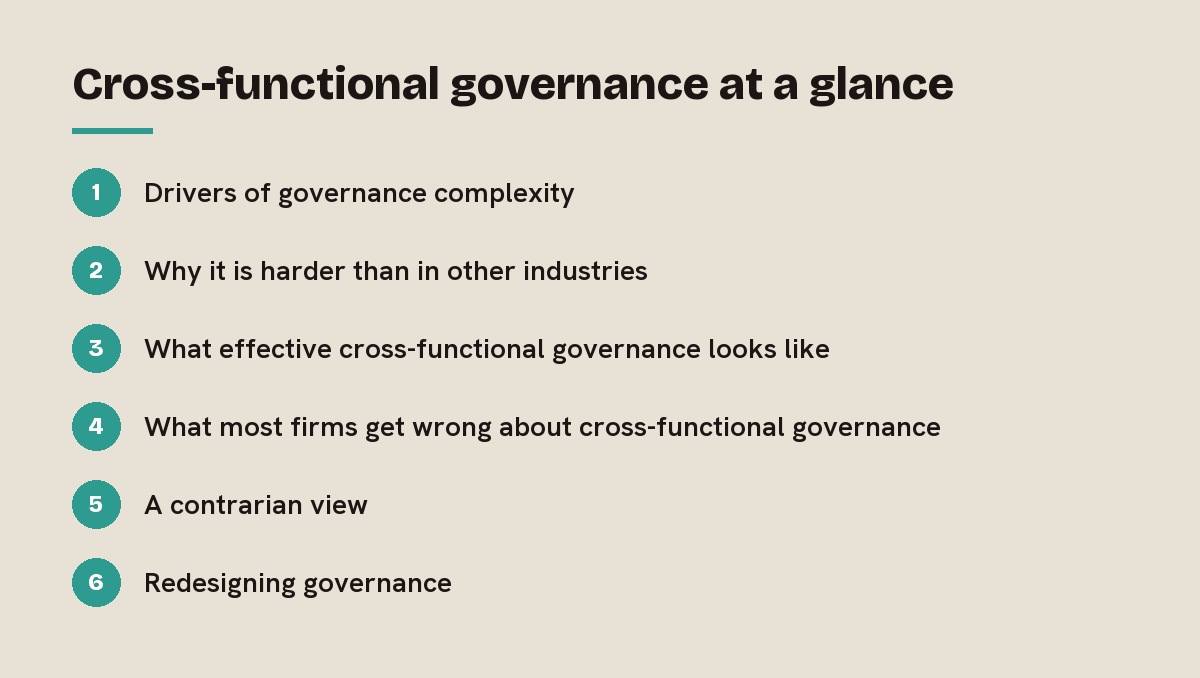
1. Drivers of governance complexity
| Driver | What it looks like on the ground | Effect on delivery |
|---|---|---|
| Independent risk functions | Separate reviews by second and third lines | Sequential approvals |
| Regulatory documentation | Detailed records for decisions and models | Time spent evidencing |
| Capital approval processes | Investment committees and business cases | Slow funding decisions |
| Data ownership fragmentation | No single owner for shared data | Disputes and delays |
2. Why it is harder than in other industries
- Overlapping regimes: a single product change may touch conduct, prudential, data and resilience rules.
- Personal accountability: senior managers carry personal responsibility for decisions.
- Supervisory scrutiny: supervisors expect evidence, not just outcomes.
- Resilience obligations: under the Digital Operational Resilience Act, applicable since 17 January 2025, ICT risk, testing and third-party oversight are formal requirements.
The ECB assesses governance explicitly. Its 2024 review of digitalisation practices includes criteria such as clear allocation of digital responsibility within the management body, involvement of internal control functions and a risk-aware culture. When the ECB surveyed 105 large banks, it found many lacked adequate indicators to steer their digital strategy.
3. What effective cross-functional governance looks like
| Practice | What it replaces |
|---|---|
| Embedded risk partners | Late, sequential reviews |
| Standing cross-functional forums | Chains of separate approvals |
| Pre-approved patterns | Bespoke review of routine changes |
| Automated control evidence | Manual documentation after the fact |
| Clear decision rights | Escalation of every question |
4. What most firms get wrong about cross-functional governance
- Trying to bypass control functions: speed gained this way is lost at the first audit or incident.
- Adding agile on top of existing governance: teams end up with more meetings, not fewer.
- Treating all changes alike: low-risk changes deserve lighter governance than high-risk ones.
- Ignoring data ownership: without owners, cross-functional decisions stall on data disputes.
Example: an insurer’s AI models waited months for approval because model risk, compliance and data protection reviewed them separately. A joint model review board with agreed criteria and templates shortened approval to weeks and produced clearer documentation for supervisors.
5. A contrarian view
Governance is often blamed for slow transformation. In many institutions, the problem is not the amount of control but its timing and design. When risk and compliance shape decisions early and evidence is produced automatically, cross-functional governance can make delivery faster, because fewer problems surface late.
6. Redesigning governance
- Tier changes by risk, with lighter paths for low-risk work.
- Bring control functions into teams from the start.
- Replace sequential approvals with standing forums.
- Automate evidence in delivery pipelines.
- Clarify data and decision ownership.
Key takeaways on cross-functional governance
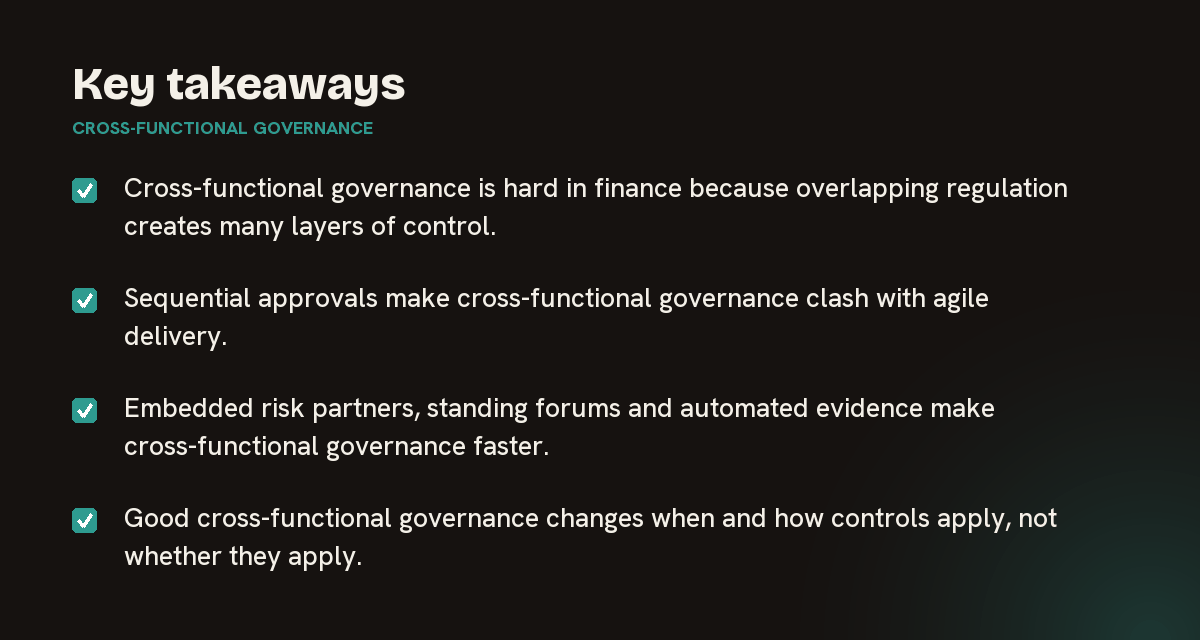
- Cross-functional governance is hard in finance because overlapping regulation creates many layers of control.
- Sequential approvals make cross-functional governance clash with agile delivery.
- Embedded risk partners, standing forums and automated evidence make cross-functional governance faster.
- Good cross-functional governance changes when and how controls apply, not whether they apply.
For leadership teams, redesigning cross-functional governance is often the single biggest lever on transformation speed. Done well, it satisfies supervisors and lets teams deliver at a pace customers notice.
Optimizium helps banks, insurers and wealth managers redesign governance for agile delivery in a regulated setting. We respect the role and expertise of control functions, because they protect customers and the institution. And we bring risk, compliance and audit into the design as co-authors, so faster governance is also stronger governance.
Explore how we approach this across Banking, Insurance, Wealth Management and Beyond Banking, browse the FAQ Hub, or read the related question: How should transformation be governed in regulated financial institutions?
On this page
Partner with the experts.
Let's discuss how Optimizium can accelerate your roadmap and navigate complex digital transformation.
Schedule a consultation →