Home › Insights › Wealth Management › Portfolio transfer: why Europe’s wealth industry still takes weeks to let a client leave
Wealth ManagementPortfolio transfer: why Europe’s wealth industry still takes weeks to let a client leave
Portfolio transfer in Europe still takes weeks while ACATS moves US accounts in days. What the gap costs clients and what wealth firms should do now.
Portfolio transfer is the truest test of whether a client owns their assets. Europe has some of the best securities plumbing in the world – a single Eurosystem settlement platform, a harmonised rulebook, and a T+1 future. Yet the moment a retail client tries to move a portfolio from one broker, bank or insurer to another, the experience often still takes weeks.
The US and South Africa solved the same problem differently: with one automated industry protocol (ACATS) and one private switching hub (Finswitch). The gap between wholesale plumbing and retail portability is not a technology problem. It is a governance choice, and it is worth money to firms and their clients.
The concept, briefly: three layers of transfer
Moving assets happens at three distinct layers, and speed can differ by an order of magnitude between them.
- Trade settlement: securities moving against cash after a trade. This is the wholesale layer.
- Account transfer: re-registering a client’s entire holding from one intermediary to another. This is the retail layer, and the one clients feel.
- Wrapper transfer: moving pension, insurance or fund-based savings between providers. This is the product layer.
Europe leads the world on the first layer and lags on the second and third. That paradox is the whole story.
Europe: world-class plumbing behind a fragmented front door
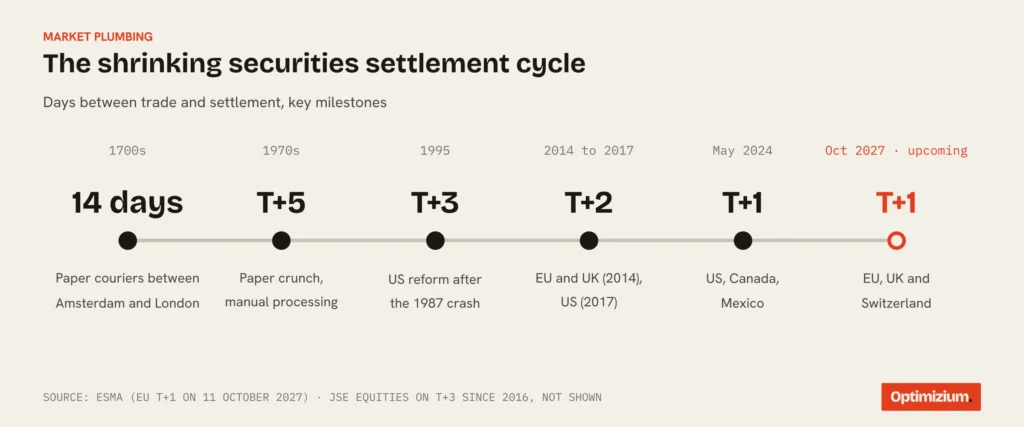
At the wholesale layer, Europe built something remarkable. TARGET2-Securities (T2S), the Eurosystem’s settlement platform, went live in June 2015 and now connects 24 central securities depositories, offering delivery-versus-payment settlement in euro and Danish krone central bank money. Above it sits a harmonised rulebook in the Central Securities Depositories Regulation, and a firm next step: on 16 October 2026 ESMA confirmed that the regulatory framework is complete and that the EU will move from T+2 to T+1 settlement on 11 October 2027, with the UK and Switzerland moving on the same day.
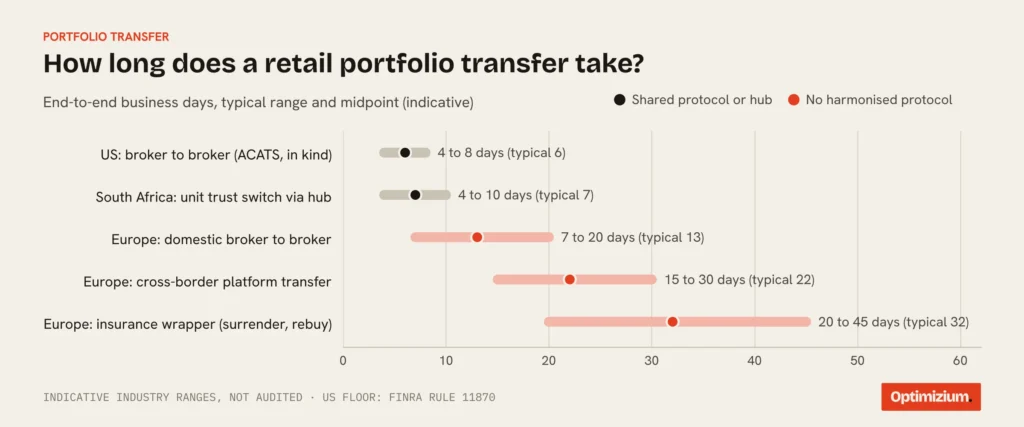
Portfolio transfer at the retail layer looks very different. When an investor moves from a Spanish broker to a Dutch platform, there is no single protocol both firms must speak. The portfolio transfer decomposes into a chain of free-of-payment deliveries between custodians, paper or portal forms, per-market re-registration rules and, often, exit fees. Timelines are not standardised. In our experience a domestic portfolio transfer takes one to three weeks and cross-border moves frequently run longer; some instruments cannot move in kind at all, forcing a sale and a taxable event.
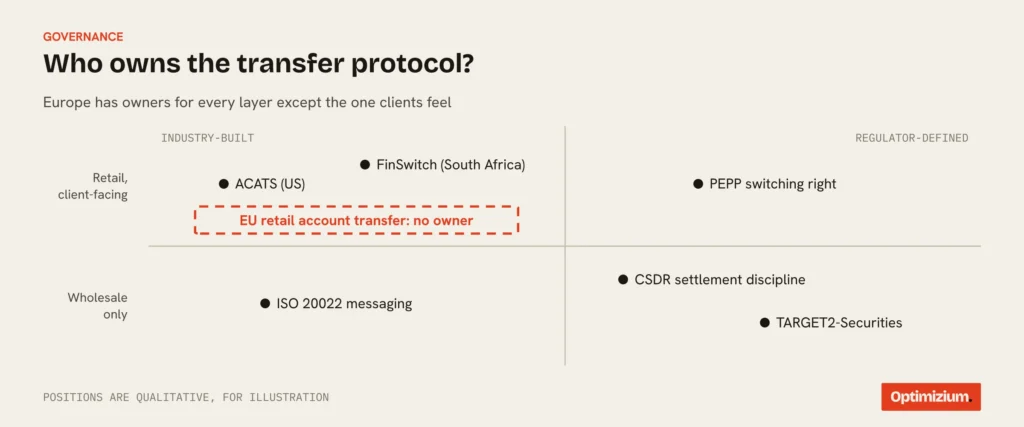
What Europe has instead are components. ISO 20022 messaging standardises the instructions, but perfect messages can still take a month to act on. Fund order networks speed up dealing, not whole-account portability. International CSD links make deliveries possible without making them fast. Nobody owns the end-to-end portfolio transfer, so nobody is accountable for its clock.
The product layer is weaker still. The Pan-European Personal Pension Product (PEPP) does embed a switching right, with fees capped at 0.5 per cent of the assets moved, but a saver may only switch after five years from the start of the contract and five years from any later switch. Most traditional unit-linked insurance contracts offer no transfer at all; the client’s remedy is surrender and repurchase.
The pattern is plain. Wherever European supervisors took ownership, speed and standards followed. Where the outcome was left to bilateral market practice, the client waits.
The United States: one protocol, enforced timelines
The American answer is the Automated Customer Account Transfer Service (ACATS), run by the National Securities Clearing Corporation within DTCC. Under FINRA Rule 11870, the delivering firm must validate or take exception to a transfer instruction within one business day, then complete the transfer within three business days of validation. In practice a straightforward portfolio transfer completes in about a week end to end, in kind, so the client stays invested and no gain is crystallised.
The governance model is the lesson: an industry-owned utility runs the protocol, while a regulator enforces the timetable. Neither alone would have produced the result.
Speed has a cost that Europe should study before copying it. ACATS has become a channel for fraud in which criminals open an account in a victim’s name and pull their holdings across. In August 2026 Senators Wyden and Warren wrote to FINRA urging mandatory customer alerts, transfer locks and stronger authentication, after finding that protections varied widely between brokers. Fast portfolio transfer and strong controls have to ship together.
South Africa: a private hub with a common rulebook
South Africa shows that this does not require a supranational regulator. Strate, the licensed central securities depository, provides the securities backbone, and the JSE has settled equities on T+3 since July 2016. The fund layer is where the market built something Europe never did: FinSwitch, an industry transaction switch that carries prices, transaction instructions and confirmations between unit trust managers, platforms and other product providers, and which counts all the major fund providers and distributors among its users.
The effect is that a fund portfolio transfer between managers or onto a platform runs on shared instructions through one hub rather than through bespoke paperwork between two institutions. The mechanism is a trade initiative; the conduct regulator supervises the outcome. A mid-sized market agreed on a single hub and gained ACATS-like discipline for pooled funds as a result.
Why speed pays, for clients and for firms
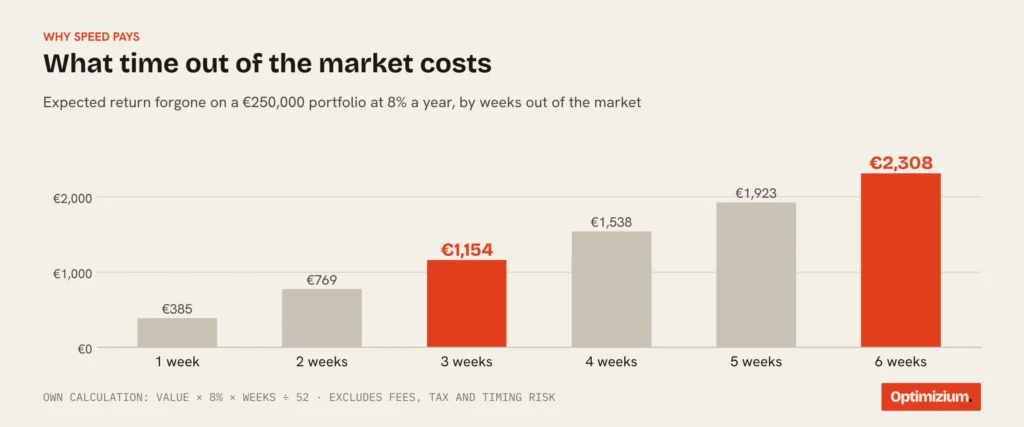
For the client, time out of the market is a real cost. Take a €250,000 portfolio expected to earn 8 per cent a year. A three-week gap before reinvestment costs roughly €1,150 in expected return; six weeks costs about €2,300, before exit fees, tax on any forced sale, or the risk of missing a rebound. An in-kind portfolio transfer removes most of that: no sale, no taxable event, no gap.
For the firm, transfer speed is an asset-gathering engine. A slow portfolio transfer is the biggest leak in most “win new clients” funnels: every week between a signed form and a funded account is a week in which the client can lose patience, the old provider can mount a retention call, and the new firm earns nothing. Standardised processes also cut manual re-registration, reconciliation breaks and complaints.
And there is a regulatory tailwind. In its Recommendation of 30 September 2025 on savings and investment accounts, the European Commission asked Member States to ensure that investors are not deterred from switching by excessive fees or cumbersome processes, and that transfer charges reflect only administrative cost. It is not binding, but the Savings and Investments Union mid-term review is due in 2027, and the direction of travel is clear. Slow portfolio transfer is a hidden exit barrier, and exit barriers look like revenue until a competitor or a regulator removes them.
What wealth and investment firms should do now
- Measure your transfer clock. Set an internal service level per corridor (domestic broker to broker, cross-border, pension and insurance) and track it monthly, both inbound and outbound. If you cannot measure portfolio transfer times, you cannot sell them or defend them.
- Use T+1 as the forcing event. The work to meet 11 October 2027 (automated allocations and confirmations, earlier instruction cut-offs, cleaner standing data) is the same work that shortens a portfolio transfer. Scope the two together rather than funding them twice.
- Adopt the standards that exist. ISO 20022 transfer messaging, standard re-registration templates and in-kind transfer as the default option remove frictions that are already solved. There is no need to wait for a pan-European ACATS to fix your own house.
- Build the controls with the speed. Customer notification of outgoing transfer requests, a self-service transfer lock and step-up authentication should launch alongside any faster process. Fast and safe is a differentiator; fast and fraudulent is a headline.
- Price for portability. Review exit and transfer fees against the Commission’s “administrative cost only” benchmark now, on your own timetable, rather than later under supervisory pressure.
Key Findings
Europe has already proved that it can build the fastest, most harmonised settlement plumbing in the world when someone takes ownership. The retail portfolio transfer is slow because nobody has. Firms that treat transfer speed as a product feature, and pair it with strong controls, will find the coming portability agenda works in their favour; those that rely on friction to retain clients will find that friction stops working on the day the rules change.
Further reading
- ESMA, one year to go for T+1 settlement in the EU.
- European Central Bank, five central securities depositories join T2S.
- FINRA, Rule 11870: Customer Account Transfer Contracts.
- US Senate Finance Committee, Wyden and Warren letter to FINRA on ACATS fraud.
- EUR-Lex, Commission Recommendation (EU) 2025/2029 on savings and investment accounts.
- EUR-Lex, Regulation (EU) 2019/1238 on the Pan-European Personal Pension Product.
Related on our site: T+1 readiness for wealth managers, operations transformation services, the Savings and Investments Union explained.
This article reflects published regulatory sources and general practitioner commentary as at October 2026. Transfer timings for Europe and South Africa are indicative and based on industry practice. It is professional insight, not legal or financial advice. Verify current guidance before acting.
In this article
Further reading