Home › FAQ Hub › How do APIs and open finance change distribution?
Tech & Core ModernisationHow do APIs and open finance change distribution?
APIs and open finance change distribution by decoupling product manufacturing from digital distribution, so that a bank's credit, an insurer's cover or an asset manager's portfolio can be offered inside a partner's journey, compared on a marketplace, or combined with data from other providers.
For most of their history, financial institutions controlled both the product and the shop window. APIs and data-sharing regulation are separating the two, and changing who gets to sell what, where.
APIs and open finance change distribution by decoupling product manufacturing from digital distribution, so that a bank’s credit, an insurer’s cover or an asset manager’s portfolio can be offered inside a partner’s journey, compared on a marketplace, or combined with data from other providers. APIs make products and data callable by other systems; open finance regulation extends customers’ right to share their financial data, beyond payment accounts, with authorised third parties. Together they enable embedded finance, marketplaces and partner ecosystems, and they make direct digital journeys faster by allowing institutions to use permissioned data for onboarding and eligibility. Distribution becomes a network rather than a set of owned channels.
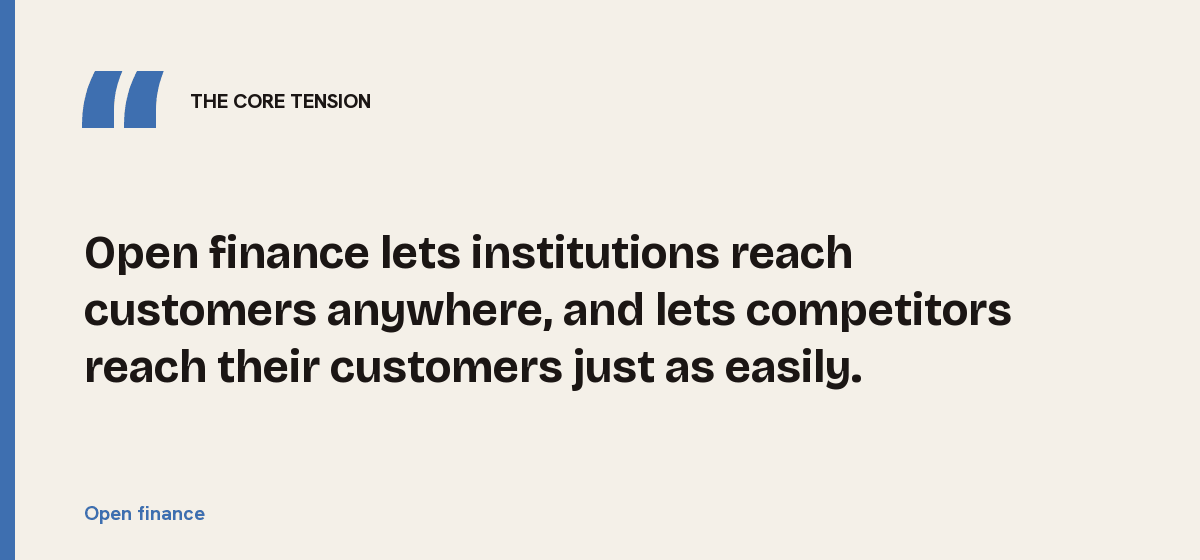
The core tension, in one line:
Open finance lets institutions reach customers anywhere, and lets competitors reach their customers just as easily.
a customer applies for a mortgage through a property platform. With her permission, the lender retrieves income and spending data from her current account at another bank and her pension details from a third provider. The application is pre-filled, affordability is assessed in minutes, and the offer is presented inside the platform’s journey.
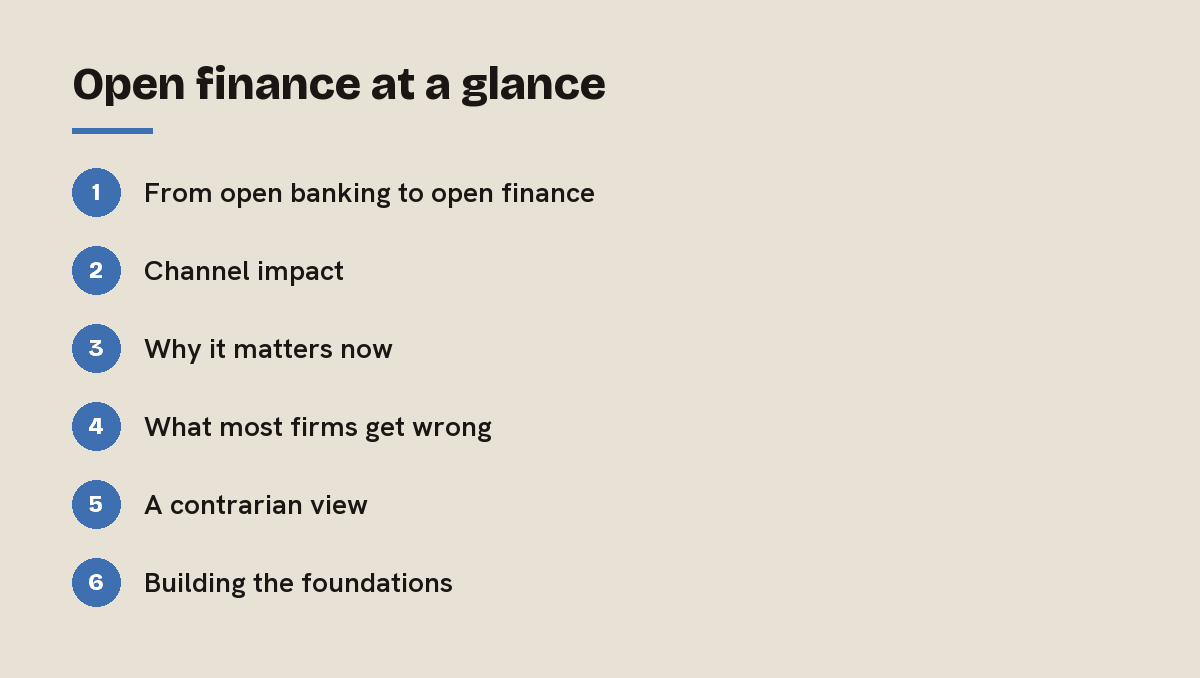
1. From open banking to open finance
Open banking, introduced in the EU by the second Payment Services Directive, gave customers the right to share payment account data and initiate payments through third parties. The next step extends that idea to the rest of the financial relationship.
The European Commission’s proposal for a Financial Data Access regulation, published in June 2023, would require data holders across the financial sector to share selected customer data with authorised users when customers ask, through standardised APIs. It also proposes permission dashboards so customers can see and manage who has access, and financial data sharing schemes to set common standards.
| Stage | Data in scope | Distribution impact |
|---|---|---|
| Open banking | Payment accounts | Account aggregation, payment initiation, faster lending decisions |
| Open finance | Savings, investments, pensions, insurance, credit | Holistic advice, switching, comparison, embedded offers across products |
2. Channel impact
- Embedded: credit, payments, insurance and investments appear inside partner journeys, from retail checkouts to accounting software.
- Marketplace: customers compare prices and products across providers, often with pre-filled data.
- Direct digital: onboarding and eligibility improve because institutions can use permissioned data instead of asking customers for documents.
| Channel | What APIs enable | What wider data access adds |
|---|---|---|
| Embedded | Products offered inside partners’ journeys | Richer data for instant decisions |
| Marketplace | Real-time quotes and applications | Comparison across a wider product range |
| Direct digital | Faster integration of services | Pre-filled applications, fewer documents |
| Advice | Integration with planning tools | A full view of the client’s finances across providers |
3. Why it matters now
Digital channels are already the main route for many customers. Eurostat reports that 67 per cent of people aged 16 to 74 in the EU used internet banking in 2024. Wider data access builds on that behaviour by letting data follow customers between providers.
Payments infrastructure is moving the same way. The EU’s Instant Payments Regulation requires providers that offer euro credit transfers to offer instant transfers as well, around the clock, at no higher charge. Instant payment rails combined with data access make fully embedded financial journeys more practical than ever.
4. What most firms get wrong
- Treating it as compliance only: building the minimum required APIs misses the commercial opportunity to use shared data and reach new channels.
- Ignoring the defensive side: if competitors can access your customers’ data with permission, the quality of your own experience becomes the main defence.
- Underinvesting in API quality: slow or unreliable APIs drive partners elsewhere.
- Forgetting consent design: customers must understand and control what they share; poor consent journeys undermine trust.
Example: a mid-sized bank used open banking data to offer small business loans through an accounting software provider. Applicants connected their bank accounts and accounting data, and the bank decided most applications automatically. Lending through the partner grew to a significant share of new small business lending within two years, while the bank’s own channels focused on larger and more complex clients.
5. A contrarian view
Data sharing is often described as a threat to incumbents. In practice, incumbents with strong products, good APIs and trusted brands are well placed to benefit, because they can both receive data to improve their own offers and distribute through many more partners. The real risk is for institutions that rely on customers’ inertia rather than the quality of their products.
6. Building the foundations
- Treat APIs as products, with owners, documentation and service levels.
- Design consent and permission journeys with customers.
- Prepare data quality for sharing, because poor data shared is poor data multiplied.
- Choose partners strategically, by customer segment and product fit.
- Bring risk and compliance in early, especially for data protection and third-party oversight.
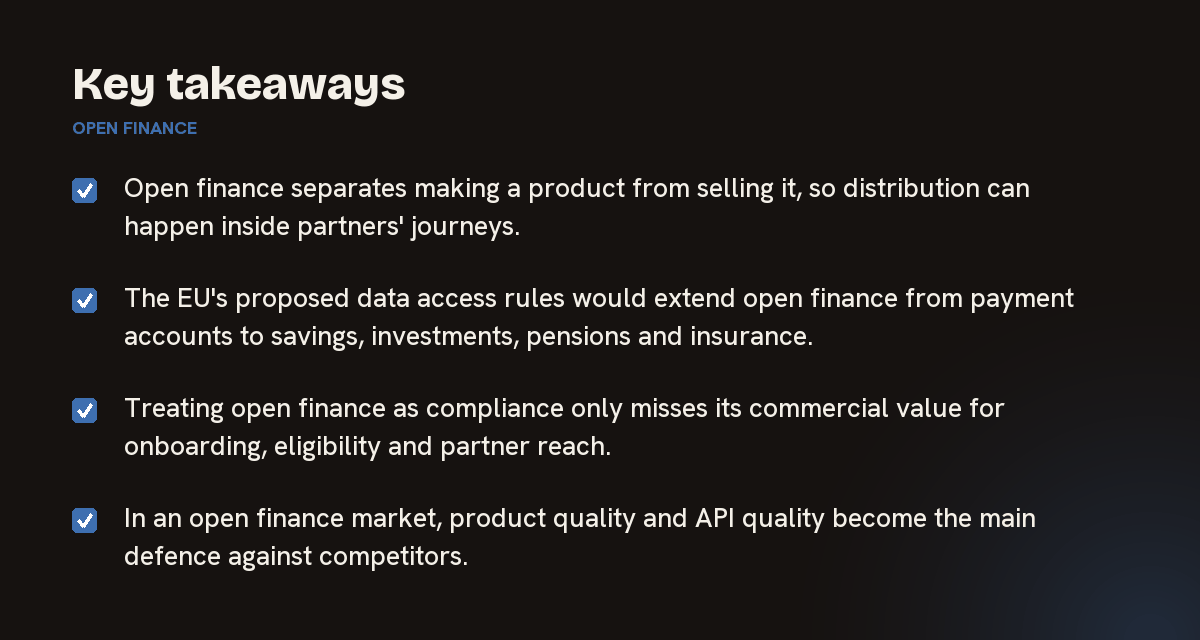
Key takeaways on open finance
- Open finance separates making a product from selling it, so distribution can happen inside partners’ journeys.
- The EU’s proposed data access rules would extend open finance from payment accounts to savings, investments, pensions and insurance.
- Treating open finance as compliance only misses its commercial value for onboarding, eligibility and partner reach.
- In an open finance market, product quality and API quality become the main defence against competitors.
For executives, APIs and open finance are reshaping the map of distribution. The decisions now are which capabilities to offer through partners, which data to use to improve direct journeys, and how to compete when customers can move their data, and their business, more easily than ever.
Optimizium helps banks, insurers and wealth managers turn APIs and open finance into distribution strategy. We respect the product and risk expertise that makes institutions trusted data holders and partners. And we bring data protection, risk and compliance colleagues into the design as co-authors, so open finance grows the business while protecting customers.
Explore how we approach this across Banking, Insurance, Wealth Management and Beyond Banking, browse the FAQ Hub, or read the related question: How does digital transformation change talent requirements?
Related questions
Partner with the experts.
Let's discuss how Optimizium can accelerate your roadmap and navigate complex digital transformation.
Schedule a consultation →