Home › FAQ Hub › How do customer expectations differ across the four sectors?
Strategy & PositioningHow do customer expectations differ across the four sectors?
Customer expectations differ across banking, insurance, wealth and fintech because each sector serves a different need at a different frequency and with a different emotional weight.
It is tempting to talk about “the financial services customer” as if one person bought a current account, a home insurance policy, a managed portfolio and a fintech app with the same hopes. They are often the same person, but they expect very different things from each.
Customer expectations differ across banking, insurance, wealth and fintech because each sector serves a different need at a different frequency and with a different emotional weight. Banking customers mainly expect speed and convenience in frequent, everyday tasks. Insurance customers expect clarity when buying and, above all, fairness when they claim. Wealth clients expect transparency about performance and costs, and advice they can trust. Fintech customers expect simplicity and frictionless onboarding. Across all four, expectations sit on three layers: functional (speed, accuracy, usability), emotional (trust, safety, competence) and regulatory (transparency, suitability, disclosure). Strategy should start from the layer that matters most in each sector.
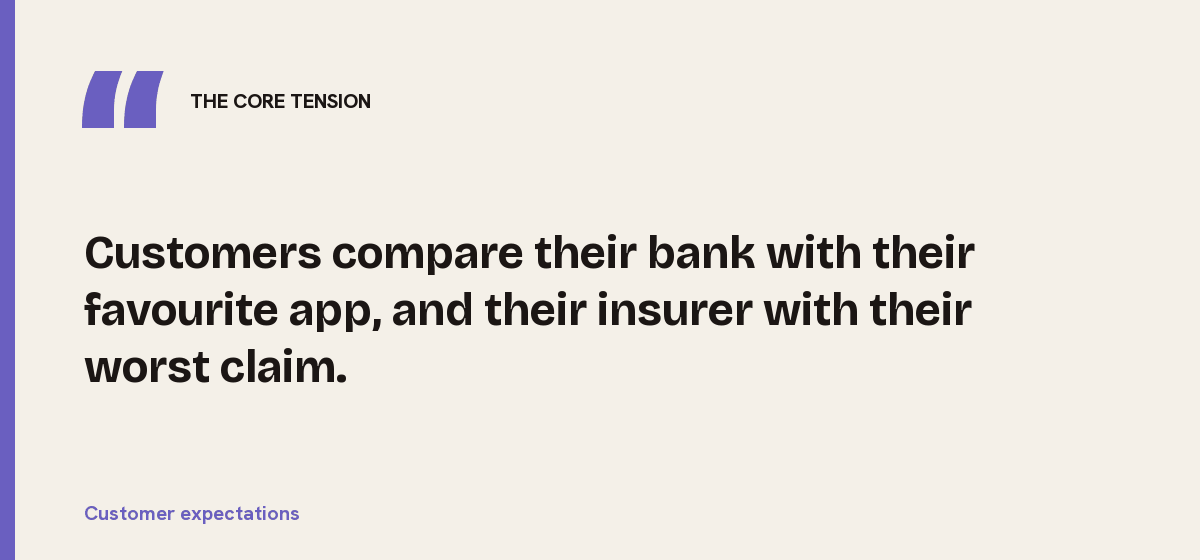
The core tension, in one line:
Customers compare their bank with their favourite app, and their insurer with their worst claim.
the same customer uses a fintech app for daily spending, a traditional bank for her mortgage, an insurer for her home and an adviser for her pension. She expects instant notifications from the app, a clear answer from the bank, a fair and quick settlement from the insurer, and a plain explanation of fees from the adviser.
1. Expectations by sector
| Sector | Dominant expectation | What it looks like on the ground | What breaks trust |
|---|---|---|---|
| Banking | Speed and convenience | Instant payments, real-time balances, quick answers | Downtime, delays, unexplained blocks |
| Insurance | Clarity and fair claims | Plain cover, simple claims, regular updates | Surprise exclusions, slow or opaque claims |
| Wealth | Transparency and advice | Clear performance, costs and rationale for decisions | Hidden fees, unexplained losses, unavailable advisers |
| Fintech | Simplicity and frictionless onboarding | Account open in minutes, intuitive features | Sudden account freezes, poor support |
2. The three layers of experience
Customer expectations can be read on three layers, each of which applies to every sector in different proportions.
- Functional: speed, accuracy, usability. Does the service work quickly and correctly? This layer dominates in banking and fintech.
- Emotional: trust, safety, competence. Does the customer feel safe and well looked after? This layer dominates in insurance claims and wealth advice.
- Regulatory: transparency, suitability, disclosure. Does the customer receive clear information and suitable products? This layer matters everywhere but carries most weight in wealth and insurance-based investments.
| Layer | Banking | Insurance | Wealth | Fintech |
|---|---|---|---|---|
| Functional | Very high | Medium | Medium | Very high |
| Emotional | Medium | Very high at claim | Very high | Medium |
| Regulatory | High | High | Very high | Growing |
3. How behaviour is shifting
Digital use has become the norm. Eurostat reports that 67 per cent of people aged 16 to 74 in the EU used internet banking in 2024, so functional customer expectations in banking are now set by digital experiences.
Insurance is moving more slowly. EIOPA’s survey of European insurers found that digital-only distribution channels still lag well behind physical or hybrid ones, especially for life insurance, where consumers prefer in-person meetings. Customer expectations there remain anchored in human contact at key moments.
Banking itself is not purely digital either. The ECB notes that purely digital banks held a market share below 4 per cent in the euro area in 2024. Customers want digital speed, but most still choose established institutions to provide it.
4. What most firms get wrong about customer expectations
- Copying another sector’s playbook: an insurer that optimises for app engagement like a neobank may neglect the claim, which is where its reputation is made.
- Treating expectations as uniform within a sector: a wealth client in accumulation and one in retirement expect different things.
- Focusing on the functional layer only: a fast, accurate journey that feels cold at a difficult moment still disappoints.
- Ignoring rising baselines: expectations set by the best digital services keep moving. Last year’s good experience is this year’s minimum.
Example: a wealth manager surveyed clients about digital features and found that the most requested improvement was not a new app capability but a clear quarterly explanation of costs and performance in plain language. Delivering it digitally raised satisfaction more than any feature launch that year.
5. Expectations at the moments that matter
Each sector has a small number of moments that shape most of the relationship. In banking, they include opening an account, a payment that goes wrong and a request for credit. In insurance, the claim outweighs almost everything else, followed by the renewal. In wealth, they are the first plan, the annual review and the conversation after markets fall. In fintech, they are onboarding and the first time a customer needs help. Mapping these moments and asking what customers expect at each one, functionally and emotionally, gives a sharper agenda than any generic customer strategy. It also shows where human contact remains essential, and where digital speed is what customers value most.
6. Turning expectations into strategy
- Identify the moments that matter in each line of business: payment, claim, review, onboarding.
- Decide which layer dominates at each moment and design for it first.
- Measure what customers experience, not only what systems do.
- Revisit regularly, because customer expectations shift with every new benchmark.
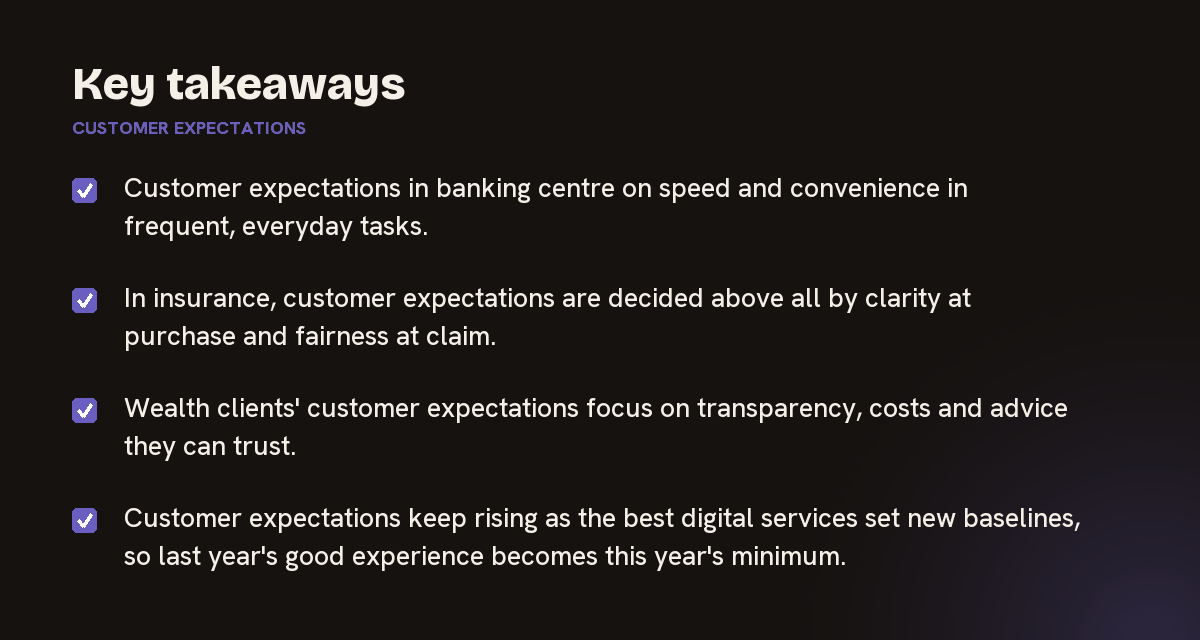
Key takeaways on customer expectations
- Customer expectations in banking centre on speed and convenience in frequent, everyday tasks.
- In insurance, customer expectations are decided above all by clarity at purchase and fairness at claim.
- Wealth clients’ customer expectations focus on transparency, costs and advice they can trust.
- Customer expectations keep rising as the best digital services set new baselines, so last year’s good experience becomes this year’s minimum.
For leaders, the lesson is to resist generic customer strategies. Understanding how customer expectations differ by sector, by moment and by layer allows investment to go where it will be noticed, rather than spread evenly across journeys that customers value very differently.
Optimizium helps banks, insurers, wealth managers and fintechs translate customer expectations into practical priorities. We respect the customer knowledge held by frontline teams, because they hear expectations every day. And we bring risk and compliance colleagues into the design as co-authors, so meeting expectations and meeting obligations go hand in hand.
Explore how we approach this across Banking, Insurance, Wealth Management and Beyond Banking, browse the FAQ Hub, or read the related question: What are the main strategic drivers for transformation?
Related questions
Partner with the experts.
Let's discuss how Optimizium can accelerate your roadmap and navigate complex digital transformation.
Schedule a consultation →