Home › FAQ Hub › What are the main strategic drivers for transformation?
Strategy & PositioningWhat are the main strategic drivers for transformation?
The main strategic drivers for transformation in financial services are rising digital adoption, changing customer expectations, regulatory mandates, cost efficiency and competitive dynamics. Each pushes institutions to rethink products, channels, operations and technology, but they do not weigh equally everywhere.
Every transformation programme starts with a reason, but the reasons are often left unspoken. Is the institution changing to cut costs, to meet regulators, to keep up with customers or to fend off competitors? The answer shapes almost every decision that follows.
The main strategic drivers for transformation in financial services are rising digital adoption, changing customer expectations, regulatory mandates, cost efficiency and competitive dynamics. Each pushes institutions to rethink products, channels, operations and technology, but they do not weigh equally everywhere.
Mature institutions tend to emphasise efficiency and risk, using transformation to lower cost-to-serve and meet regulatory demands. Challengers emphasise growth and speed, using technology to win customers quickly. Being explicit about which strategic drivers matter most helps an institution set priorities, measure progress and avoid programmes that try to do everything at once.
The core tension, in one line:
Every driver points towards change, but they rarely point in exactly the same direction.
a bank’s transformation plan listed twenty objectives, from cost cuts to new products. Progress stalled because teams pulled in different directions. After the board named two primary strategic drivers, lower cost-to-serve and regulatory resilience, the plan was reprioritised and delivery accelerated.
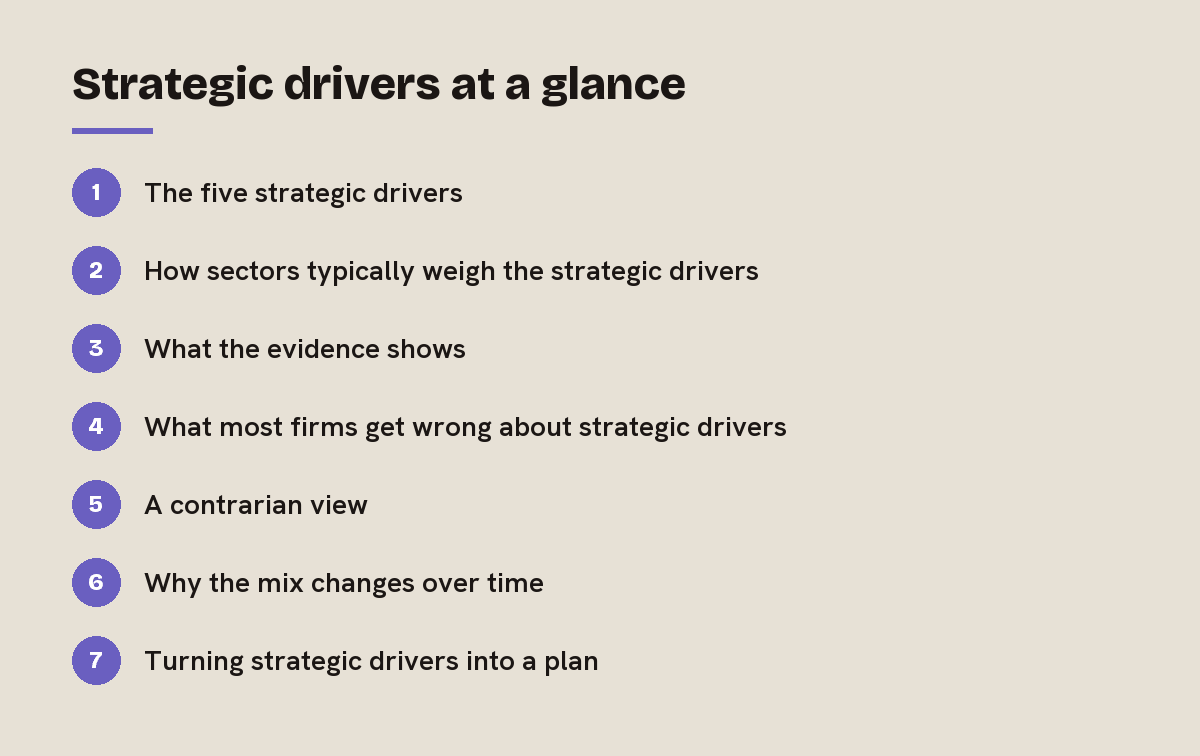
1. The five strategic drivers
| Driver | What it looks like on the ground | Why it matters |
|---|---|---|
| Digital adoption | Customers use apps and online channels by default | Channels and operations must follow |
| Customer expectations | Instant, clear, personalised service | Experience becomes a competitive factor |
| Regulatory mandates | Resilience, data, conduct and AI rules | Non-negotiable deadlines and evidence |
| Cost efficiency | Pressure on margins and returns | Automation and simplification |
| Competitive dynamics | Fintechs, platforms and digital banks | Speed and product innovation |
2. How sectors typically weigh the strategic drivers
| Driver | Banking | Insurance | Wealth | Fintech |
|---|---|---|---|---|
| Efficiency | High | High | Medium | Medium |
| Regulation | Very high | High | High | Medium |
| Customer expectations | High | Medium | High | Very high |
| Competition | High | Medium | Medium | Very high |
3. What the evidence shows
Digital adoption is a powerful driver: Eurostat reports that 67 per cent of people aged 16 to 74 in the EU used internet banking in 2024. Regulation is another: the Digital Operational Resilience Act, applicable since 17 January 2025, made ICT resilience a board-level obligation. Yet investment remains measured. According to ECB Supervisory Board Chair Claudia Buch, banks under ECB supervision invest on average 2.8 per cent of their operating income in digital transformation projects. With limited budgets, choosing the right strategic drivers matters.
4. What most firms get wrong about strategic drivers
- Naming every driver as a priority: programmes that chase all drivers equally deliver little against any.
- Copying competitors’ drivers: a challenger’s growth agenda may not fit an incumbent’s economics.
- Ignoring regulation as a driver: treating it as a constraint rather than a reason to modernise misses opportunities.
- Not linking drivers to measures: without clear indicators, it is impossible to know whether transformation is working.
Example: an insurer framed its transformation around customer experience but measured success mainly by cost savings. Teams optimised for cost and customers noticed little change. Once the insurer agreed measures for both strategic drivers, claims satisfaction and cost per claim, decisions became more balanced and both improved.
5. A contrarian view
Competition from fintechs is often cited as the main driver. For many incumbents, regulation and cost pressure are stronger and more immediate. Admitting that openly can produce more focused, realistic programmes than framing every initiative as a response to disruption.
6. Why the mix changes over time
The balance between forces is not fixed. A wave of regulation, such as new resilience or AI rules, can dominate priorities for two or three years. A shift in interest rates can change the economics of deposits and lending, making cost efficiency more urgent. A new competitor or partnership model can suddenly raise customer expectations in one product line. Institutions that revisit their reasons for change each year, and adjust their portfolio of initiatives accordingly, avoid running yesterday’s programme against today’s pressures. That review is also the moment to stop initiatives whose original rationale no longer holds, freeing budget and people for what matters now.
7. Turning strategic drivers into a plan
- Name the top two or three strategic drivers explicitly.
- Translate each into measurable outcomes.
- Prioritise journeys and capabilities that serve those outcomes.
- Review drivers annually, as markets and rules change.
Key takeaways on strategic drivers
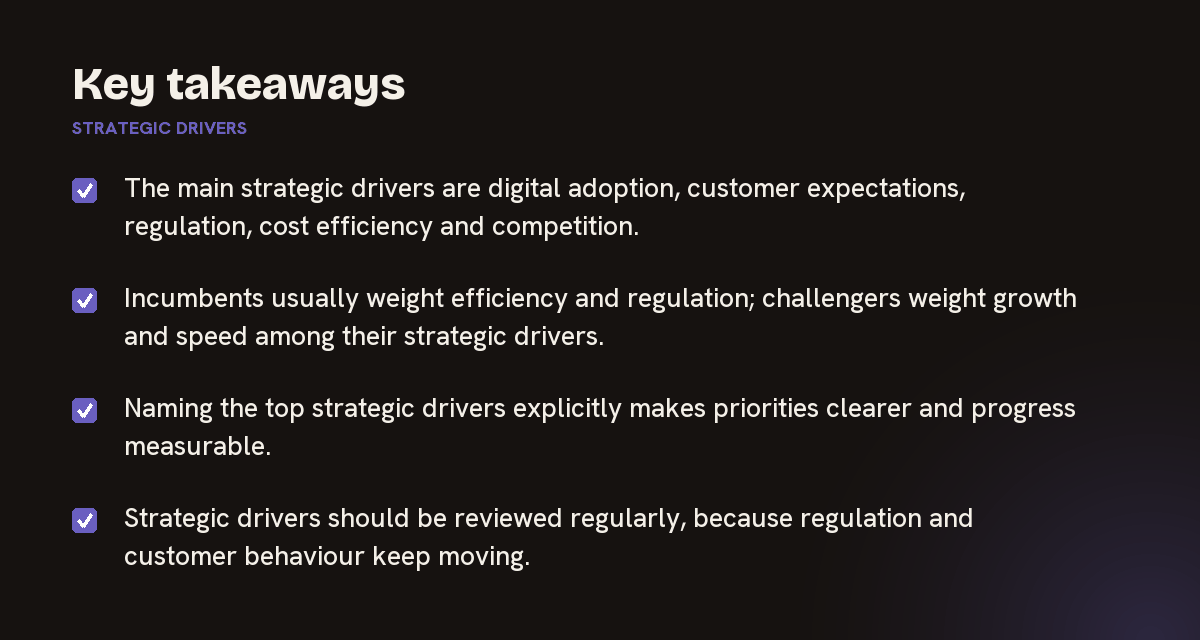
- The main strategic drivers are digital adoption, customer expectations, regulation, cost efficiency and competition.
- Incumbents usually weight efficiency and regulation; challengers weight growth and speed among their strategic drivers.
- Naming the top strategic drivers explicitly makes priorities clearer and progress measurable.
- Strategic drivers should be reviewed regularly, because regulation and customer behaviour keep moving.
For leadership teams, agreeing the main strategic drivers is the first and most important transformation decision. It shapes investment, sequencing and measurement, and it gives every team a shared answer to the question of why change is needed.
Optimizium helps banks, insurers and wealth managers clarify their strategic drivers and turn them into focused programmes. We respect the experience and priorities of existing leadership teams, because they know where pressure is felt most. And we bring risk, finance and compliance into the design as co-authors, so the plan is ambitious and achievable.
Explore how we approach this across Banking, Insurance, Wealth Management and Beyond Banking, browse the FAQ Hub, or read the related question: What does digital transformation mean in financial services?
Related questions
On this page
Partner with the experts.
Let's discuss how Optimizium can accelerate your roadmap and navigate complex digital transformation.
Schedule a consultation →