Home › FAQ Hub › How do marketplaces differ from aggregators in financial services?
Leadership, Change & Operating ModelsHow do marketplaces differ from aggregators in financial services?
Aggregators mainly compare financial products and pass the customer to the provider to complete the purchase; marketplaces facilitate the whole transaction inside the platform. That requires much deeper integration with providers' systems for know-your-customer checks, payments, compliance and product provisioning, and they often take on more operational responsibility.
Comparison sites changed how many people shop for insurance, loans and savings. A newer model goes further: instead of sending customers to a provider’s website, the platform completes the purchase itself. The difference matters a great deal for the institutions whose products are on show.
Aggregators mainly compare financial products and pass the customer to the provider to complete the purchase; marketplaces facilitate the whole transaction inside the platform. That requires much deeper integration with providers’ systems for know-your-customer checks, payments, compliance and product provisioning, and they often take on more operational responsibility.
In return, marketplaces reduce friction for customers, can improve conversion and allow direct monetisation beyond referral fees. Aggregators often act as lead generators, while transaction platforms behave more like distribution channels. Adoption varies by sector and product, depending on how standardised the products are and how much advice or underwriting they require.
The core tension, in one line:
The closer a platform gets to completing the sale, the closer it gets to owning the customer.
an insurer appears on a comparison site and a newer marketplace. On the comparison site, customers click through to the insurer’s own journey and many drop out. On the marketplace, they buy without leaving the platform through the insurer’s API. Conversion is higher, but the insurer sees less of the customer relationship.
1. Key differences
| Dimension | Aggregators | Marketplaces |
|---|---|---|
| Main role | Compare and refer | Compare and complete the transaction |
| Integration | Pricing feeds or quotes | Full APIs for KYC, payment, issuance |
| Customer journey | Leaves to the provider | Stays on the platform |
| Revenue model | Referral or lead fees | Commissions, fees, sometimes subscriptions |
| Operational responsibility | Limited | Shared with providers |
2. What it means for providers
- Distribution reach: both models expand reach, but transaction platforms convert more of it.
- Customer ownership: on marketplaces, the provider may never control the full relationship.
- Integration effort: these platforms require robust, real-time APIs and clear operational responsibilities.
- Price pressure: both models make comparison easy, which compresses margins on standard products.
3. Sector adoption
| Sector | Typical model | Why |
|---|---|---|
| Insurance | Aggregators widely; marketplaces growing for simple personal lines | Standardised products suit comparison |
| Banking | Aggregators for savings and loans; some transaction platforms for credit | Credit decisions need provider systems |
| Wealth | Fund platforms | Suitability limits full self-service |
| Fintech | Often operate platforms themselves | Platform economics |
Regulation follows the sale wherever it happens. When insurance is sold together with other products on marketplaces, the Insurance Distribution Directive requires customers to be told whether components can be bought separately and to see the costs of each. The European Commission’s Financial Data Access proposal would also make it easier for platforms to use customers’ financial data, with permission, which could strengthen transaction platforms further.
4. What most providers get wrong about marketplaces
- Treating them like comparison sites: they need operational integration, not just a price feed.
- Competing on price alone: without differentiation, providers become interchangeable.
- Losing sight of the customer: contracts should cover data sharing, servicing and claims experience.
- Ignoring conduct responsibility: the regulated provider usually remains accountable for outcomes.
Example: a lender joined a credit marketplace and saw volumes rise, but early arrears were higher than in its direct channel. The lender worked with the marketplace to share affordability data in real time and adjusted its decision rules for marketplace applicants. Performance converged with the direct channel while volumes stayed high.
5. A contrarian view
Many providers see marketplaces as a threat to their brand. They can also be a disciplined way to reach customers they would never have found otherwise. The question is not whether to participate, but which products to place there, on what terms and with what data and servicing arrangements.
6. How to approach marketplaces
- Choose products suited to comparison, usually standard and simple ones.
- Invest in reliable APIs for quotes, KYC, payment and issuance.
- Agree servicing and data terms clearly in contracts.
- Measure profitability by channel, including acquisition cost and retention.
Key takeaways on marketplaces
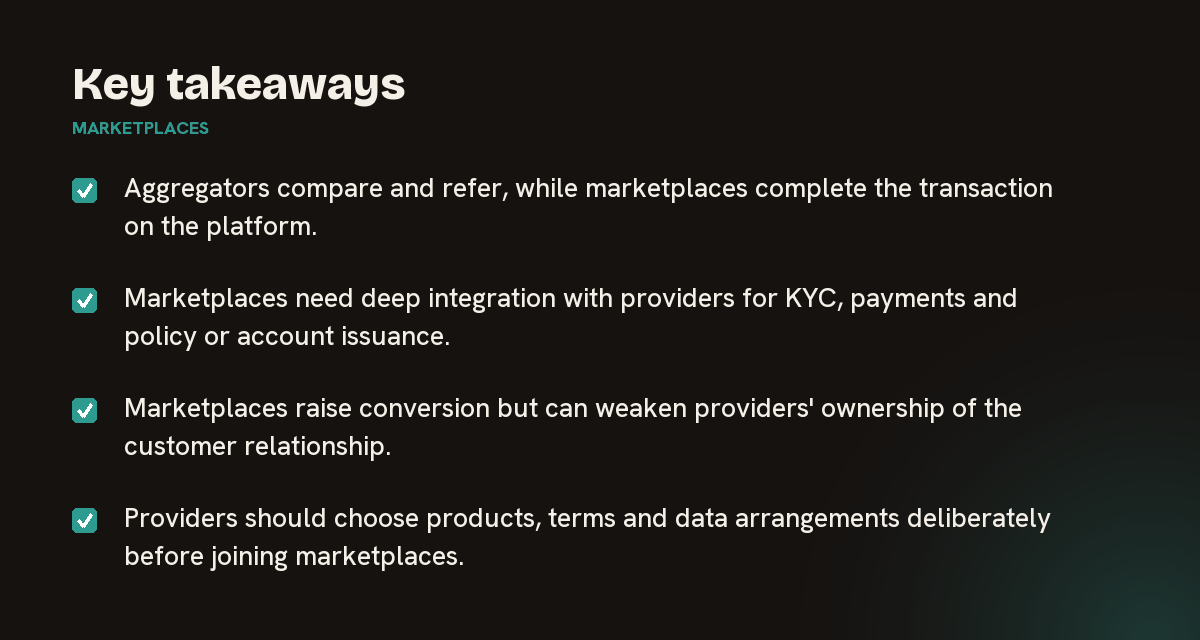
- Aggregators compare and refer, while marketplaces complete the transaction on the platform.
- Marketplaces need deep integration with providers for KYC, payments and policy or account issuance.
- Marketplaces raise conversion but can weaken providers’ ownership of the customer relationship.
- Providers should choose products, terms and data arrangements deliberately before joining marketplaces.
For leadership teams, both models are now part of the distribution landscape in most consumer financial products. The strategic task is to use them for reach and conversion without giving away the relationships and data that create long-term value.
Optimizium helps banks, insurers and wealth managers design platform and partner distribution strategies. We respect the brand and customer relationships institutions have built, because they are worth protecting. And we bring distribution, risk and compliance teams into the design as co-authors, so platform growth stays profitable and well governed.
Explore how we approach this across Insurance, Banking, Wealth Management and Beyond Banking, browse the FAQ Hub, or read the related question: Why do digital transformations require cultural change, not only technology change?
Partner with the experts.
Let's discuss how Optimizium can accelerate your roadmap and navigate complex digital transformation.
Schedule a consultation →