Home › FAQ Hub › How do mobile apps differ in banking vs. insurance vs. wealth?
Tech & Core ModernisationHow do mobile apps differ in banking vs. insurance vs. wealth?
Mobile apps differ across banking, insurance and wealth because they serve very different usage patterns. Mobile banking is task-heavy and frequent: payments, transfers, balance checks and authentication almost every day.
Many financial firms design their app by looking at the best banking apps. The problem is that customers open their banking app several times a week, their insurer’s app a couple of times a year and their wealth app when markets move. Designing the same way for such different patterns is a common and costly mistake.
Mobile apps differ across banking, insurance and wealth because they serve very different usage patterns. Mobile banking is task-heavy and frequent: payments, transfers, balance checks and authentication almost every day. Insurance apps are event-driven, built around a policy, a claim or a renewal, with long dormant periods in between.
Wealth apps support episodic engagement, such as portfolio reviews, research and execution, with a higher cognitive load because decisions involve risk and long horizons. Fintech apps often optimise onboarding and activation funnels for growth. Each pattern needs different features, different design priorities and different measures of success.
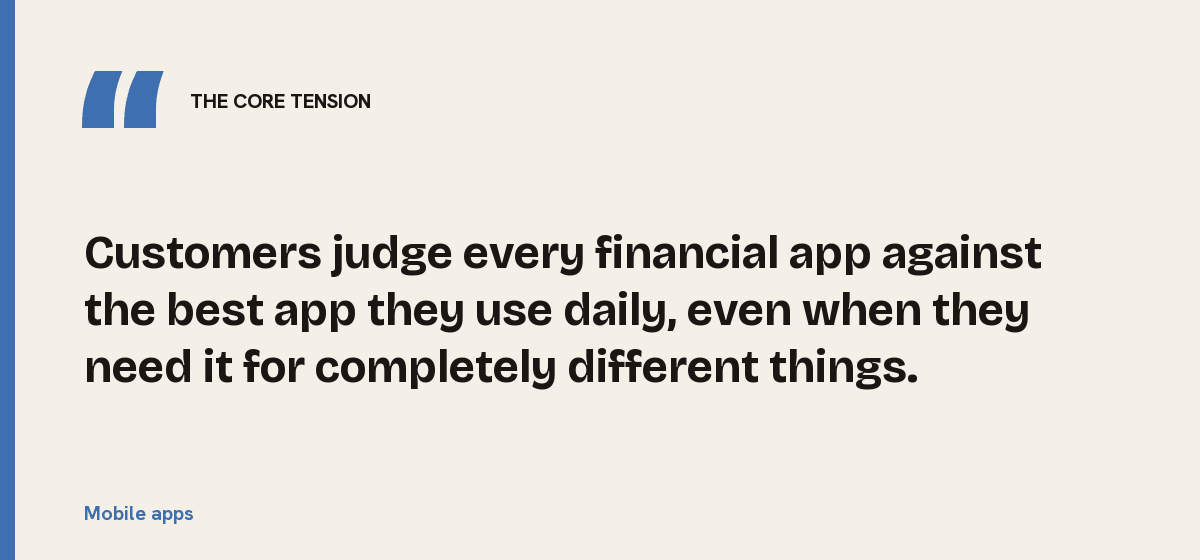
The core tension, in one line:
Customers judge every financial app against the best app they use daily, even when they need it for completely different things.
an insurer launched an app with a policy summary and news feed, and usage collapsed after the first month. Redesigned around the moment that matters, the claim, with guided notification, photo upload, status tracking and direct contact with the handler, satisfaction among customers who claimed rose markedly.
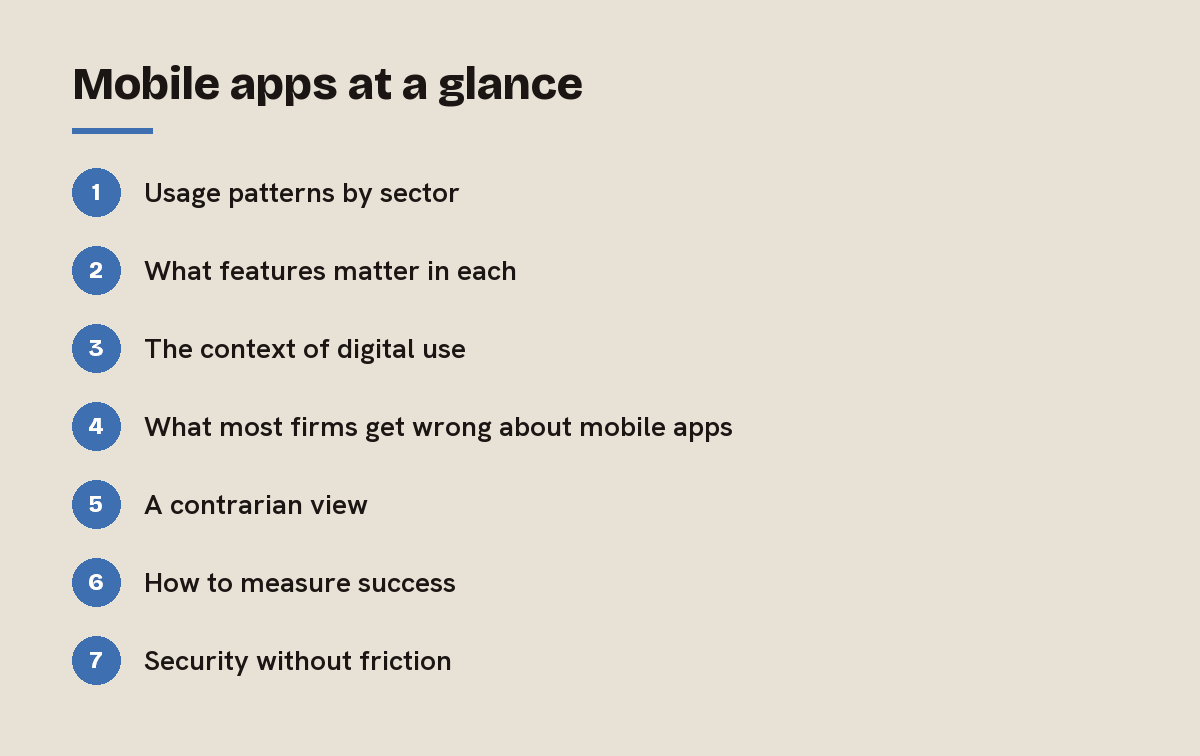
1. Usage patterns by sector
| Sector | Typical frequency | Moment that matters most | Design priority |
|---|---|---|---|
| Banking | Daily or weekly | Payments and balance checks | Speed, reliability, security |
| Insurance | Episodic, event-driven | The claim | Clarity, guidance, status updates |
| Wealth | Episodic, decision-driven | Portfolio reviews and market falls | Understanding, transparency, adviser access |
| Fintech | High at the start | Onboarding and first transaction | Simplicity and activation |
2. What features matter in each
- Banking: instant payments, card controls, real-time notifications and low-friction authentication.
- Insurance: guided claims, policy documents, clear renewals and support at difficult moments.
- Wealth: a consolidated view of wealth, plain explanations of performance and costs, and easy contact with an adviser.
- Fintech: sign-up in minutes, a fast first transaction and simple features that bring customers back.
3. The context of digital use
Digital use is already the norm in European banking. Eurostat reports that in 2024, 93 per cent of people aged 16 to 74 used the internet and 67 per cent used internet banking. Insurance is different: EIOPA found that digital-only distribution channels still lag well behind physical or hybrid ones, especially in life insurance.
Accessibility is now a legal requirement too. Under the European Accessibility Act, consumer banking services provided after 28 June 2025 must meet accessibility requirements, which directly affects mobile apps.
| Measure | Banking | Insurance | Wealth |
|---|---|---|---|
| Monthly active use | Very relevant | Less relevant | Relevant |
| Claims completed in the app | Not applicable | Very relevant | Not applicable |
| Adviser contacts started in the app | Less relevant | Relevant | Very relevant |
4. What most firms get wrong about mobile apps
- Copying another sector’s app: an insurer measuring success by daily use is measuring the wrong thing.
- Filling mobile apps with features: more screens do not make up for a key moment handled badly.
- Ignoring accessibility: for consumer banking, it is now a legal obligation.
- Disconnecting the app from people: customers should be able to move from the app to an adviser or claims handler without repeating themselves.
Example: a wealth manager found that clients opened its app mainly after market falls and closed it without finding answers. It added a short message from the investment team at those moments and a button to request a call. Adviser conversations concentrated where they added value, and client confidence improved.
5. A contrarian view
Firms often chase more app usage. In insurance and wealth, the right goal is not more use but better use at the moments that matter. An app a customer opens twice a year to settle a claim smoothly is worth more than one they open often with no purpose.
6. How to measure success
Each sector needs its own measures for mobile apps. In banking, the share of tasks completed without contacting the bank, and payment reliability. In insurance, the share of claims notified and tracked in the app, and satisfaction after a claim. In wealth, how well clients understand performance and costs, and how easily they reach an adviser.
7. Security without friction
Security expectations differ too. Banking apps need strong authentication for frequent payments, but customers expect it to be quick, usually biometric. Insurance and wealth apps are opened rarely, so customers often forget passwords; recovery journeys must be secure and simple. Designing authentication around each sector’s usage pattern keeps protection high without driving customers back to the phone.
Key takeaways on mobile apps
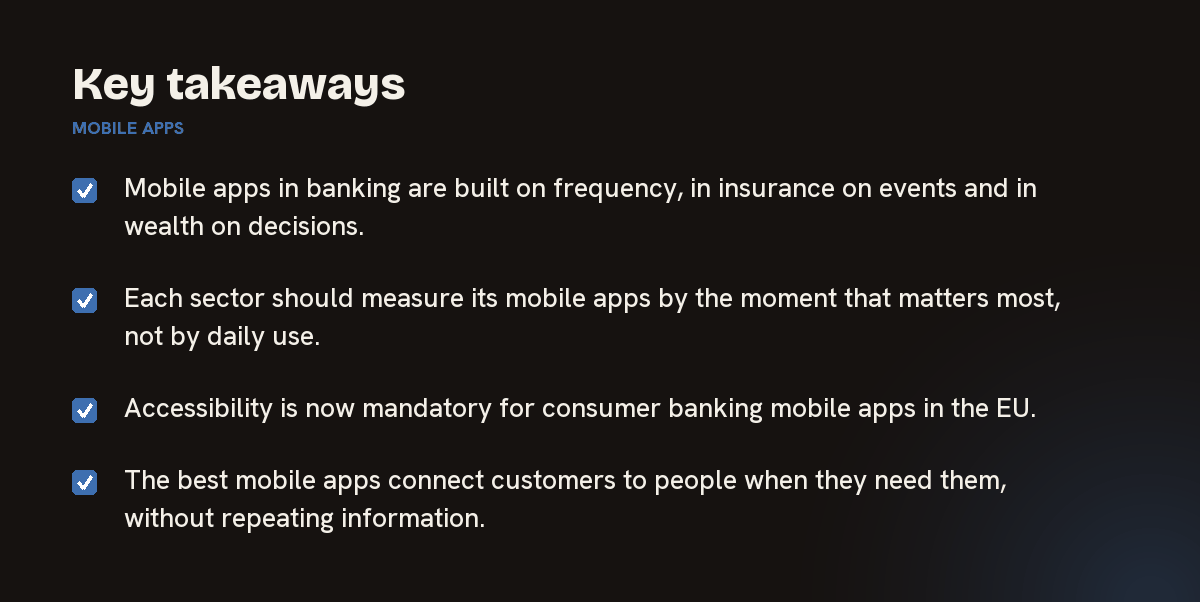
- Mobile apps in banking are built on frequency, in insurance on events and in wealth on decisions.
- Each sector should measure its mobile apps by the moment that matters most, not by daily use.
- Accessibility is now mandatory for consumer banking mobile apps in the EU.
- The best mobile apps connect customers to people when they need them, without repeating information.
For leadership teams, the useful question is not whether the app looks modern, but whether it handles each business line’s key moments well. Measuring against those moments directs investment to what customers value.
Optimizium helps banks, insurers and wealth managers design mobile experiences suited to their business. We respect the knowledge of service and operations teams, because they know what customers look for at each moment. And we bring risk, security and compliance into the design as co-authors, so apps are simple, safe and accessible.
Explore how we approach this across Banking, Insurance and Wealth Management, browse the FAQ Hub, or read the related question: What is the role of portfolio platforms in wealth digitalization?
Related questions
Partner with the experts.
Let's discuss how Optimizium can accelerate your roadmap and navigate complex digital transformation.
Schedule a consultation →