Home › FAQ Hub › What is the role of portfolio platforms in wealth digitalization?
Tech & Core ModernisationWhat is the role of portfolio platforms in wealth digitalization?
Portfolio platforms are the integrated systems that bring together client and holdings data, order execution, custody links, reporting, analytics and tax workflows for wealth managers, private banks and advisory firms.
Ask a wealth adviser where their week goes and the answer is rarely “advising clients”. It is reconciling data from several systems, preparing reports, checking suitability files and chasing transactions. That is the problem portfolio platforms exist to solve.
Portfolio platforms are the integrated systems that bring together client and holdings data, order execution, custody links, reporting, analytics and tax workflows for wealth managers, private banks and advisory firms. Their role in wealth digitalisation is to give advisers, clients and operations one version of the truth, so that advice, transactions and reporting run on the same data. Done well, portfolio platforms reduce adviser complexity, strengthen compliance by making suitability and costs traceable, and allow firms to scale their product shelves without adding proportional headcount. They are the operational core on which client-facing digital wealth experiences depend.
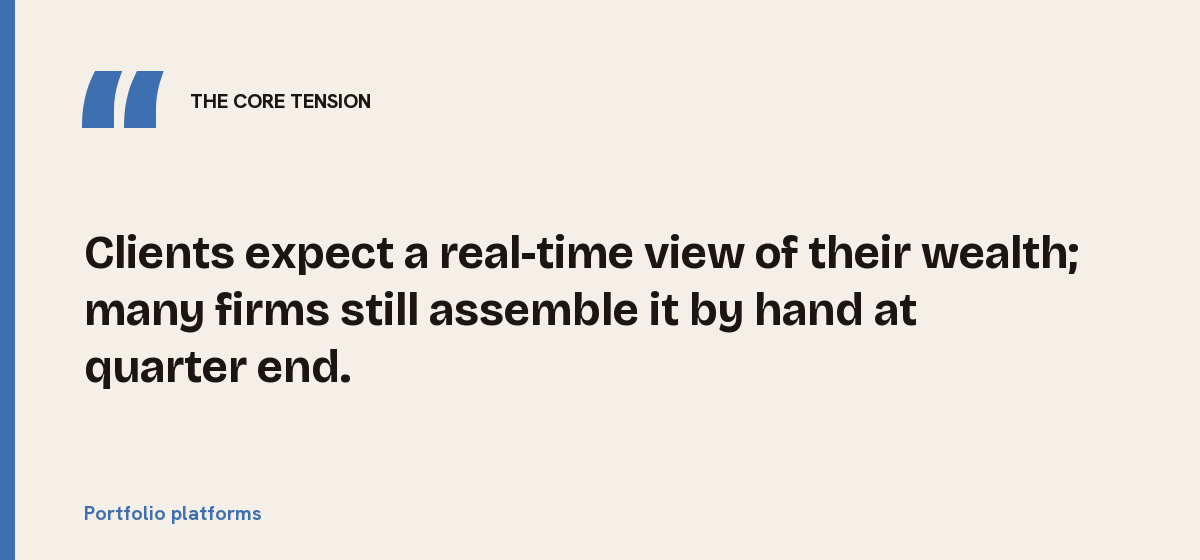
The core tension, in one line:
Clients expect a real-time view of their wealth; many firms still assemble it by hand at quarter end.
a private bank’s advisers prepare quarterly client reviews by exporting data from three systems into spreadsheets. After consolidating onto one portfolio platform, the review pack is generated automatically, including performance, costs and suitability notes, and advisers spend the saved hours with clients.
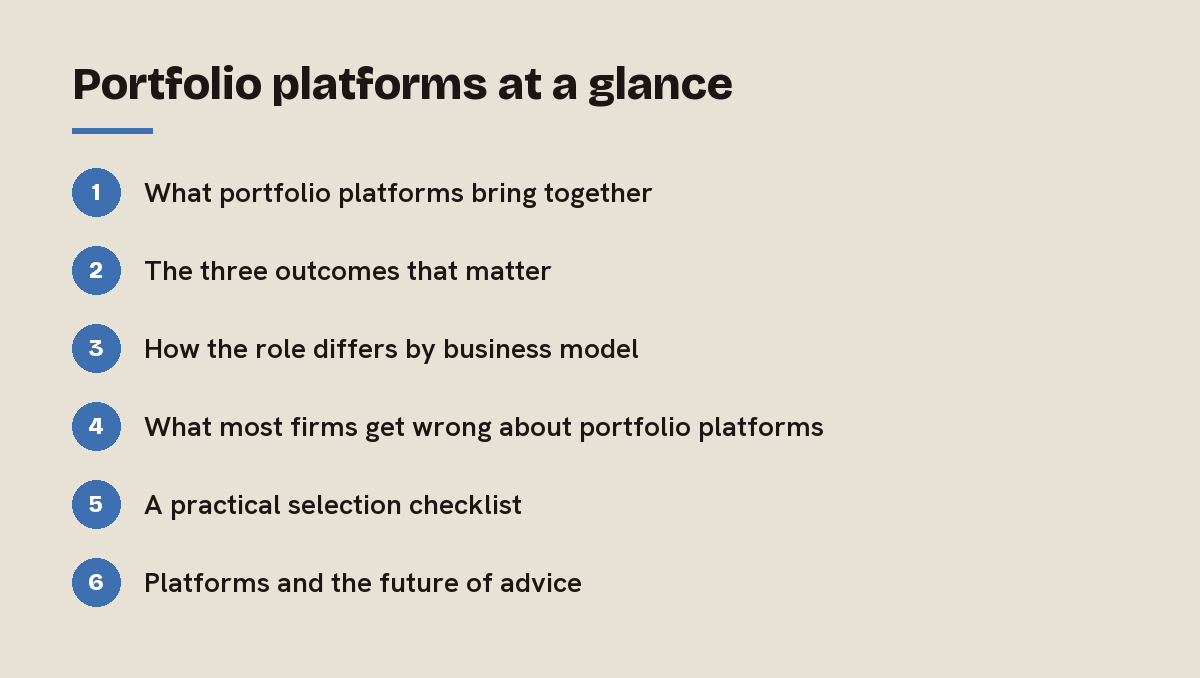
1. What portfolio platforms bring together
| Capability | What it looks like on the ground | Why it matters |
|---|---|---|
| Data | One record of clients, accounts and holdings | Advisers stop reconciling and start advising |
| Execution | Orders, rebalancing and model portfolios from one screen | Faster, consistent implementation of advice |
| Custody | Automated links to custodians and depositaries | Fewer breaks and manual corrections |
| Reporting | Performance, costs and charges, regulatory reports | Clients see accurate, timely information |
| Analytics | Risk, exposure and scenario tools | Better conversations about portfolios |
| Tax workflows | Tax lots, wrappers, reporting | Value that clients notice and value |
2. The three outcomes that matter
- Reduced adviser complexity: when the portfolio, the client file and the order screen are in one place, an adviser can prepare, recommend and implement in a single sitting.
- Improved compliance: suitability under MiFID II must be assessed and recorded consistently. ESMA’s guidelines on the MiFID II suitability requirements, updated in 2022 to include clients’ sustainability preferences, set clear expectations for information gathering and record-keeping that are far easier to meet on an integrated platform.
- Scaled product shelves: model portfolios, funds and discretionary mandates can be added to the shelf and distributed through advisers and digital channels without bespoke processes for each.
3. How the role differs by business model
| Business model | Main role of the platform | What it looks like on the ground |
|---|---|---|
| Private bank | Consolidated view across banking and investments | Relationship managers see the whole client balance sheet |
| Discretionary manager | Model management and rebalancing at scale | Thousands of portfolios rebalanced to models in one run |
| Advisory firm | Suitability, recommendations and reporting | Advice evidence and client reports generated from the same data |
| Broker-dealer | Execution and custody efficiency | Straight-through processing from order to settlement |
4. What most firms get wrong about portfolio platforms
The usual mistake is to treat the platform choice as a software selection rather than an operating model decision.
- Buying features, not workflows: comparing feature lists misses how advisers and operations will work day to day.
- Migrating bad data: moving inaccurate holdings and client data onto new portfolio platforms simply digitises the problem.
- Leaving the client experience for later: the platform should be chosen with the client portal and app in mind, because clients see its data directly.
- Underestimating dependency risk: many firms rely on third-party providers for their platform. Under the EU’s Digital Operational Resilience Act, which has applied since 17 January 2025, those ICT third-party arrangements must be identified, managed and tested.
Example: a wealth manager running two legacy systems after an acquisition decided to consolidate. Rather than migrate everything at once, it moved one adviser team and its clients first, cleaned the data, refined the workflows and only then moved the rest. The first team’s experience shaped the configuration, and the remaining migrations ran faster and with fewer client issues.
5. A practical selection checklist
Selection processes often run for months and still miss what matters. A short, practical checklist helps.
- Day-in-the-life tests: ask shortlisted vendors to run real adviser and operations scenarios, from onboarding a new client to producing a quarterly review, using your own sample data.
- Data model fit: check how the system represents households, entities, trusts and wrappers, because a poor fit here creates workarounds for years.
- Integration effort: list the custodians, research providers, CRM and accounting systems you need to connect, and ask for evidence of existing connections.
- Regulatory reporting: confirm how costs and charges, suitability records and transaction reporting are produced, and who maintains them as rules change.
- Exit and continuity: understand how data can be extracted and how the service would continue if the provider failed, a question supervisors increasingly ask.
6. Platforms and the future of advice
Portfolio platforms increasingly power hybrid models, in which clients self-serve for simple needs and work with advisers for complex ones. The same data supports both, so a client who starts a top-up in the app and calls an adviser is never asked to repeat themselves. This is where wealth digitalisation stops being a back-office project and becomes a proposition clients can feel.
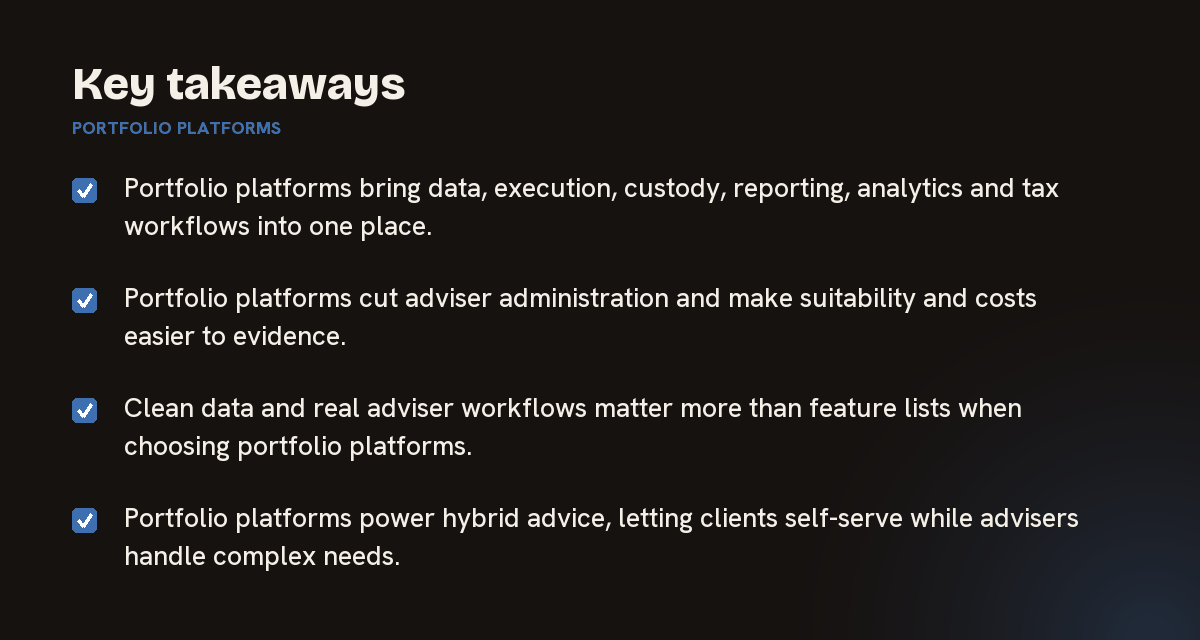
Key takeaways on portfolio platforms
- Portfolio platforms bring data, execution, custody, reporting, analytics and tax workflows into one place.
- Portfolio platforms cut adviser administration and make suitability and costs easier to evidence.
- Clean data and real adviser workflows matter more than feature lists when choosing portfolio platforms.
- Portfolio platforms power hybrid advice, letting clients self-serve while advisers handle complex needs.
For wealth leaders, the platform decision is one of the longest-lived they will make. It shapes adviser productivity, client experience and regulatory confidence for a decade or more, which is why it deserves executive attention beyond the technology function.
Optimizium helps wealth managers, private banks and advisory firms choose, implement and get value from portfolio platforms. We respect the investment and client knowledge held by advisers and operations teams, because it determines how the platform should be configured. And we bring compliance and risk colleagues into the design as co-authors, so suitability, costs disclosure and resilience are built in from the start.
Explore how we approach this across Wealth Management, Banking and Beyond Banking, browse the FAQ Hub, or read the related question: How does digital improve operational excellence?
Related questions
On this page
Partner with the experts.
Let's discuss how Optimizium can accelerate your roadmap and navigate complex digital transformation.
Schedule a consultation →