Home › FAQ Hub › How do orchestration and workflow platforms support transformation?
Tech & Core ModernisationHow do orchestration and workflow platforms support transformation?
Orchestration and workflow platforms support transformation by connecting core systems, third-party services, data sources and regulatory checks into coherent end-to-end journeys such as onboarding, claims, lending and advice.
Most transformation programmes eventually discover that the hard part is not any single system. It is the space between systems, where cases wait, data is re-keyed and nobody quite owns the outcome.
Orchestration and workflow platforms support transformation by connecting core systems, third-party services, data sources and regulatory checks into coherent end-to-end journeys such as onboarding, claims, lending and advice. Workflow platforms define the steps, route work between systems and people, enforce the order of controls and record what happened. The result is less friction for customers, shorter cycle times and fewer errors, without having to replace every system at once. They are often the fastest way for an institution to show measurable progress, because they improve journeys that cross many systems, which is where most cost and frustration sits.
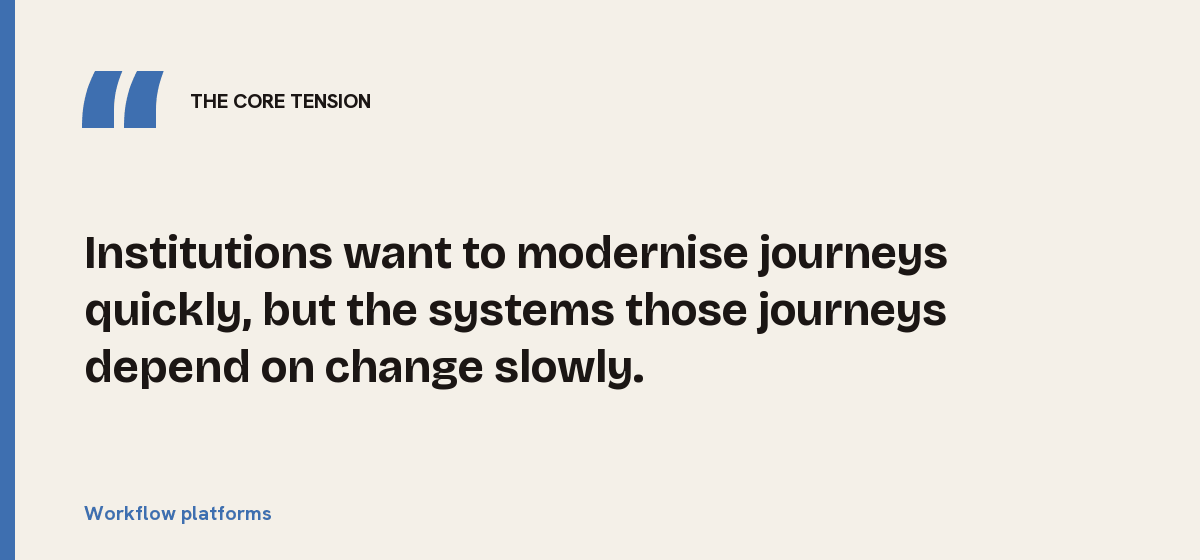
The core tension, in one line:
Institutions want to modernise journeys quickly, but the systems those journeys depend on change slowly.
a bank’s small business onboarding involves seven systems and four teams, and takes three weeks. A workflow platform coordinates identity checks, beneficial ownership screening, credit assessment and account opening in one case, with exceptions routed to specialists. Most applications now complete in days.
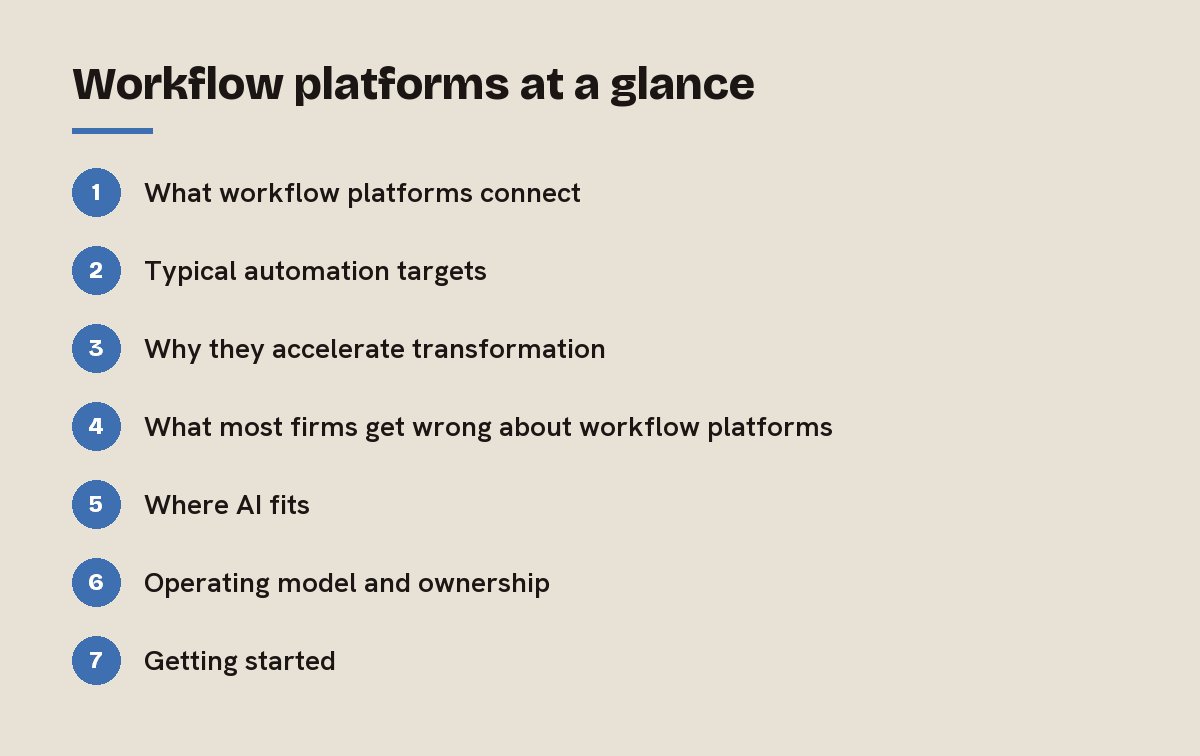
1. What workflow platforms connect
| Element | What it looks like on the ground | Why connecting it matters |
|---|---|---|
| Core systems | Ledgers, policy administration, portfolio systems | Journeys complete without re-keying |
| Third parties | Identity providers, credit bureaus, data vendors | External checks happen in sequence, automatically |
| Data sources | Customer, product and risk data | Decisions use current, consistent information |
| Regulatory checks | KYC, sanctions, suitability, affordability | Controls cannot be skipped and are evidenced |
| People | Underwriters, advisers, operations teams | Human steps are queued, prioritised and tracked |
2. Typical automation targets
Four families of process account for much of the value.
- KYC, AML and identity verification: document checks, screening and risk scoring coordinated into a single onboarding case.
- Suitability and advice: fact-finds, risk profiling and recommendation records captured once and reused.
- Underwriting and claims: data gathering, rules, referrals and approvals routed automatically, with complex cases sent to specialists.
- Payments and settlements: initiation, validation, exception handling and reconciliation.
| Process | Before | With workflow platforms |
|---|---|---|
| Onboarding | Paper forms, emails between teams | One digital case, automated checks |
| Advice | Fact-find re-entered in several systems | Data captured once, reports generated |
| Claims | Handlers chase status across systems | Automatic routing and service levels |
| Payments exceptions | Manual investigation queues | Rules-based triage, specialist escalation |
3. Why they accelerate transformation
- They work with existing systems. Workflow platforms coordinate legacy cores rather than replacing them, so value arrives before modernisation is complete.
- They make processes visible. Every step is measured, so bottlenecks become obvious.
- They create evidence. Supervisors expect robust execution as well as strategy. The ECB’s 2024 review of digitalisation practices highlights sound practices such as real-time KPIs and automated dashboards, which become far easier when processes run on one platform.
- They free scarce people. The ECB notes that only around 5 per cent of bank staff are allocated to digital transformation, so automating routine work is one of the few ways to release capacity for change.
4. What most firms get wrong about workflow platforms
- Automating broken processes: speeding up an unnecessary step only makes waste faster. Redesign the journey first.
- Letting every department buy its own tool: separate platforms for onboarding, servicing and claims recreate silos.
- Hard-coding business rules into flows: rules belong in decision services that can be governed and changed independently.
- Underestimating resilience: once critical journeys depend on the platform, it falls within ICT risk management under the EU’s Digital Operational Resilience Act, including testing and third-party oversight.
Example: an insurer introduced a workflow platform for motor claims. In the first phase it simply mapped and coordinated the existing steps, which revealed that most delay came from waiting for repair estimates. The second phase connected repairers directly, and simple claims settled in days rather than weeks. The platform had paid for itself before any core system changed.
5. Where AI fits
AI models increasingly sit inside workflows: reading documents, classifying claims, flagging suspicious transactions. Workflow platforms give those models a controlled place to operate, with human review where needed and a record of each decision. That combination of automation and oversight is what makes AI usable in regulated processes.
6. Operating model and ownership
Technology is only half of the answer. Institutions that get lasting value usually set up a small central team that owns the platform, its standards, its reusable connectors and its resilience, while product and operations teams own their journeys and decide how they evolve. Clear service levels between the two prevent the central team from becoming a bottleneck.
Change approval needs attention as well: if every adjustment to a flow requires a full release and committee review, the speed advantage disappears. A tiered model, where low-risk changes are approved within the team and higher-risk changes go to a standing forum with risk and compliance, keeps both pace and control. Finally, the people who handle cases every day should be part of the design, because they know which steps cause the most frustration and which shortcuts are hiding risk.
7. Getting started
- Choose a journey with visible pain and many hand-offs.
- Map the real process, including exceptions and workarounds.
- Separate flow from rules, and design the audit trail with compliance.
- Measure before and after: cycle time, touch time, error rate, cost per case.
- Scale journey by journey, reusing connectors and services.
Key takeaways on workflow platforms
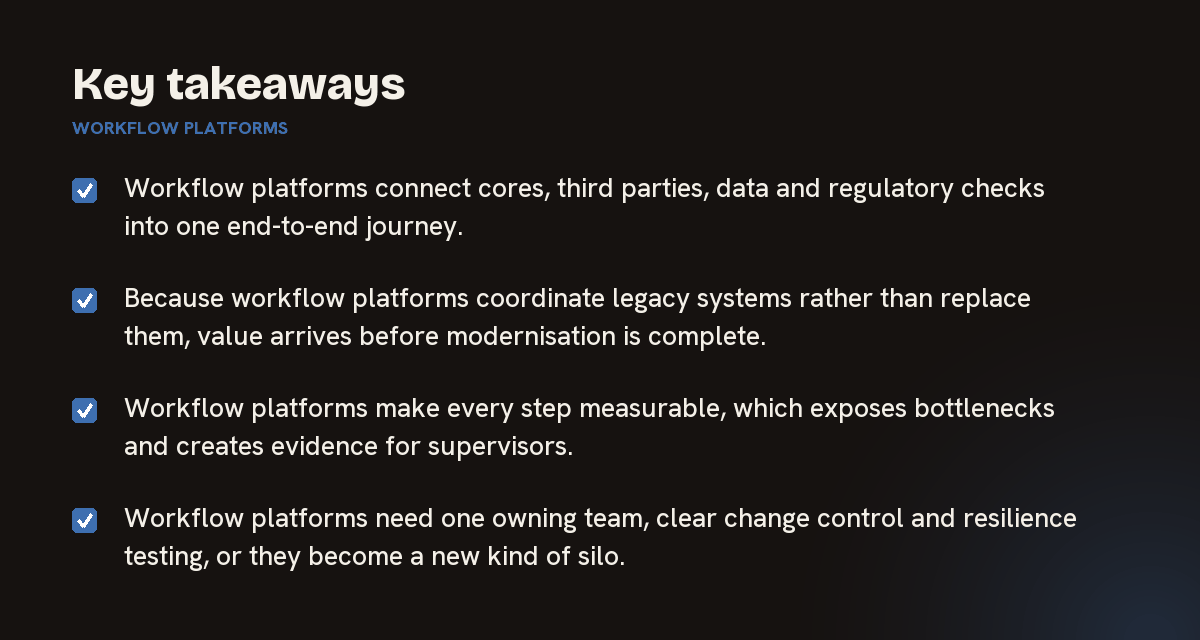
- Workflow platforms connect cores, third parties, data and regulatory checks into one end-to-end journey.
- Because workflow platforms coordinate legacy systems rather than replace them, value arrives before modernisation is complete.
- Workflow platforms make every step measurable, which exposes bottlenecks and creates evidence for supervisors.
- Workflow platforms need one owning team, clear change control and resilience testing, or they become a new kind of silo.
For leadership teams, workflow platforms offer a rare combination: lower cost, better customer experience and stronger control, delivered incrementally. The key is to treat them as an enterprise capability with clear ownership rather than a series of departmental tools.
Optimizium helps banks, insurers and wealth managers design and roll out workflow platforms journey by journey. We respect the operational knowledge embedded in today’s processes, because it reveals where the real exceptions lie. And we bring operations, risk and compliance colleagues into the design as co-authors, so automated journeys are faster and easier to evidence from the first release.
Explore how we approach this across Banking, Insurance and Wealth Management, browse the FAQ Hub, or read the related question: How does AI affect financial transformation?
Related questions
Partner with the experts.
Let's discuss how Optimizium can accelerate your roadmap and navigate complex digital transformation.
Schedule a consultation →