Home › FAQ Hub › How does AI affect financial transformation?
Tech & Core ModernisationHow does AI affect financial transformation?
AI affects financial transformation by changing how decisions are made and how work is done across the value chain: fraud detection, credit scoring, underwriting, claims triage, portfolio recommendations and operational automation.
Artificial intelligence has moved from pilots to production in financial services remarkably quickly. The question for most institutions is no longer whether to use it, but where it changes the economics of the business and how to govern it safely.
AI affects financial transformation by changing how decisions are made and how work is done across the value chain: fraud detection, credit scoring, underwriting, claims triage, portfolio recommendations and operational automation. Within financial transformation, it allows institutions to decide faster, at lower cost and often more accurately than with traditional rules, and to automate tasks such as reading documents, answering routine queries and classifying cases.
Yet AI also introduces model risk, and explainability becomes critical wherever decisions affect customers, especially in regulated advice and underwriting. The impact depends on the sector: banks lean on AI for credit, fraud and customer experience; insurers for underwriting and claims; wealth managers for advice and portfolio models; fintechs for optimisation, user experience and pricing.
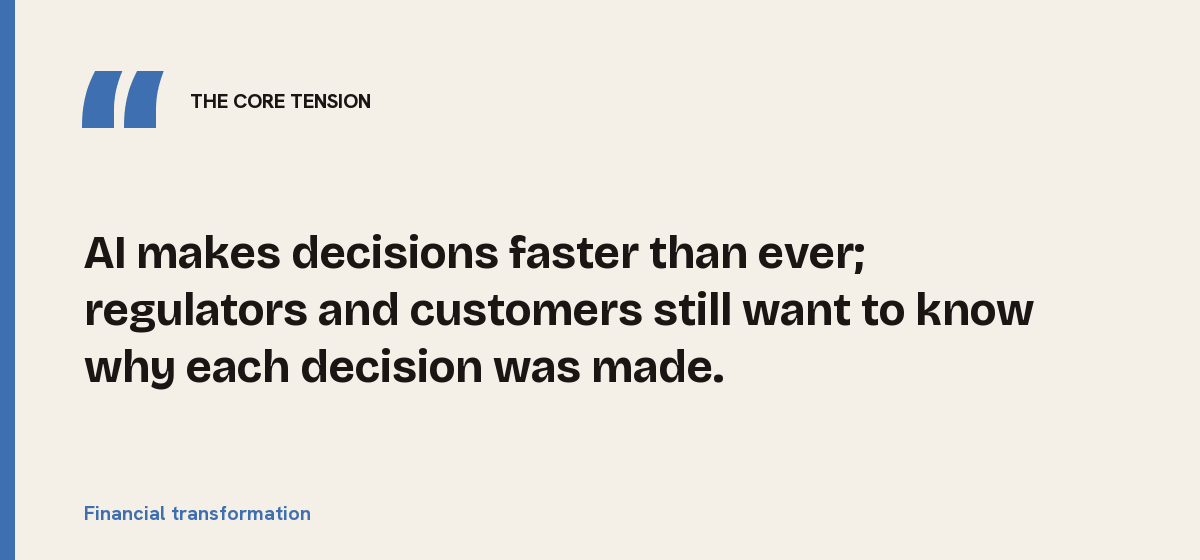
The core tension, in one line:
AI makes decisions faster than ever; regulators and customers still want to know why each decision was made.
an insurer uses AI to read incoming claim documents and photos, classify each claim by complexity and route simple ones for automatic settlement. Complex claims go to experienced handlers with a summary already prepared. Settlement times fall for simple claims, and handlers spend their time where judgement matters.
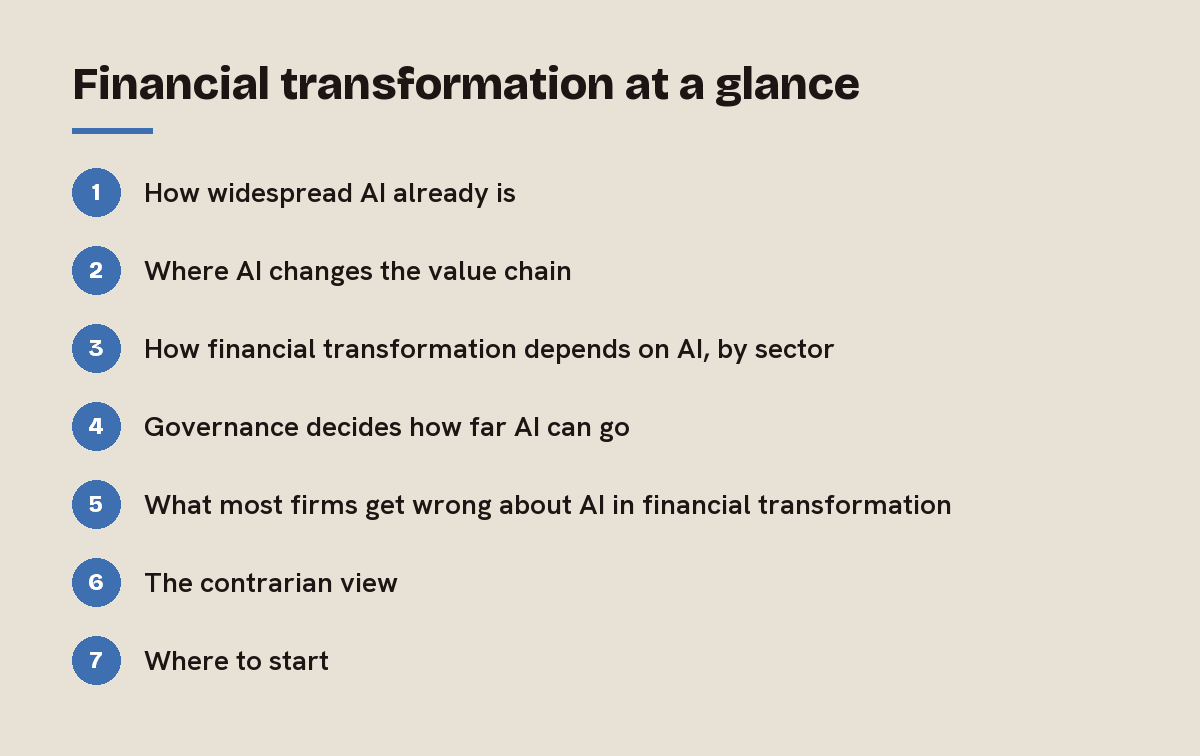
1. How widespread AI already is
Adoption is high and rising. According to ECB Supervisory Board Chair Claudia Buch, more than 90 per cent of banks directly supervised by the ECB integrate AI into their operations, and 85 per cent use generative AI, with fraud and cybercrime prevention the leading use. In insurance, EIOPA found that AI was used by 50 per cent of respondents in non-life and 24 per cent in life, reflecting the greater complexity and longer horizons of life business.
2. Where AI changes the value chain
| Area | What AI does | Effect on financial transformation |
|---|---|---|
| Fraud detection | Scores transactions and applications in real time | Lower losses, fewer false alarms |
| Credit scoring | Uses richer data to assess risk | Faster decisions, potentially wider access |
| Underwriting | Assesses risk from structured and unstructured data | Quicker quotes, more precise pricing |
| Claims triage | Classifies and routes claims, reads documents | Faster settlement, lower handling cost |
| Portfolio recommendations | Supports advisers with analysis and proposals | More productive advice, better personalisation |
| Operations | Automates document handling and routine queries | Lower cost-to-serve |
3. How financial transformation depends on AI, by sector
- Banking: credit, fraud and customer experience. High transaction volumes make banks natural users of AI for scoring, monitoring and service.
- Insurance: underwriting and claims. AI helps price risk and handle claims, though life and health lines move more cautiously.
- Wealth: advice and portfolio models. AI supports advisers with research, portfolio construction and client communication.
- Fintech: optimisation, user experience and pricing. Fintechs use AI to improve conversion, engagement and pricing at speed.
4. Governance decides how far AI can go
The more an AI system affects a customer’s access to financial services, the stricter the rules.
- High-risk AI: the EU Artificial Intelligence Act classifies AI used to assess creditworthiness, and for risk assessment and pricing in life and health insurance, as high-risk, with requirements on data quality, documentation, human oversight and monitoring.
- Model risk management: banks and insurers already validate and monitor models; AI extends that discipline to more models, changing more often.
- Explainability: in advice and underwriting, institutions must be able to explain outcomes to customers and supervisors.
| Use case | Risk level | Governance emphasis |
|---|---|---|
| Internal document processing | Lower | Accuracy, data protection |
| Fraud detection | Medium | Performance, fairness of false positives |
| Credit scoring | High | Explainability, bias testing, human oversight |
| Life and health pricing | High | Fairness, documentation, oversight |
| Advice support | High | Suitability, adviser accountability |
5. What most firms get wrong about AI in financial transformation
- Running pilots without a path to production: many institutions have dozens of experiments and few scaled deployments.
- Neglecting data foundations: AI is only as good as the data it learns from, and weak data is the most common reason AI fails to move financial transformation forward.
- Treating governance as a brake: well-designed governance speeds adoption by giving decision-makers confidence.
- Automating without redesigning: inserting AI into an unchanged process captures little of its value.
Example: a bank ran many AI pilots across departments, but few reached customers. It created a single AI platform team, a standard model approval path with risk and compliance, and a short list of priority use cases tied to business outcomes. Within a year, fraud detection, document processing and collections models were in production, each with clear monitoring.
6. The contrarian view
AI is often presented as the centre of financial transformation. In practice, it is an accelerator: it makes good processes, data and organisations much better, and it makes weak ones fail faster. Institutions that fix their data and operating model first tend to get far more from AI than those that buy AI to avoid fixing them.
7. Where to start
- Pick use cases with clear value and manageable risk, such as document processing or fraud.
- Build shared foundations: data, platforms, model governance.
- Design human oversight into high-impact decisions.
- Measure outcomes, including fairness and customer impact.
Key takeaways on financial transformation
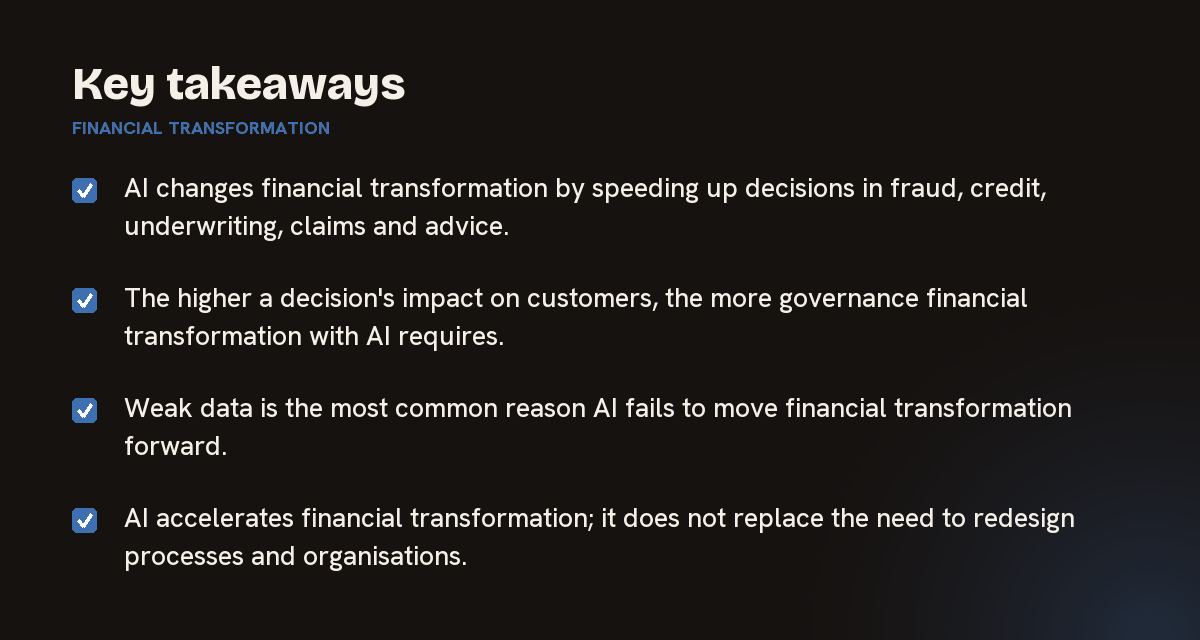
- AI changes financial transformation by speeding up decisions in fraud, credit, underwriting, claims and advice.
- The higher a decision’s impact on customers, the more governance financial transformation with AI requires.
- Weak data is the most common reason AI fails to move financial transformation forward.
- AI accelerates financial transformation; it does not replace the need to redesign processes and organisations.
For leaders, the practical question is how to make AI a dependable part of operations rather than a collection of experiments. That requires clear priorities, solid data, governance that enables rather than blocks, and redesigned processes that let AI do the work it does best.
Optimizium helps banks, insurers and wealth managers place AI at the heart of financial transformation, responsibly. We respect the risk and modelling expertise institutions already have, because it is the foundation of sound AI governance. And we bring model risk, data protection and compliance colleagues into the design as co-authors, so AI scales with confidence.
Explore how we approach this across Banking, Insurance, Wealth Management and Beyond Banking, browse the FAQ Hub, or read the related question: How do mobile apps differ in banking vs. insurance vs. wealth?
Related questions
On this page
Partner with the experts.
Let's discuss how Optimizium can accelerate your roadmap and navigate complex digital transformation.
Schedule a consultation →