Home › FAQ Hub › How do regulations shape digital product design?
Tech & Core ModernisationHow do regulations shape digital product design?
Regulations shape digital product design because financial products are constrained by disclosure, suitability, capital, anti-fraud, anti-money-laundering, accessibility and consumer protection rules, and digital channels must integrate those regulatory checkpoints without degrading the customer experience.
Designers in most industries can remove a step if customers find it annoying. In financial services, many steps exist because the law requires them. The craft lies in meeting those requirements in ways customers understand and accept.
Regulations shape digital product design because financial products are constrained by disclosure, suitability, capital, anti-fraud, anti-money-laundering, accessibility and consumer protection rules, and digital channels must integrate those regulatory checkpoints without degrading the customer experience. The intensity varies: wealth suitability requirements and insurance disclosures typically impose more friction than everyday banking, while fintechs often rely on partners’ licences and must design within those partners’ controls. Each sector has its own sensitivities: banking around AML, KYC and capital; insurance around actuarial pricing, claims and disclosure; wealth around suitability and fiduciary duties. Good digital product design treats these rules as design inputs from the start, not as obstacles added at the end.
The core tension, in one line:
Regulation tells you what must happen; design decides whether customers experience it as protection or as obstruction.
an investment app must assess each new client’s knowledge, experience and risk tolerance before recommending portfolios. Instead of a long questionnaire, it uses short, plain-language questions with examples, explains why each question matters and shows a summary for the client to confirm. Completion rises and the suitability record is clearer than before.
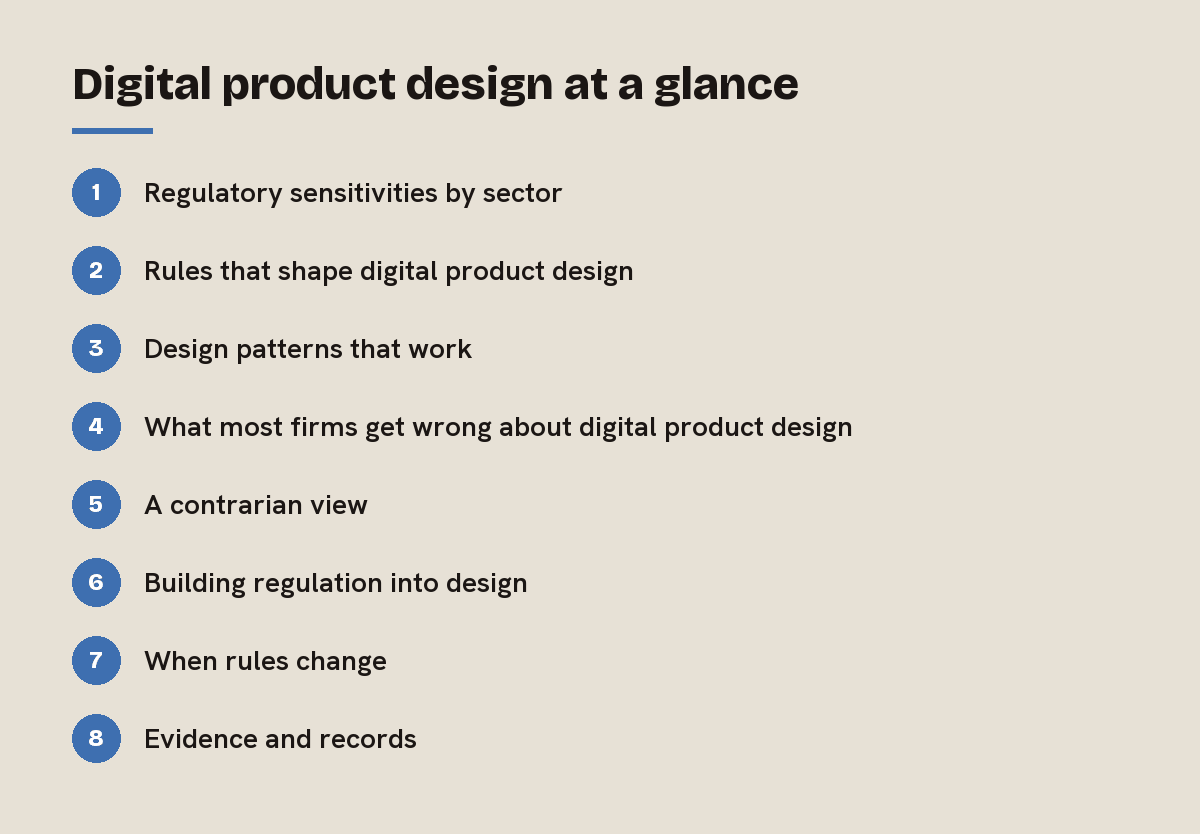
1. Regulatory sensitivities by sector
| Sector | Main regulatory sensitivities | Design implication |
|---|---|---|
| Banking | AML and KYC, capital adequacy, consumer credit rules | Identity and affordability checks woven into onboarding and lending |
| Insurance | Actuarial pricing, claims handling, disclosure | Clear cover summaries, demands and needs, fair claims journeys |
| Wealth | Suitability, fiduciary duties, costs disclosure | Risk profiling, recommendation records, transparent fees |
| Fintech | Partner licences, consumer protection | Design within partner controls and responsibilities |
2. Rules that shape digital product design
- Consumer understanding: the FCA’s Consumer Duty requires that consumers receive the information they need, at the right time, presented in a way they can understand, and that firms consider how customers behave at every stage of the journey.
- Accessibility: under the European Accessibility Act, consumer banking services provided after 28 June 2025 must meet accessibility requirements, which directly affect app and website design.
- Suitability: ESMA’s MiFID II suitability guidelines set out what must be gathered and assessed before investment advice.
- Insurance distribution: the Insurance Distribution Directive requires demands-and-needs assessments and clear information when insurance is bundled with other products.
- AI and automated decisions: the EU AI Act treats AI used for creditworthiness and for life and health insurance pricing as high-risk.
3. Design patterns that work
| Pattern | What it does | Where it helps |
|---|---|---|
| Progressive disclosure | Key facts first, detail on request | Disclosures, terms, cost information |
| Explain the why | Tells customers why information is needed | KYC, suitability, underwriting questions |
| Reuse data | Avoids asking for the same information twice | Onboarding, renewals, reviews |
| Confirmation summaries | Customer checks and confirms key answers | Suitability, demands and needs |
| Accessible by default | Readable text, screen-reader support, clear contrast | All consumer journeys |
4. What most firms get wrong about digital product design
- Adding compliance at the end: checks bolted onto a finished journey create the worst friction.
- Copying paper forms: regulatory questions designed for paper become long, unfriendly screens.
- Treating accessibility as optional: it is now a legal requirement for many financial services, and good for all customers.
- Over-interpreting rules: asking for more than the regulation requires, just in case, adds friction without adding protection.
Example: an insurer redesigned its online home insurance journey with compliance colleagues in the design team. Together they reduced the demands-and-needs questions to those required, moved them to the point where they made sense to customers, and added a one-page summary. Completion improved, and the compliance team found the new records easier to review than before.
5. A contrarian view
Regulation is often seen as the enemy of good digital product design. In practice, many rules ask for exactly what good design aims for: clear information, fair treatment, accessible services and decisions customers can understand. Teams that read regulation as a design brief, rather than a list of obstacles, often produce better products than they would have without it.
6. Building regulation into design
- Include compliance and legal colleagues in product teams from discovery onwards.
- Map every regulatory requirement to a specific moment in the journey.
- Test comprehension with real customers, not only usability.
- Design for accessibility from the first wireframe.
- Document design decisions and their regulatory rationale.
7. When rules change
Regulation is not static. New consumer credit rules, accessibility requirements and AI governance obligations all arrive on fixed dates, and products must change to meet them. Teams responsible for digital product design that keep a living map of which rule affects which screen, field or record can assess the impact of each change quickly and plan updates in normal delivery cycles, rather than in late, disruptive remediation projects.
8. Evidence and records
Regulated journeys must leave evidence: what customers were shown, what they answered and what they agreed to. Designing the record alongside the screen, with timestamps and versions of disclosures, makes audits and complaint handling far easier, and avoids costly reconstruction later.
Key takeaways on digital product design
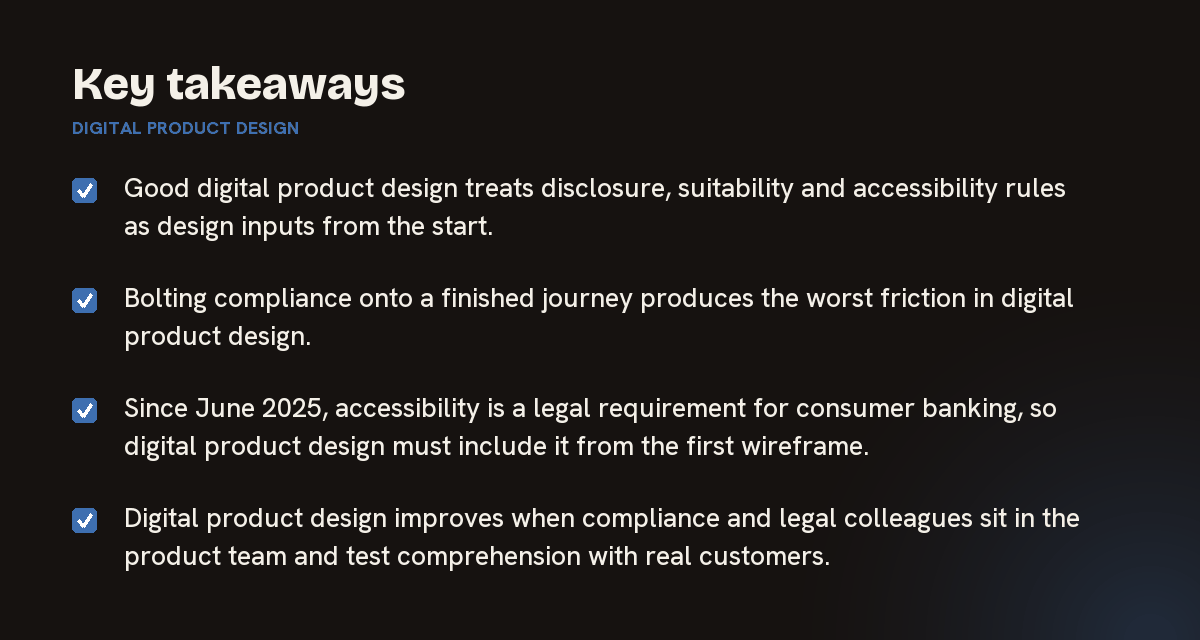
- Good digital product design treats disclosure, suitability and accessibility rules as design inputs from the start.
- Bolting compliance onto a finished journey produces the worst friction in digital product design.
- Since June 2025, accessibility is a legal requirement for consumer banking, so digital product design must include it from the first wireframe.
- Digital product design improves when compliance and legal colleagues sit in the product team and test comprehension with real customers.
For leadership teams, the lesson is to put regulation inside the design process rather than at its end. Doing so reduces friction, speeds delivery and produces products that are easier to defend to supervisors and easier for customers to trust.
Optimizium helps banks, insurers and wealth managers build regulation into digital product design from the start. We respect the expertise of compliance and legal teams, because they understand what each rule is meant to protect. And we bring them into product teams as co-authors, so journeys are clear, compliant and pleasant to use.
Explore how we approach this across Banking, Insurance, Wealth Management and Beyond Banking, browse the FAQ Hub, or read the related question: How does wealth management differ from retail banking in digital strategy?
On this page
Partner with the experts.
Let's discuss how Optimizium can accelerate your roadmap and navigate complex digital transformation.
Schedule a consultation →