Home › FAQ Hub › How does wealth management differ from retail banking in digital strategy?
Tech & Core ModernisationHow does wealth management differ from retail banking in digital strategy?
Wealth management and retail banking differ in digital strategy because their economics and customer relationships differ. Retail banking pursues volume, daily engagement and cost efficiency: millions of customers, frequent low-value interactions and a constant push to automate.
Wealth management and retail banking often sit within the same group, share technology and serve some of the same customers. Yet a digital strategy that works well for one can fail badly for the other, because they make money, build loyalty and manage risk in very different ways.
Wealth management and retail banking differ in digital strategy because their economics and customer relationships differ. Retail banking pursues volume, daily engagement and cost efficiency: millions of customers, frequent low-value interactions and a constant push to automate. Wealth management pursues trust, share of wallet and adviser productivity: fewer clients, higher value per relationship and decisions where advice matters. Wealth strategies must balance self-directed execution, adviser-assisted journeys and relationship management, while suitability rules, risk profiling and portfolio rebalancing introduce necessary friction and complex data orchestration. Retail banking digitises to scale; wealth management digitises to strengthen relationships and free advisers to advise.
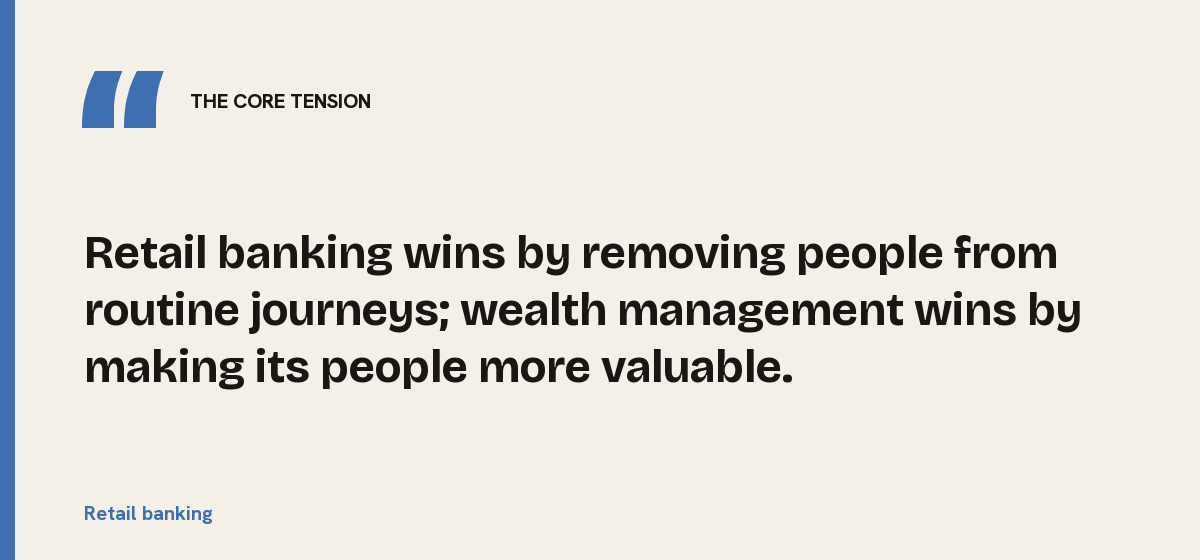
The core tension, in one line:
Retail banking wins by removing people from routine journeys; wealth management wins by making its people more valuable.
a banking group gives its private bank the same mobile app framework as its retail bank. Retail customers love the fast payments and budgeting tools; private clients use the app rarely, because what they want is a clear view of their whole wealth, timely insight and easy access to their adviser. The private bank rebuilds its app around those needs and engagement rises.
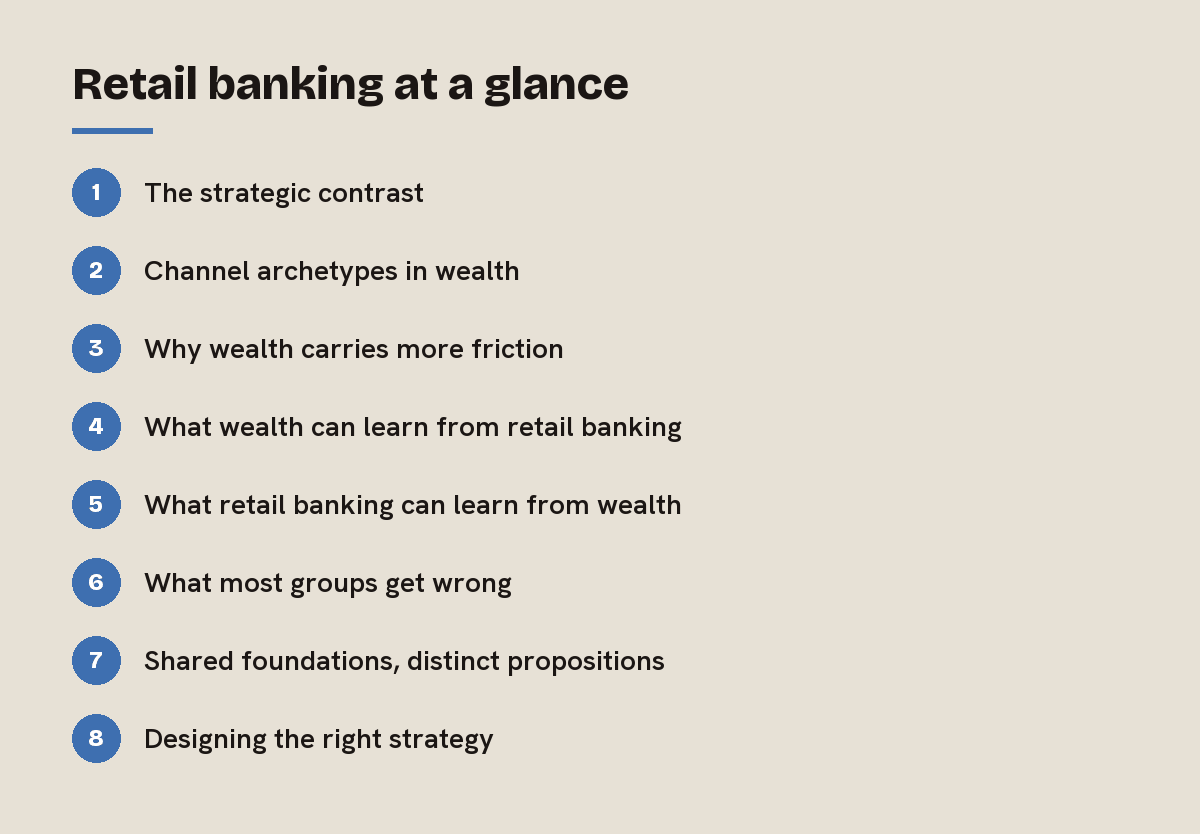
1. The strategic contrast
| Dimension | Retail banking | Wealth management |
|---|---|---|
| Primary goal | Volume, engagement, efficiency | Trust, share of wallet, adviser productivity |
| Interaction frequency | Daily | Periodic, around decisions and events |
| Role of people | Mainly for complex needs and reassurance | Central to the proposition |
| Regulatory friction | KYC, AML, credit rules | Suitability, risk profiling, costs disclosure |
| Digital success measure | Active users, digital sales, cost per customer | Assets per adviser, client retention, referrals |
2. Channel archetypes in wealth
| Wealth channel | Role | Digital priority |
|---|---|---|
| Self-directed | Execution and research | Fast, low-cost trading and good information |
| Advisory | Hybrid advice and planning | Adviser tools, client portals, digital onboarding |
| Discretionary | Portfolio management on the client’s behalf | Transparent reporting and communication |
| Broker-dealer and platforms | Products and execution infrastructure | Integration, scalability, partner APIs |
3. Why wealth carries more friction
Suitability is the defining difference. ESMA’s guidelines on the MiFID II suitability requirements set out what firms must gather and assess before recommending investments, including clients’ sustainability preferences since 2022. That friction is purposeful: it protects clients. The digital task in wealth is to make it clear, efficient and reusable, not to remove it.
Everyday banking faces different constraints. Its customers have largely moved online: Eurostat reports that 67 per cent of people aged 16 to 74 in the EU used internet banking in 2024. Its challenge is to make high-volume digital journeys fast, reliable and secure, and to handle complex needs well when they arise.
4. What wealth can learn from retail banking
- Digital onboarding: fast, data-driven onboarding with pre-filled information.
- Clear self-service: statements, documents and simple transactions without calling an adviser.
- Data discipline: a single view of the client across products and accounts.
- Measurement: tracking journeys, drop-offs and engagement systematically.
5. What retail banking can learn from wealth
- Relationship depth: proactive guidance at life events rather than only transactions.
- Trust as a strategy: clear explanations and personal contact at moments that matter.
- Advice at scale: hybrid models that combine digital tools with human expertise for complex needs.
6. What most groups get wrong
- One app for all: forcing wealth clients into a mass-market experience undervalues what they want.
- Copying retail metrics: measuring wealth success by logins misses assets, retention and adviser capacity.
- Ignoring the adviser: digital wealth strategies that bypass advisers struggle to win adoption.
- Duplicating everything: the two businesses can share platforms such as identity, payments and data, even if their front ends differ.
Example: a banking group decided to share core capabilities, identity, payments, data and security, across its retail bank and wealth business, while giving each a distinct client experience. The wealth business focused its investment on adviser tools and a consolidated wealth view; the retail bank focused on everyday journeys. Both moved faster than when each had built everything alone.
7. Shared foundations, distinct propositions
Groups that run both businesses face a recurring choice: build once and share, or build separately and tailor. The most effective answer is usually layered. Identity, security, payments, data platforms and core integration are shared, because they are expensive and rarely differentiate. Client-facing experiences, adviser tools, reporting and success measures are distinct, because that is where each business wins or loses clients. Governance should make this split explicit, so shared platform teams serve both businesses fairly and each business can move at its own pace.
8. Designing the right strategy
- Start from the economics of each business.
- Define what clients value at each moment, from daily payments to major decisions.
- Share platforms, differentiate experiences.
- Put advisers at the centre of wealth digital strategy.
- Measure what matters for each model.
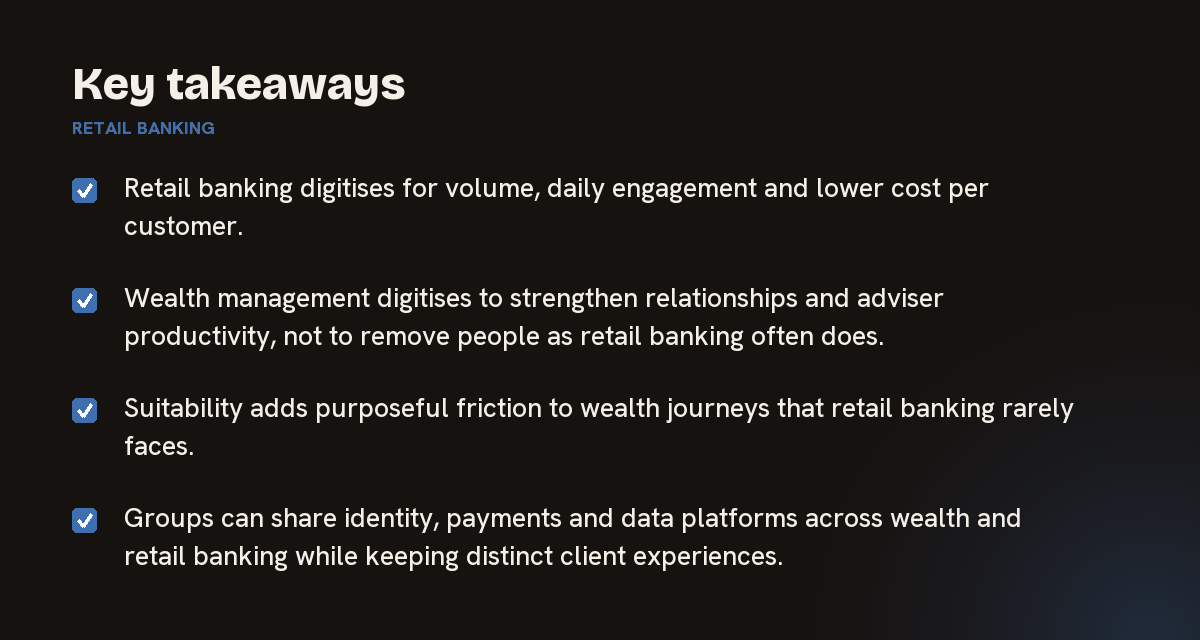
Key takeaways on retail banking
- Retail banking digitises for volume, daily engagement and lower cost per customer.
- Wealth management digitises to strengthen relationships and adviser productivity, not to remove people as retail banking often does.
- Suitability adds purposeful friction to wealth journeys that retail banking rarely faces.
- Groups can share identity, payments and data platforms across wealth and retail banking while keeping distinct client experiences.
For leaders of banking groups, recognising how wealth management and retail banking differ is the first step to investing wisely. Shared foundations reduce cost; distinct experiences and success measures make sure each business gets the digital strategy it needs.
Optimizium helps banks and wealth managers design digital strategies suited to their economics and clients. We respect the client relationships and advisory expertise at the heart of wealth management, and the operational strength of everyday banking. And we bring risk, compliance and business leaders into the design as co-authors, so each strategy is ambitious and well controlled.
Explore how we approach this across Wealth Management, Banking, Insurance and Beyond Banking, browse the FAQ Hub, or read the related question: How does digital change risk management?
Related questions
On this page
Partner with the experts.
Let's discuss how Optimizium can accelerate your roadmap and navigate complex digital transformation.
Schedule a consultation →