Home › FAQ Hub › How do unit economics shape digital strategy?
Tech & Core ModernisationHow do unit economics shape digital strategy?
Unit economics shape digital strategy because they decide which channels, products and customer segments are viable. The key measures are customer acquisition cost, lifetime value, churn, payback period, margin and productivity.
Digital strategies often start with ambitions: more customers, better journeys, new products. Whether those ambitions create value depends on simple arithmetic about each customer: what it costs to win them, what they bring in, and how long they stay.
Unit economics shape digital strategy because they decide which channels, products and customer segments are viable. The key measures are customer acquisition cost, lifetime value, churn, payback period, margin and productivity. A digital channel that acquires customers cheaply but loses them quickly, or one that attracts profitable customers at a high cost, can both destroy value if the numbers are not understood.
Each sector has different unit economics. Wealth tends to have favourable economics thanks to fees on assets; insurance economics depend heavily on loss ratios; banking depends on net interest margin and fees; fintechs depend on growth velocity and capital-light models. Digital strategy should follow those numbers, not the other way round.
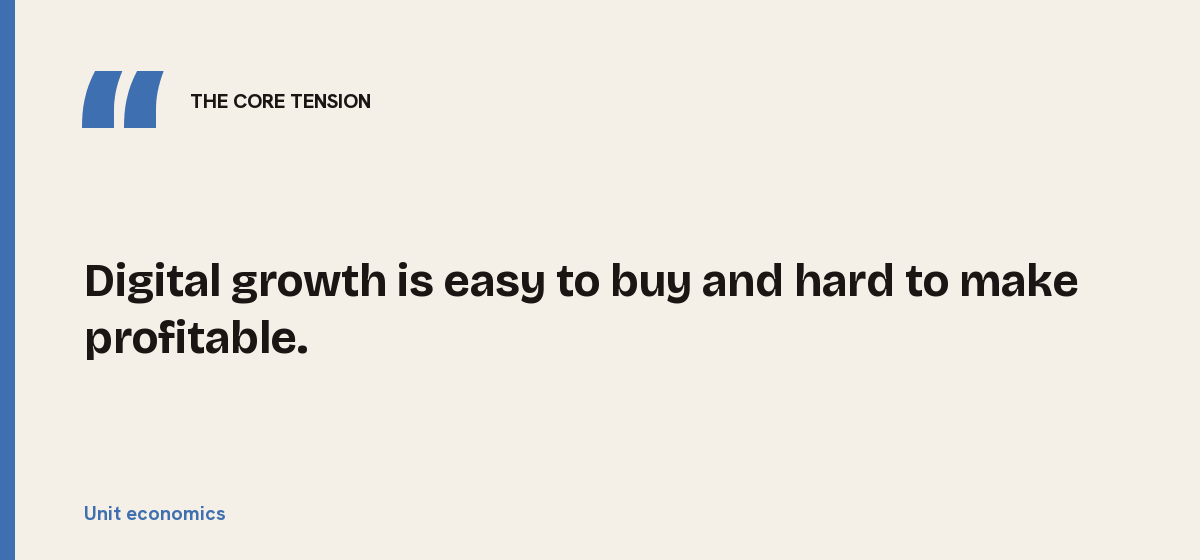
The core tension, in one line:
Digital growth is easy to buy and hard to make profitable.
a fintech grew rapidly through paid digital marketing, but a cohort analysis showed it took more than three years for an average customer to repay their acquisition cost, while many left within a year. The company shifted spending to referral and partner channels with lower acquisition cost and higher retention, and its unit economics improved within two quarters.
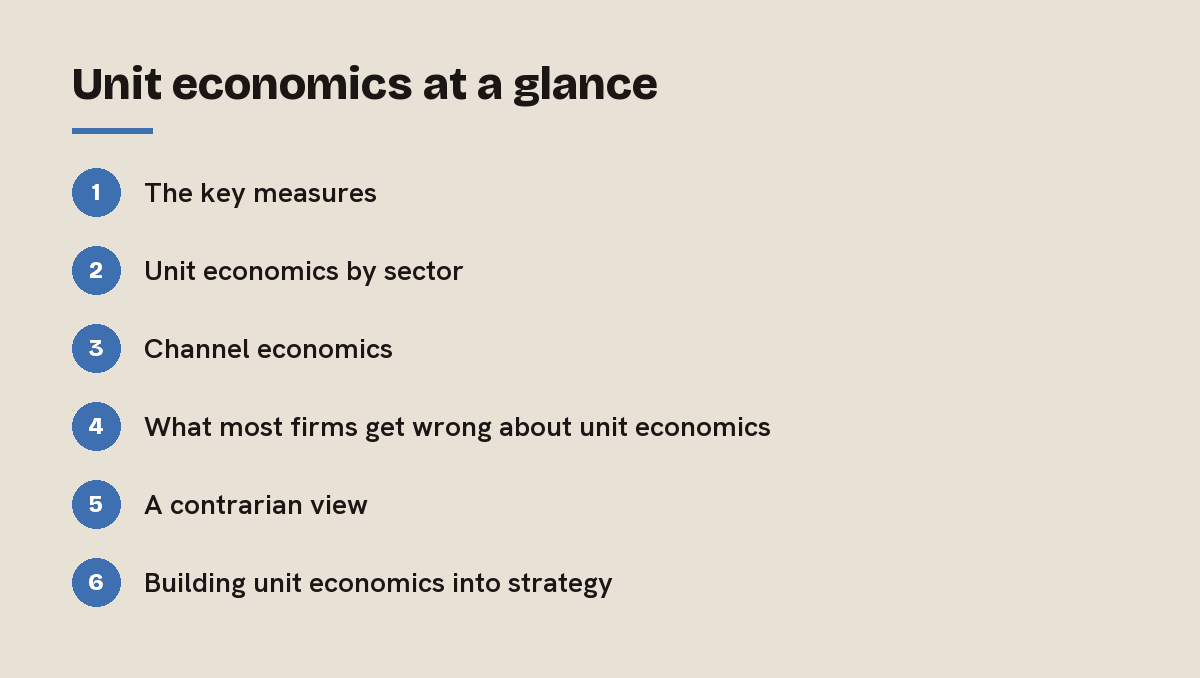
1. The key measures
| Measure | What it tells you | Typical lever |
|---|---|---|
| Acquisition cost | What it costs to win a customer | Channel mix, conversion |
| Lifetime value | What a customer contributes over time | Retention, cross-sell, pricing |
| Churn | How quickly customers leave | Service quality, engagement |
| Payback period | How long until acquisition cost is repaid | Activation, early value |
| Margin | Profit per product or customer | Pricing, cost to serve |
| Productivity | Output per adviser, handler or employee | Automation, tools |
2. Unit economics by sector
| Sector | Main value driver | Main risk to unit economics |
|---|---|---|
| Wealth | Fees on assets under management | Asset outflows, adviser costs |
| Insurance | Premium minus claims and expenses | Loss ratio, acquisition costs |
| Banking | Net interest margin plus fees | Low engagement, credit losses |
| Fintech | Growth velocity and scale | High acquisition cost, churn |
3. Channel economics
| Channel | Acquisition cost | Margin | Comment |
|---|---|---|---|
| Direct digital | Low to medium | Medium | High competition and price comparison |
| Broker and adviser | High | Higher | Commission and advice costs |
| Embedded and partner | Low | Lower | Partner shares revenue |
| Branch | High | Varies | High fixed cost |
Abandonment directly damages unit economics: Signicat found that 68 per cent of European consumers had abandoned a financial services application in the previous year, wasting the marketing spend that brought them. Regulation can also change the numbers: under the EU’s Instant Payments Regulation, providers cannot charge more for instant euro transfers than for standard ones. And investment capacity is limited: according to the ECB, banks invest on average 2.8 per cent of operating income in digital transformation.
4. What most firms get wrong about unit economics
- Measuring acquisition without retention: cheap customers who leave quickly are expensive.
- Averaging across segments: profitable and unprofitable segments hide each other.
- Ignoring cost to serve: digital customers who generate many service contacts may be less profitable than they look.
- Separating digital and finance teams: without shared numbers, digital investment decisions drift from value.
Example: an insurer celebrated rising direct online sales. A unit economics review showed that many customers came through price comparison and left at the first renewal, while partner channels brought customers who stayed longer and bought more. The insurer rebalanced marketing and introduced loyalty benefits, improving lifetime value.
5. A contrarian view
Growth is often treated as the goal and unit economics as a later concern. In financial services, where margins are regulated and competition is intense, the order should be reversed for most products: prove the economics on a small scale, then grow.
6. Building unit economics into strategy
- Measure by cohort, channel and segment.
- Agree a shared model between digital, finance and risk.
- Set payback targets for acquisition spending.
- Review regularly, as prices, costs and behaviour change.
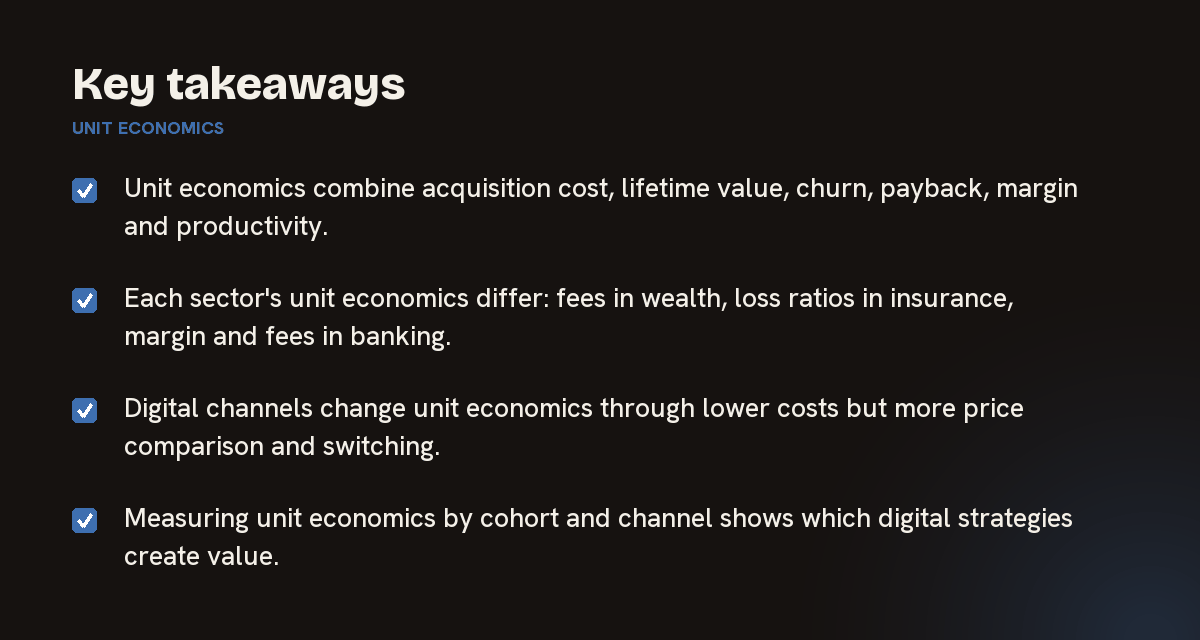
Key takeaways on unit economics
- Unit economics combine acquisition cost, lifetime value, churn, payback, margin and productivity.
- Each sector’s unit economics differ: fees in wealth, loss ratios in insurance, margin and fees in banking.
- Digital channels change unit economics through lower costs but more price comparison and switching.
- Measuring unit economics by cohort and channel shows which digital strategies create value.
For leadership teams, unit economics are the bridge between digital ambition and financial results. Making them visible, shared and part of every investment decision keeps digital strategy grounded in value.
Optimizium helps banks, insurers and wealth managers build unit economics into digital strategy. We respect the financial and actuarial expertise institutions already hold, because it gives these models credibility. And we bring finance, risk and digital teams into the design as co-authors, so growth plans are ambitious and sound.
Explore how we approach this across Banking, Insurance, Wealth Management and Beyond Banking, browse the FAQ Hub, or read the related question: How does wealth management differ from retail banking in digital strategy?
Partner with the experts.
Let's discuss how Optimizium can accelerate your roadmap and navigate complex digital transformation.
Schedule a consultation →