Home › FAQ Hub › How does AI/ML apply differently across financial verticals?
Tech & Core ModernisationHow does AI/ML apply differently across financial verticals?
AI and machine learning apply differently across financial verticals because each vertical makes money and manages risk in different ways. The same techniques support onboarding, fraud, underwriting, credit, claims, portfolio management and personalisation, but the emphasis shifts.
Artificial intelligence and machine learning are often discussed as if they meant the same thing for every financial firm. In practice, a retail bank, a motor insurer and a private wealth manager use them for very different problems, at different speeds and under different rules.
AI and machine learning apply differently across financial verticals because each vertical makes money and manages risk in different ways. The same techniques support onboarding, fraud, underwriting, credit, claims, portfolio management and personalisation, but the emphasis shifts. Banking leans on risk scoring and fraud models; insurance on underwriting and claims adjudication; wealth on portfolio recommendation engines; fintechs on growth optimisation and experimentation.
Adoption also differs in pace and depth. High transaction volumes give banks abundant data and clear payback, while long product lives and smaller data sets make some insurance and wealth uses harder. Regulation adds another layer, because some uses, such as credit scoring and life and health pricing, are treated as high-risk.
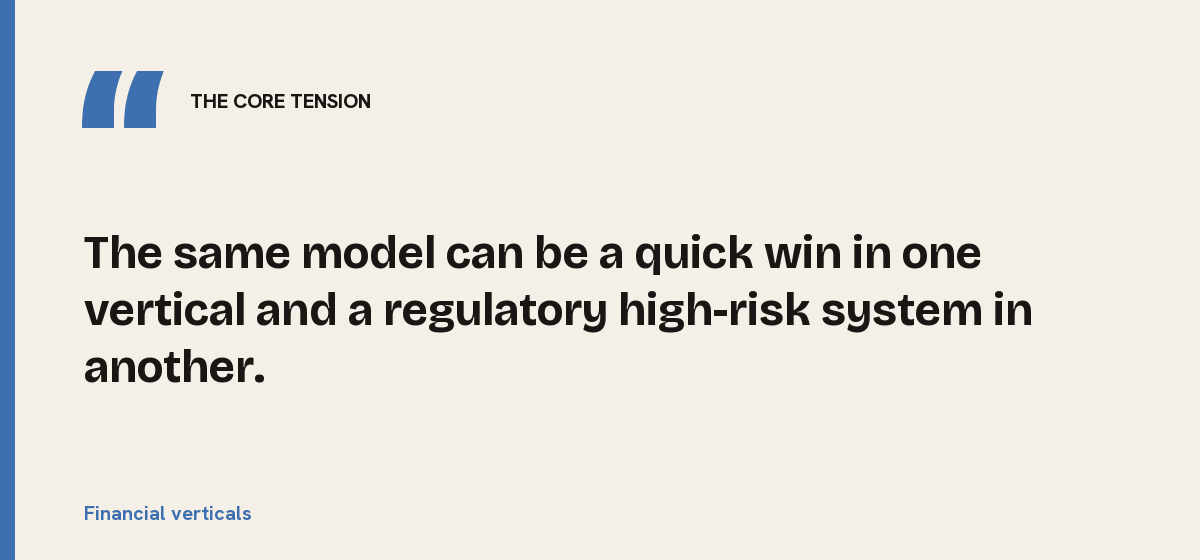
The core tension, in one line:
The same model can be a quick win in one vertical and a regulatory high-risk system in another.
a financial group runs a fraud model in its bank that scores card payments in milliseconds. It tries to reuse the approach for life insurance underwriting and discovers that the data is thinner, decisions last decades and the use is classed as high-risk under EU rules. The insurer adapts the model into a tool that supports underwriters rather than deciding alone.
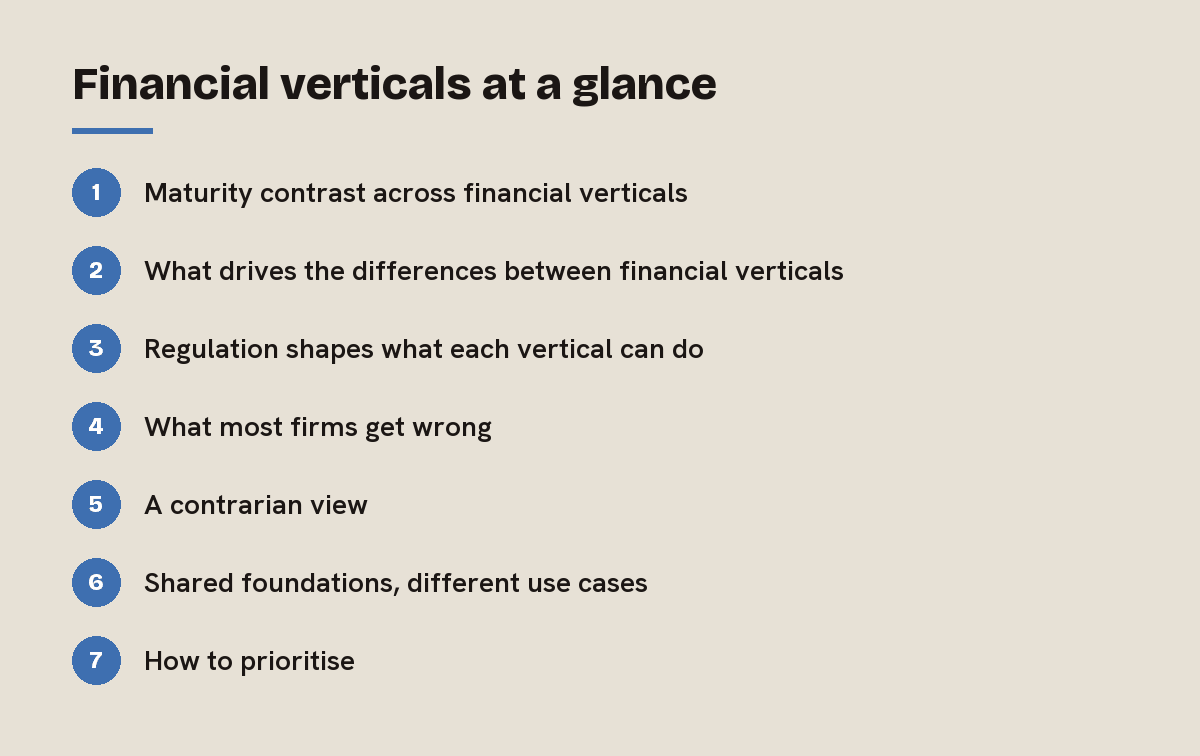
1. Maturity contrast across financial verticals
| Use case | Banking | Insurance | Wealth | Fintech |
|---|---|---|---|---|
| Fraud detection | Very high | Medium | Medium | Very high |
| Credit and underwriting | Very high | High | Low | Medium |
| Claims | Not applicable | High in non-life | Not applicable | Low |
| Portfolio recommendations | Low | Low | High | Medium |
| Growth and conversion | Medium | Medium | Low | Very high |
2. What drives the differences between financial verticals
- Data volume and frequency: banks see millions of transactions daily; insurers and wealth managers see fewer, richer events.
- Decision horizon: a payment decision lasts seconds; a life policy or pension decision lasts decades.
- Regulatory treatment: credit, insurance pricing and advice face stricter rules than marketing or operations.
- Distribution model: intermediated channels slow the flow of data back to the manufacturer.
The numbers show the gap. According to ECB Supervisory Board Chair Claudia Buch, more than 90 per cent of banks directly supervised by the ECB integrate AI into their operations. In insurance, EIOPA found that AI was used by 50 per cent of respondents in non-life and 24 per cent in life.
3. Regulation shapes what each vertical can do
The EU Artificial Intelligence Act classifies AI used to evaluate the creditworthiness of individuals, and AI used for risk assessment and pricing in life and health insurance, as high-risk. Those uses require documentation, data quality controls, human oversight and monitoring. Other uses, such as document processing or marketing optimisation, carry lighter obligations.
| Vertical | Typical high-scrutiny use | Typical lower-scrutiny use |
|---|---|---|
| Banking | Credit scoring | Document processing, service chat |
| Insurance | Life and health pricing | Claims triage support |
| Wealth | Automated advice | Research summaries for advisers |
| Fintech | Credit and onboarding decisions | Conversion optimisation |
4. What most firms get wrong
- Copying use cases across financial verticals: what pays back in banking may not fit insurance or wealth economics.
- Ignoring data limits: models trained on thin data in low-frequency businesses can mislead.
- One governance standard for all: high-risk and low-risk uses need different levels of control.
- Automating advice too early: in wealth, AI usually works best supporting advisers before advising clients directly.
Example: a wealth manager introduced an AI tool that drafted portfolio review summaries for advisers. Advisers edited and approved each summary before it reached clients. Preparation time fell sharply and suitability records improved, while the firm avoided the higher risks of fully automated advice.
5. A contrarian view
The usual question is which vertical is most advanced in AI. A more useful one is which uses fit each vertical’s economics and risk. A wealth manager that uses AI to give advisers more time with clients may create more value than a bank running dozens of marginal models.
6. Shared foundations, different use cases
Groups that operate in several financial verticals can still share a great deal: data platforms, model development tools, monitoring and a common model risk framework. What should differ is the portfolio of use cases and the level of control applied to each. A central AI team that provides the foundations, while each business line owns its priorities, usually works better than either a fully central or a fully separate approach.
7. How to prioritise
- Start from the vertical’s economics: where are cost, risk and revenue concentrated?
- Match the governance to the risk of each use case.
- Check data sufficiency before committing to a model.
- Keep humans in the loop where decisions are high-impact.
Key takeaways on financial verticals
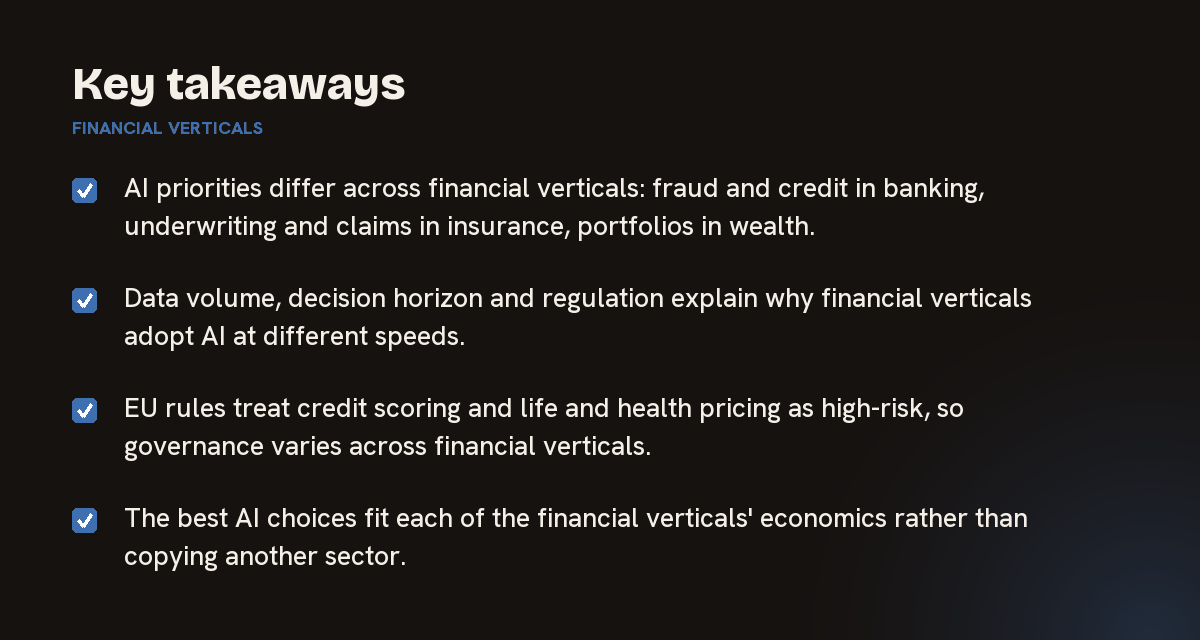
- AI priorities differ across financial verticals: fraud and credit in banking, underwriting and claims in insurance, portfolios in wealth.
- Data volume, decision horizon and regulation explain why financial verticals adopt AI at different speeds.
- EU rules treat credit scoring and life and health pricing as high-risk, so governance varies across financial verticals.
- The best AI choices fit each of the financial verticals’ economics rather than copying another sector.
For leadership teams in diversified groups, the lesson is to set AI priorities by business line rather than centrally copying the same use cases everywhere. Shared platforms and governance help; shared use cases often do not.
Optimizium helps banks, insurers and wealth managers choose and govern AI use cases that fit their economics and risk. We respect the modelling and actuarial expertise each business already holds. And we bring model risk, compliance and data protection colleagues into the design as co-authors, so AI scales safely in every vertical.
Explore how we approach this across Banking, Insurance, Wealth Management and Beyond Banking, browse the FAQ Hub, or read the related question: How does wealth management differ from retail banking in digital strategy?
On this page
Partner with the experts.
Let's discuss how Optimizium can accelerate your roadmap and navigate complex digital transformation.
Schedule a consultation →