Home › FAQ Hub › How does cannibalisation risk shape channel decisions?
Leadership, Change & Operating ModelsHow does cannibalisation risk shape channel decisions?
Cannibalisation risk shapes channel decisions because institutions hesitate to scale digital channels when doing so would erode revenue from intermediaries such as advisers or brokers. Cannibalisation can reduce margins, destabilise incentive models and damage relationships with intermediaries who control a large share of business.
Many financial institutions have built excellent digital journeys and then kept them small. The reason is rarely technical. Scaling a digital channel can eat into revenue that advisers, brokers or branches currently earn, and that prospect makes leaders cautious.
Cannibalisation risk shapes channel decisions because institutions hesitate to scale digital channels when doing so would erode revenue from intermediaries such as advisers or brokers. Cannibalisation can reduce margins, destabilise incentive models and damage relationships with intermediaries who control a large share of business.
Institutions manage the risk through tiered incentives, channel segmentation and hybrid fulfilment. Banks often route complex products to advisers and routine transactions to digital platforms; insurers frequently keep complex lines with brokers while growing direct sales in simple personal lines. Handled deliberately, cannibalisation risk becomes a design question rather than a reason to stand still.
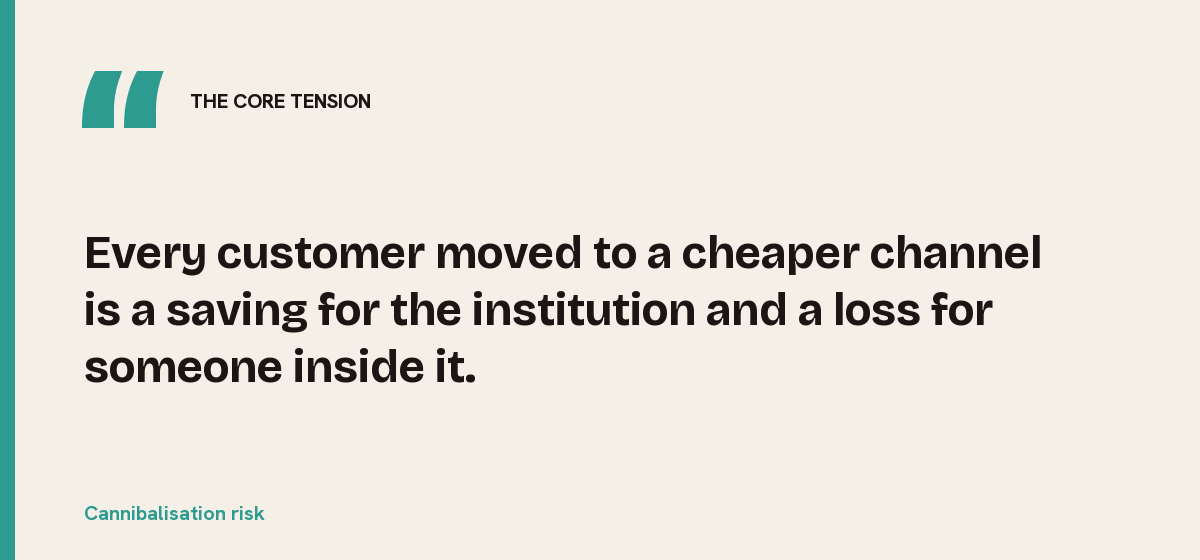
The core tension, in one line:
Every customer moved to a cheaper channel is a saving for the institution and a loss for someone inside it.
an insurer wants to grow direct online sales of home insurance but fears brokers will move commercial business elsewhere. It limits the direct offer to simple home cover, gives brokers the same digital quoting tools and credits brokers for digital renewals of their clients. Direct sales grow without broker defections.
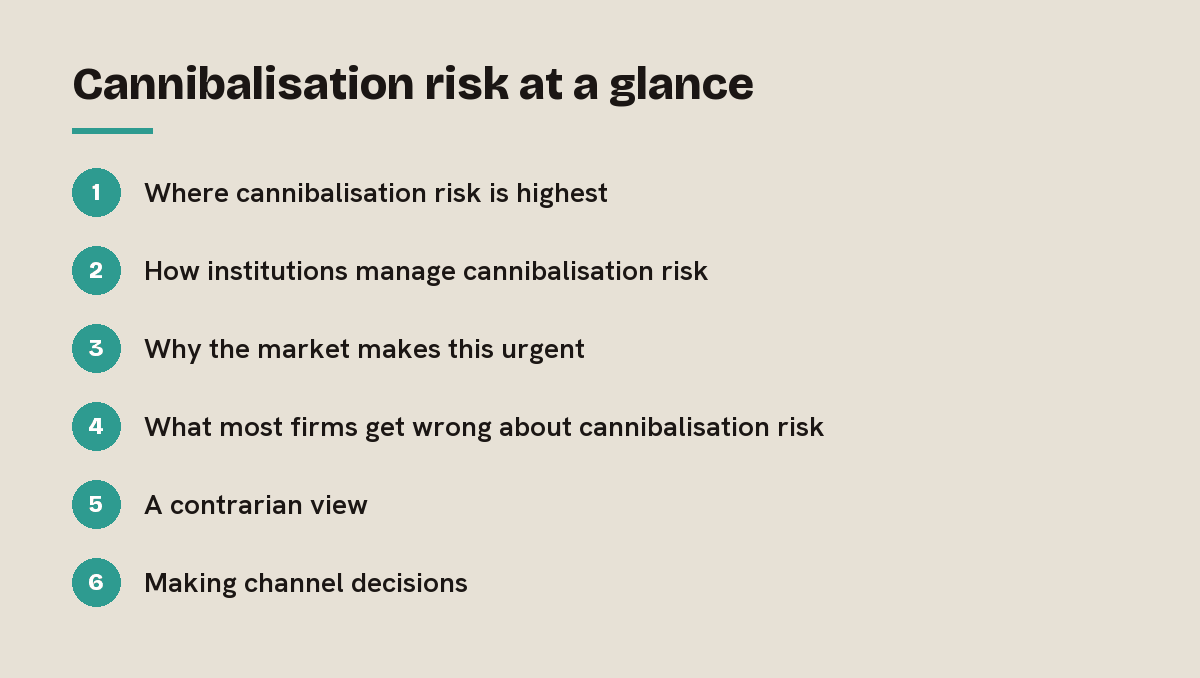
1. Where cannibalisation risk is highest
| Sector | Channel under pressure | What is at stake |
|---|---|---|
| Insurance | Brokers and agents | Commissions and broker loyalty |
| Wealth | Advisers | Advice fees and client relationships |
| Banking | Branches | Branch targets, roles and costs |
| Partnerships | Existing intermediaries | Customer ownership |
2. How institutions manage cannibalisation risk
- Channel segmentation: simple products and needs go digital; complex ones stay with people.
- Tiered incentives: intermediaries earn on digital business from their clients, at an appropriate rate.
- Hybrid fulfilment: customers start digitally and finish with an adviser or broker, or the reverse.
- Separate propositions: digital products aimed at segments intermediaries do not serve.
| Approach | Strength | Watch-out |
|---|---|---|
| Segmentation | Clear roles for each channel | Needs good data on needs and value |
| Tiered incentives | Aligns intermediaries with digital | Must stay fair and transparent |
| Hybrid fulfilment | Uses the best of both channels | Hand-overs must be designed well |
| Separate propositions | Grows new segments | Risk of confusing brands |
3. Why the market makes this urgent
Intermediaries remain central in insurance: EIOPA found that digital-only distribution channels still lag well behind physical or hybrid ones, especially in life insurance. At the same time, customers are digital by default in banking: Eurostat reports that 67 per cent of people aged 16 to 74 in the EU used internet banking in 2024. Purely digital banks still held less than 4 per cent of the euro area market in 2024, which shows that institutions combining channels well, rather than abandoning them, keep most customers.
4. What most firms get wrong about cannibalisation risk
- Avoiding it completely: keeping digital channels small leaves room for competitors.
- Ignoring it completely: launching cheaper direct offers that undercut intermediaries invites retaliation.
- Measuring channels in isolation: total relationship profit matters more than channel results.
- Leaving incentives unchanged: people respond to how they are paid, whatever the strategy says.
Example: a wealth manager’s advisers resisted a new digital investment service, fearing lost fees. The firm repositioned it as a tool advisers could offer to smaller clients and family members, credited to their books. Adoption rose quickly and adviser income grew, because time saved on small accounts went into larger relationships.
5. A contrarian view
Cannibalisation risk is usually treated as a threat to be minimised. Sometimes cannibalisation is the right outcome: if a digital journey serves a need better and at lower cost, moving customers there is the point. The real task is to make that shift deliberate, resize the affected channel and treat the people in it fairly.
6. Making channel decisions
- Map revenue by product, channel and segment.
- Decide where cannibalisation is acceptable, and where it is not.
- Align incentives with the channel strategy.
- Measure total relationship value, not just channel volume.
Key takeaways on cannibalisation risk
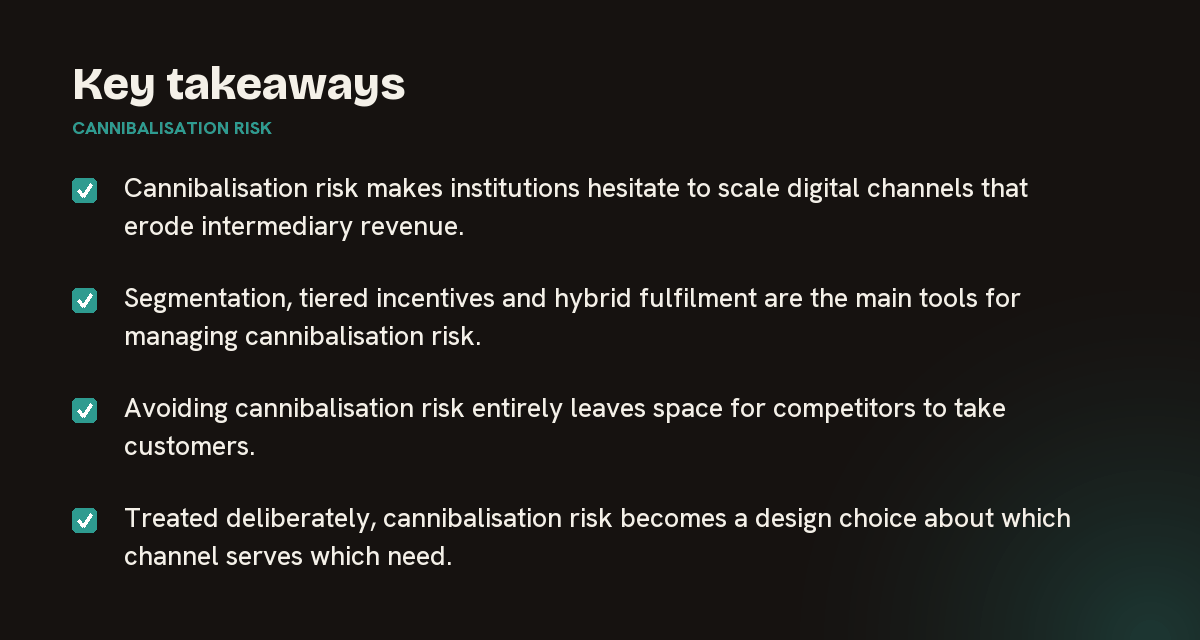
- Cannibalisation risk makes institutions hesitate to scale digital channels that erode intermediary revenue.
- Segmentation, tiered incentives and hybrid fulfilment are the main tools for managing cannibalisation risk.
- Avoiding cannibalisation risk entirely leaves space for competitors to take customers.
- Treated deliberately, cannibalisation risk becomes a design choice about which channel serves which need.
For leadership teams, cannibalisation risk is one of the most important and least discussed influences on channel strategy. Bringing it into the open, with clear segmentation and fair incentives, allows institutions to grow digital channels without breaking the relationships that still matter.
Optimizium helps banks, insurers and wealth managers design channel strategies and incentive models that manage cannibalisation deliberately. We respect the relationships held by brokers, advisers and branch teams, because they remain valuable. And we bring distribution, finance and compliance into the design as co-authors, so channel shifts are fair and sustainable.
Explore how we approach this across Insurance, Wealth Management, Banking and Beyond Banking, browse the FAQ Hub, or read the related question: Why do institutions invest in segmentation analytics?
Related questions
Partner with the experts.
Let's discuss how Optimizium can accelerate your roadmap and navigate complex digital transformation.
Schedule a consultation →