Home › FAQ Hub › How does data lineage affect transformation programmes?
AI, Data & AnalyticsHow does data lineage affect transformation programmes?
Data lineage is the ability to trace data from its source, through every transformation and system, to the report, model or decision that uses it. It affects transformation programmes because they depend on traceable, auditable and governable data pipelines.
A new risk dashboard, an AI model or an automated report is only as trustworthy as the answer to one question: where did this number come from? In many financial institutions, nobody can answer it quickly.
Data lineage is the ability to trace data from its source, through every transformation and system, to the report, model or decision that uses it. It affects transformation programmes because they depend on traceable, auditable and governable data pipelines. Without clear lineage, automation and AI deployment face regulatory resistance and operational fragility: supervisors and auditors cannot verify results, and teams cannot tell what will break when a system changes.
Weak lineage shows up as delayed model approvals, audit challenges, reconciliation failures and higher operational risk. Strong data lineage, by contrast, supports regulatory reporting, capital modelling and AI governance, and makes it far safer to modernise systems one piece at a time.
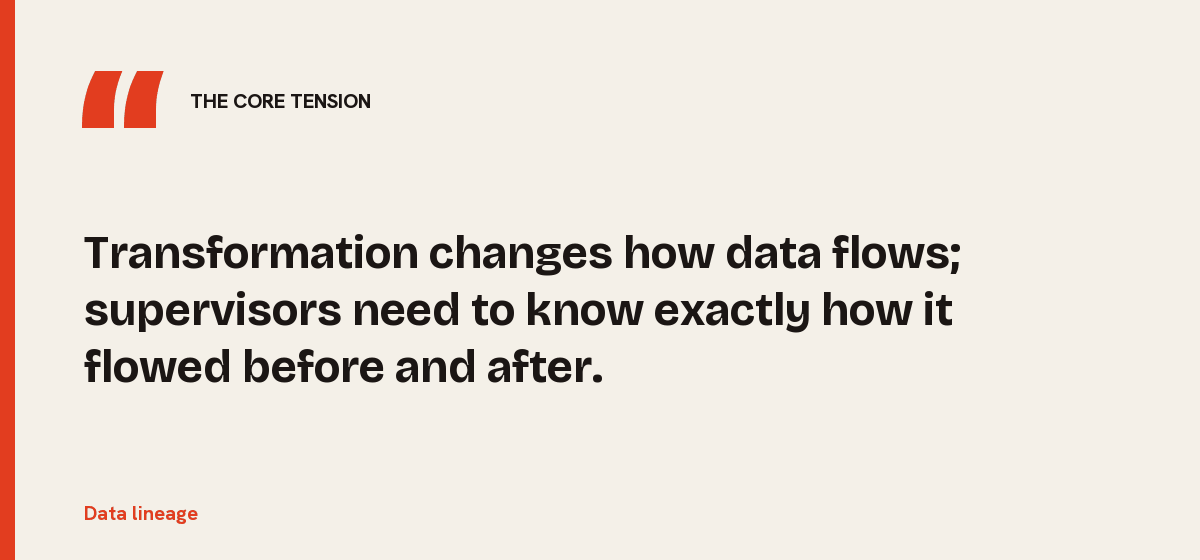
The core tension, in one line:
Transformation changes how data flows; supervisors need to know exactly how it flowed before and after.
a bank wants to replace a legacy data warehouse that feeds dozens of regulatory reports. Without lineage, nobody knows which reports depend on which tables. After mapping data lineage for the most critical reports first, the bank migrates in stages, proves each report’s results match and avoids a risky big-bang cut-over.
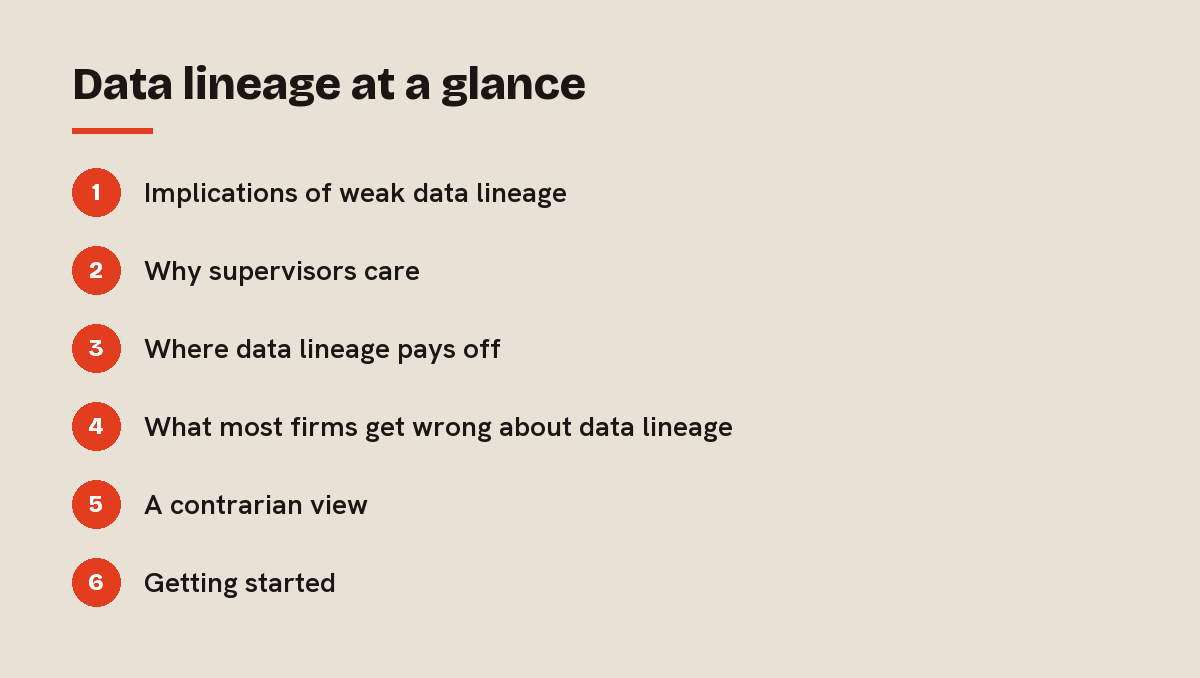
1. Implications of weak data lineage
| Implication | What it looks like on the ground | Effect on transformation |
|---|---|---|
| Delayed model approval | Validators cannot trace model inputs | AI and analytics stuck in testing |
| Audit challenges | Reports cannot be reproduced on request | Findings, remediation, lost time |
| Reconciliation failures | Numbers differ between systems | Manual workarounds and delays |
| Operational risk | Changes break unknown dependencies | Incidents during migrations |
2. Why supervisors care
Supervisors increasingly expect institutions to show how risk data is produced. The ECB reported in 2025 that the number of institutions without fully adequate risk data aggregation and reporting capabilities is still too high, measured against its May 2024 guide, which uses the Basel Committee’s principles for effective risk data aggregation and risk reporting as its benchmark. AI adds to the pressure: the EU Artificial Intelligence Act requires data governance and documentation for high-risk systems such as credit scoring.
3. Where data lineage pays off
- Regulatory reporting: results can be traced and reproduced, reducing audit effort.
- Capital and risk models: model inputs are documented and stable.
- AI governance: training data, features and outputs can be explained.
- System modernisation: dependencies are known, so systems can be replaced step by step.
| Area | Without data lineage | With data lineage |
|---|---|---|
| Migration | Big-bang, high risk | Staged, verified |
| Model approval | Months of questions | Faster validation |
| Incidents | Hard to trace root causes | Quick impact analysis |
| Audits | Manual reconstruction | Evidence on demand |
4. What most firms get wrong about data lineage
- Trying to map everything at once: full enterprise lineage projects stall. Start with critical reports and models.
- Treating lineage as documentation only: static diagrams go out of date; automated capture keeps up with change.
- Leaving business owners out: technical lineage without business definitions does not answer supervisors’ questions.
- Starting too late: adding lineage after a migration is far harder than building it in.
Example: an insurer’s new pricing model sat in validation for months because reviewers could not trace several input fields back to policy systems. The team mapped data lineage for the model’s inputs, documented each transformation and agreed definitions with business owners. Validation then completed in weeks, and the same lineage was reused for the next model.
5. A contrarian view
Data lineage is often seen as a compliance chore. In transformation programmes, it is better understood as an accelerator: it reduces the fear that slows every change to legacy systems, and it shortens the path from a promising model to one that is approved and in use.
6. Getting started
- Prioritise critical data: regulatory reports, capital models, high-risk AI.
- Automate lineage capture in data platforms where possible.
- Link technical lineage to business definitions and owners.
- Make lineage part of the definition of done for every data change.
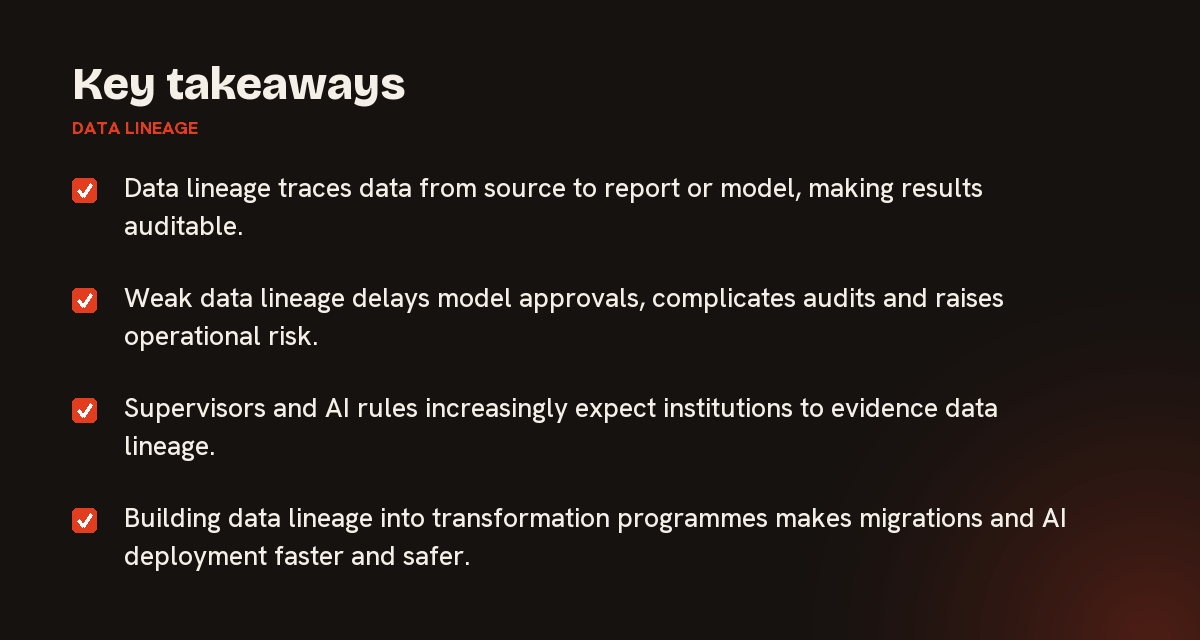
Key takeaways on data lineage
- Data lineage traces data from source to report or model, making results auditable.
- Weak data lineage delays model approvals, complicates audits and raises operational risk.
- Supervisors and AI rules increasingly expect institutions to evidence data lineage.
- Building data lineage into transformation programmes makes migrations and AI deployment faster and safer.
For leadership teams, data lineage is one of the quiet foundations that decides whether transformation programmes run smoothly or stall in validation and audit. Investing early, in the data that matters most, pays back across every later initiative.
Optimizium helps banks, insurers and wealth managers build data governance and lineage into their transformation. We respect the knowledge of finance, risk and data teams, because they understand how numbers are really produced. And we bring audit, risk and compliance into the design as co-authors, so new data flows are trusted from the start.
Explore how we approach this across Banking, Insurance and Wealth Management, browse the FAQ Hub, or read the related question: Why is data quality a persistent weakness in financial institutions?
Related questions
Partner with the experts.
Let's discuss how Optimizium can accelerate your roadmap and navigate complex digital transformation.
Schedule a consultation →